

5 Songs That Defined '90s Pop-Punk
Think of the greatest pop-punk artists of the '90s as brats with guitars and an abundance of chaotic energy. Full of attitude and a brash garage-level approach to songwriting and arranging, these bands had a free spirit reminiscent of punk's biggest hits, passed through the filter of the pop-heavy '80s. The result was a new approach to both pop and punk that fell somewhere near traditional rock, but with more youthful verve and a melodic sensibility that made the songs highly approachable, especially the tunes that most strongly define the early '90s pop-punk sound.
Making our picks for these genre-setting tunes was easy; we just reached into our musical memory and let the pop-punk songs that came the easiest become the chosen ones. Catchy choruses and clear-eyed sentiments fused to cranking guitars and even a stroke of slithering funk are hallmarks of these representative works. Now-foundational names like Green Day, Blink-182, and No Doubt all serve up generous sass and a bold-as-anything approach to making music that became masterworks of the '90s pop-punk sound.
Basket Case — Green Day
Green Day made big pop-punk waves in 1994 with their major label debut album, "Dookie." Their now-classic single "Basket Case" introduced the band to a mainstream audience with vibrant energy that served a crackling counterpunch to the grunge sounds that had taken over the rock scene. Frantic power chords and the carefree vocals of lead singer Billie Joe Armstrong were the definition of pop-punk seemingly tailor-made to transport traditional punk music into a more commercial setting.
With self-aware snark like "Do you have the time to listen to me whine / About nothin' and everything all at once?" Green Day smartly reflected the emo tendencies of the shoegazing bands and subverted them into something more direct and authentic. Their frankness gave punk musicians with pop sensibilities permission to talk about their feelings without being precious or overly artsy about it. As an anthem for the insecure, "Basket Case" is a flag in the sand for pop-punk musicians getting their feelings out into the open on their terms. It's also pretty darned fun to sing and air guitar along to.
Come Out and Play — The Offspring
Dexter Holland, lead singer of the Offspring, didn't hit notes in the band's 1994 single "Come Out and Play," the band's most iconic contribution to the pop-punk movement; he smashed them with a vocal sledgehammer, barely even aiming for the right ones. That sort of loose-and-free approach backed by buzzsaw guitars and bone-rattling drum work gave the band a dangerous edge at times. But they crafted one of the catchiest underground tunes of the mid-'90s, becoming legends in the process.
The deceptively quiet intro that precedes the now-iconic line "You gotta keep 'em separated" is a red herring, giving way to one of the grittiest guitar passages that punk pop ever produced. It sounds like a sample from a cult film, a phrase listeners feel like they should be able to place thanks to the distinctive character it's delivered with. The song was more punk than pop, for sure, but it had a melody that clung like thistles and an unforgettable chorus that mixed glee with menace.
Just A Girl — No Doubt
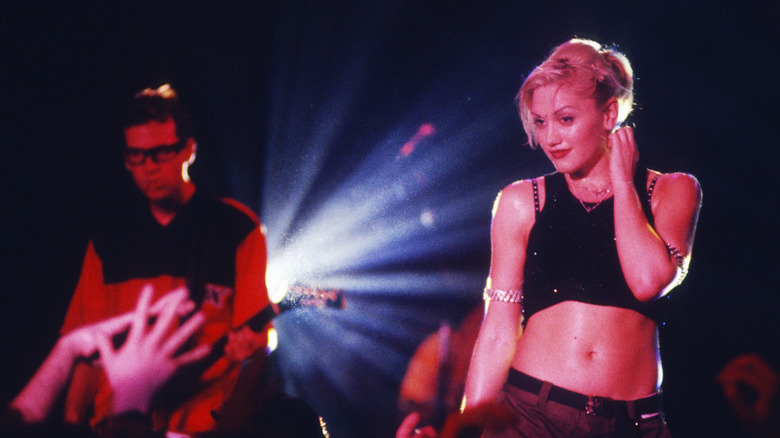
Gwen Stefani leading her pop-punk-ska unit No Doubt made the one of biggest impressions among the young women of '90s music, giving feminist culture a sizzling jolt in 1995 with the anthemic "Just a Girl." The imagery cuts to the heart of the issue, that of the limitations placed on women from time immemorial, simply due to gender. "Take this pink ribbon off my eyes / I'm exposed and it's no big surprise," Stefani warbles, all controlled notes and constrained feelings, "Don't you think I know exactly where I stand? / This world is forcing me to hold your hand." It's a simple yet stunning indictment of the patriarchy set to a cautious melody that tiptoes into the fray.
Then, the song bursts into a frenetic spin as the full-throated chorus blasts, "Cause I'm just a girl, oh, little old me / Well, don't let me out of your sight / Oh, I'm just a girl, all pretty and petite / So don't let me have any rights." The contrast is pointed and works perfectly as an indictment of the ongoing struggles women face under the power of men, even in the '90s. Stefani and team may have struck pop-punk lightning with this scorcher back in 1995, but it will remain every bit as fearsome and relevant in the 21st century — long past the band's ongoing hiatus and subsequent 2026 Las Vegas reunion residency at the Sphere.
Santeria — Sublime
One of the most coveted sounds in pop-punk was the slinky funk-groove of Sublime and their premium invention, 1996's classic "Santeria." It was a love-gone-wrong song disguised as a revenge tune — or the other way around — and despite the title, the only element of magic in the lyrics is the negation of the topic: "I don't practice Santeria, I ain't got no crystal ball," sings Sublime leader Bradley Nowell in a punchy crackle with a bit of a croon on top. The song's narrator is searching for the woman who betrayed him with the lothario she's run off with, threatening them with violence for upsetting his apple cart. It's a modern Mexican Western melodrama set to a pseudo-ska beat, saturated in attitude and bass-heavy skate-punk bravado.
Sublime seemed poised for an influential run on the alt rock circuit. Sadly, a heroin overdose claimed the life of Nowell in 1996, just two months after the band's self-titled album containing "Santeria" dropped. His untimely passing locked Nowell's vocal character into a historic framework for genre-defining mid-'90s pop-punk. Sublime discontinued making music for nearly three decades, reuniting in 2023 with Nowell's son Jakob taking over vocal duties. Though the band's hit-making era was tragically cut short, "Santeria" made an indelible impression and still stands as a peak piece of pop-punk artistry.
All The Small Things — Blink-182
Musical tricksters Blink-182 were the ultimate disrupters in their music videos, engaging in antics like running buck naked down packed city streets and goofing on boy band trends that surrounded them. But their pop-punk sounds were a revelation and a refreshing twist for an audience hungry for music that was somehow frivolous and feeling, ridiculous and thoughtful all at the same time. So when "All The Small Things" dropped in 1999 to liven up the airwaves, it shook up the timeline of the band's career and became a representative piece of the genre's most celebrated works.
This playful hit was also serious business for the pop-punk movement, showing off a canny knack for catchy hooks and sweet melodies with lyrics that affirmed their devil-may-care philosophy. But there are strokes of unexpected sensitivity embedded in those words, too: "Late night, come home / Work sucks, I know / She left me roses by the stairs / Surprises let me know she cares." Other songs in the band's canon like "What's My Age Again?" would bring the band's maturity level into question, but this foundational banger demonstrated a higher-than-expected emotional I.Q. peeking out from behind the puckish pranks.