

The 5 Most Beautiful Voices In Modern Rock History
When it comes to discussing the most beautiful voices in rock history, many modern rockers are woefully under-considered. More often than not, people will default to the greats of rock's past like Tina Turner and Stevie Nicks. Rarely do any of the younger cohort, the singers still on the charts and actively touring, come up, and that is a massive omission. Over the last few decades, rock music has evolved and branched out into myriad new sounds, and there is no shortage of incredible voices out there leading these new sounds into the future.
When making our choices, we've included singers such as Regina Spektor, who charm with endearing voices and melodies, while others, such as Thom Yorke, dazzle with vocal range and abilities that seem superhuman. Among all of them, too, is the ability to create melodic hooks and moods that feel entirely new to the world of rock, which is a high hoop to jump through while still sounding beautiful to millions. To further narrow down our shortlist, we've required that these voices and the bands they front are commercially successful, maintain dedicated fan bases, and create unheard-of new melodies — the marks of the true greats. So, let's celebrate some of the best modern rock voices from the last 30 years or so, all of which deserve to be in the same conversation with classic rock legends.
Matthew Bellamy
Though Matthew Bellamy isn't quite a household name yet (at least in the U.S.), his band sure is. Muse have spent more than 20 years releasing one modern radio staple after another — ubiquitous tracks like "Time Is Running Out," "Hysteria," and "Starlight" — which is quite the feat for a band as thoroughly steeped in progressive and hard rock as they are. A major part of that continued success is Bellamy, the band's principal songwriter, (thoroughly underrated) lead guitarist, and, of course, singer.
Unlike many frontmen for harder rock bands, Bellamy's voice isn't snarling, gritty, or screaming. Instead, it unfurls like a thin, gossamer line through the band's music, pulling the band's crushing guitar and bass riffs into the clouds. Off their 2001 album "Origin of Symmetry," "Micro Cuts" is a song in which Bellamy's voice is even more elevated and crystalline than usual. He spends much of the song in his trademark falsetto voice and with a heavy application of his other signature, a powerful vibrato.
The end result is a performance that at times sounds genuinely operatic, and it's not a sound you'll hear from many rock bands, modern or not. "Micro Cuts" also displays Bellamy's tremendous upper range, though to hear the full extent of his range, the more recent hit "Madness" is also a necessity. In that, he croons lowly and softly before jumping up to Bono-like flourishes. Bellamy cites Jeff Buckley as an influence, and it's a high compliment to say that it shows.
Regina Spektor
There is no singer like Regina Spektor, and if you're not familiar, a single listen will prove it. You could start with the 2006 album "Begin to Hope," specifically "Samson," in which Spektor keeps her voice breathy, tender, and colored with a lush melancholy. It's undoubtedly beautiful, just from its timbre, but "Samson" also offers a peek at Spektor's tremendous all-around vocal abilities. She has range, control, character, and rarest of all, she can produce melodies that sound previously undreamt of.
Another song from the same album, "Fidelity," shows off Spektor's playful inventiveness with melody. In the verses, she allows her lines to drift up and down as the lyrics and mood strike her, each seeming like a one-off whim of hers left to drift away in the breeze. The choruses simply contain the repeated line "It breaks my heart," which at first glance might be expected to be monotonous, but coming from Spektor, nothing ever is. She sings the otherwise tragic line through bubbly, lilting syllables that transmute the heartbreak into a cheer that suggests resolve.
One Spektor song that captures her smooth tone, melodic playfulness, and vocal prowess all in one is "Eet," from her 2009 album "Far." Her performance in the verses, especially as the song starts picking up steam, is strong and passionate, while her work in the choruses turns one onomatopoeic syllable, "Eet," into an oscillating melody that sounds more like a keyboard riff than a vocal line. Spektor often uses her voice as an instrument, and it's one she's mastered.
Ben Gibbard
Ben Gibbard, everyone's cool indie rock uncle, is proof that vocal beauty doesn't have to come from lung-bursting feats of singing strength or rapid technical runs through scales. Instead, Gibbard has made a career out of plying his gentle, charming, guy-next-door voice to the graceful melodies he writes, and all in service to his poetic lyrics. Gibbard is best known by far as the frontman of Death Cab for Cutie, with whom the singer has produced a mountainous catalog of songs that play soundtrack to feelings like coziness, ennui, existentialism, and a surplus of quirk.
One of their early standouts is "Title and Registration," which demonstrates how naturally pleasant Gibbard's voice is. He doesn't do anything in the song to show off vocally, but the song and its contemplativeness are better off without it. It's Gibbard's dulcet tone, combined with a hypnotic guitar riff, that makes the song feel like meditation. Gibbard gets more melodic and shows off more range in "Soul Meets Body," in which he moves from low to falsetto and back seamlessly. That falsetto is even softer and kinder than his regular voice, and it makes the "Ba-da ba" scatting cute enough to be palatable.
To hear Gibbard's power and versatility, listen to "Bixby Canyon Bridge." He enters as light as a feather before allowing weight to gradually build, eventually more jet-plane than feather. Yet even when he's emoting forcefully, Gibbard's tone remains heavenly.
Hayley Williams
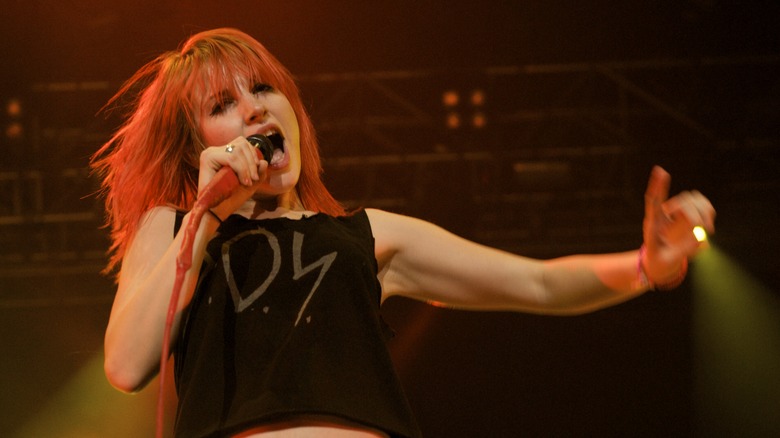
Hayley Williams rose to fame as the frontwoman for Paramore, one of the most important and influential rock bands of the 2000s, and has since added a successful solo career in between stints with the group. Of all the names here, Williams is by far the most widely recognized in the current zeitgeist, meaning her stunningly beautiful voice is everywhere, which is fortunate for all of us.
Williams boasts an incredible range, which has been reported as four octaves, and from her songs, especially live versions, it sounds all but confirmed. Moreover, her power at seemingly every inch of that range is almost unbelievable. On top of all of her natural and technical ability, Williams also has a voice that is simply pleasing to the ear, making her the total vocal package.
For proof, look no further than "All I Wanted" from Paramore's 2009 album "Brand New Eyes." Compare the song's lowest notes, which come from the first chorus, to its highest in the last chorus. The span is notable on its own, but it's the way Williams belts out the highest notes that makes the song feel like an epic. Williams and the band didn't perform the song live for 13 years, which led to rumors that it was too vocally challenging for Williams, but when the band finally broke it out, such doubts were immediately dispelled. Live performances like at Bonnaroo in 2023 sound even better than the recording and show a voice that might only be getting better.
Thom Yorke
Thom Yorke, the enigmatic and inscrutable frontman of Radiohead (along with impressive side projects "Atoms for Peace" and "The Smile"), has a voice that deserves to be exalted alongside the likes of Freddie Mercury, Robert Plant, and Stevie Nicks. Over his long career, Yorke has put out more innovative vocal performances than pretty much anyone in rock, with melodies that range from delicate and gorgeous to utterly alien. Likewise, his tone ranges from sneering punk to rapturous angel, and just like Radiohead's music, Yorke's singing is perpetually inventive.
Early Radiohead ballad "Fake Plastic Trees" proves not only Yorke's phenomenal ability but also that it was clearly either innate or picked up very early in life. There aren't many vocal performances as naked and haunting as Yorke's on "Fake Plastic Trees," and that's just the beginning. By the song's climax, coming back from the guitar solo, Yorke has traded that divine tone for real rock snarl before instantly and effortlessly returning to its origin.
"Nude" is another song in which Yorke plays things softly. Even still, the dynamism of his voice, its tone and its range, as well as the creativity of the various vocal parts throughout the song, is unparalleled. His run-up during the line "You'll go to Hell / For what your dirty mind is thinking" must be heard to be believed. There are dozens upon dozens of other examples, so do yourself a favor and bask in Yorke's catalog.