

The 5 Most Beautiful Female Voices In Rock History
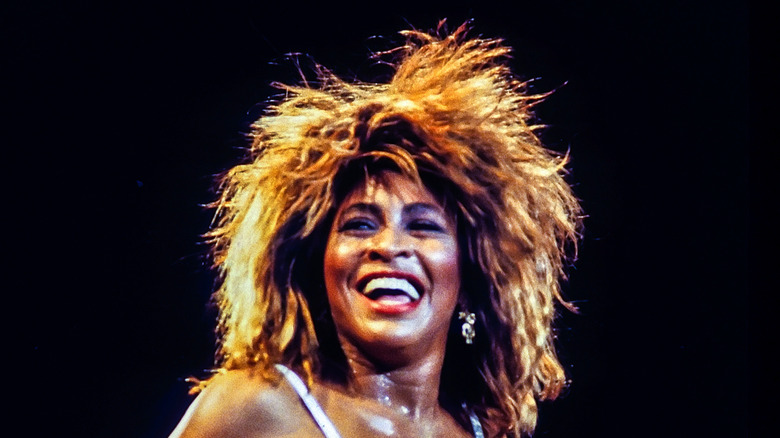
A beautiful voice can mean a lot of things to different people, especially in a genre as boundary-pushing as rock 'n' roll. But, at the same time, there are some standout female vocalists who have risen to the top with singing that is widely acknowledged as some of the best around. When it comes to defining what that means, foremost should be artistry, or the ability to use one's pipes to take what could be a plain song and transform it into magic. You could nail that down by focusing on the particulars of technique, like stamina, breath control, phrasing, and intonation, but there's also something difficult to define in the mix. Perhaps that's charisma and energy — just about every singer on this list has that compelling mix of stage presence and real singing power.
Sometimes, a beautiful voice is not necessarily technically perfect, but a blazing beacon of energy and unabashed emotion. Janis Joplin had that in spades and used it to connect her singing with something beyond mere lyrics, taking her raw, unfiltered voice to heights that still awe listeners more than five decades after her death. In other words, you may not be able to break it down into an equation, but you will know a truly great rock singer when you hear her.
Ann Wilson
When someone's rendition of "Stairway to Heaven" is so beautiful that it even impresses Zeppelin, they must have a beautiful voice. The musician who accomplished such a feat? Ann Wilson, who rose to fame as the powerhouse lead singer of Heart. Both her parents were musicians, though her father also served in the Marines, necessitating multiple international moves. To deal with this, along with other childhood stressors, Wilson turned to music. She developed a uniquely commanding voice, one so arresting it secured her the spot of lead singer for Heart in 1970.
While other personnel within Heart changed, it always centered on Wilson's powerful, acrobatic voice. One legendary single, "Barracuda," from the band's 1977 second album "Little Queen," showcases Wilson's heady mix of blow-your-hair-back vocal power, dialed-in technique, and wild rock 'n' roll edge. Another single, "Alone," helped propel the band's self-titled eighth album to the No. 1 spot, thanks in no small part to Wilson's towering capabilities.
The "Stairway to Heaven" cover took place at the December 2012 Kennedy Center Honors performance celebrating Led Zeppelin. Later, Wilson said that Robert Plant and Jimmy Page both told her that they'd liked the performance. When asked if her own voice gives her goosebumps, Wilson told Classic Rock Revisited that "I don't know if 'goosebumps' is the word, but there are moments when it is really clicking, where it's like the analogy of the singer and the voice being like a reed, a piece of bamboo with the wind blowing through it, and it is divine."
Janis Joplin
What Janis Joplin may have lacked in technical refinement, she more than made up for with sheer emotive power. In fact, the roughness of Joplin's voice was kind of the whole point, though some of her earliest role models were the pretty princesses of the folk world, like Judy Collins. However, Joplin concluded that striving for delicate perfection was never her thing. Instead, she leaned into the rawness and realness of other artists, like the bold blues singer Bessie Smith. Joplin was also inspired by Otis Redding and the deeply nuanced vocal work of Billie Holiday and Aretha Franklin.
The self-taught Joplin understood that, even if she didn't have the biggest range, she could deliver serious power. In "Janis Joplin: Little Girl Blue," she claimed that, during her youth, "I discovered I had this incredibly loud voice. So I started singing blues because that was always what I liked" (via PBS). That mix of strength and feeling famously made waves at the 1967 Monterey Pop Festival (Mama Cass can be seen in the audience, clearly in awe of Joplin's stunning performance). Shortly before her death in 1970, fellow musicians noted that Joplin was working harder to improve her vocal abilities, bringing more technical skill to that blazing, emotive magic.
Today, even modern singers have a hard time recreating Joplin's technique. Kacee Clanton, who played Joplin on stage, told Seattle Weekly in 2016 that "there is no healthy way to sing this way." Clanton said that Joplin used "a head voice and pulled chest, where we pull our chest way up high. Most singers never pull their chest that high."
Tina Turner
Could anyone really compete with Tina Turner on the stage? Known for her high-energy shows, Turner's skill went far beyond putting on an exciting act while sporting towering high heels and equally lofty hair. She delivered those high-energy songs for decades with impeccable control of her breath, phrasing, pitch, and more. Oh, and she danced while doing all this. Besides being a legendary singer, you can easily make a case for Tina Turner, high-octane athlete. But even focusing on her voice alone, you can see why Turner earned the nickname of "Queen of Rock 'n' Roll." She had technical skill, to be sure — you don't keep singing like that into your 60s without it — but there was also a soaring artistry to her vocal stylings that made Turner like no other.
She first came to prominence in the 1960s, after pairing with Ike Turner, a musician, producer, and talent scout who recognized her electric ability after she watched his own group perform at St. Louis venues. Eventually, the Ike and Tina Turner act became hit-making phenoms, with songs like "River Deep-Mountain High" and a cover of Creedence Clearwater Revival's "Proud Mary" transformed through Turner's powerful vocals. However, Ike proved to be abusive, and so Turner left their marriage by the late 1970s. As a solo artist, she returned to massive fame in the '80s, with hits like "What's Love Got to Do With It" showcasing her ability to both belt and deliver a world-weary sigh in captivating fashion.
Stevie Nicks
Stevie Nicks is the queen of mystical rock vocals, with her unique use of vibrato setting her apart from other singers. She's practically always had a powerful voice with commanding stage presence, but it did go through a dramatic change, from a less-confident energy at the beginning of her career to the bold heights of rock history in tracks like "Rhiannon" and the fan-favorite breakup song, "Silver Springs," plus Fleetwood Mac and solo stunners such as "Edge of Seventeen" and "Bella Donna." There, she landed notes with power and leaned into her signature sound.
However, it's worth noting that her self-taught style hasn't always worked out. Drummer Mick Fleetwood noticed that Nicks' characteristic tone was due to the way she sang from high up in her throat, not supported by the diaphragm as a more conventionally-trained singer might do. She's sometimes been plagued by vocal woes, as well as reviews noting cracks in her technique, with The New York Times even predicting back in 1977 that her singing couldn't last.
That year, Nicks told the Scottsdale Daily Progress that she had nodules on her vocal chords, which are benign but symptoms of vocal stress. At the time, Nicks blamed her low speaking voice, but she ultimately had to admit that more technique was necessary to save her singing. By 2014, she was working with a vocal coach before performances and recording sessions, saving her otherworldly voice. "If I do my lesson, I can sing through almost anything," she told Grammy.com.
Debbie Harry
Debbie Harry was part of the folk rock band Wind in the Willows back in the '60s, followed by the Stilettos, but it's her time as lead singer for Blondie that most remember. Her whole stage presence was disaffected cool, while her voice was anything but, with strength, confidence, and remarkable ability that got better as time went on. In a December 1979 interview with Melody Maker, she said, "I think my recording technique has really improved." In previous recordings, "I would do three and four major vocals in a day, and all the harmony parts and back-ups. [...] Now I usually do two leads in a day, and sometimes a few harmony parts." Harry, initially self-taught, would eventually seek out training to preserve her instrument, including sessions with the legendary vocal coach Barbara Gustern.
Harry's work is characterized by a clear and controlled voice perfectly paired with her icy, commanding stage persona. "Heart of Glass" in particular showcases Harry's smooth, sliding transitions from head voice — the popular term for a higher-register technique that produces a clear tone — to deeper, more resonant chest voice. Where other singers might have a bright head voice that sounds brittle, Harry's is supported by a sturdier chest voice that gives her performances more strength and complexity. But all that control doesn't mean a lack of attitude, as hers is full of closely observed expression, communicating disappointment, a snide send-off, and even a knowing smile. It's not all prettiness, either, as "One Way or Another" sees Harry lean into the raw edges of her pipes, snarling artistically but never losing clarity.