

Malaysia Flight 370: Chilling Details About The Mysterious Disappearance
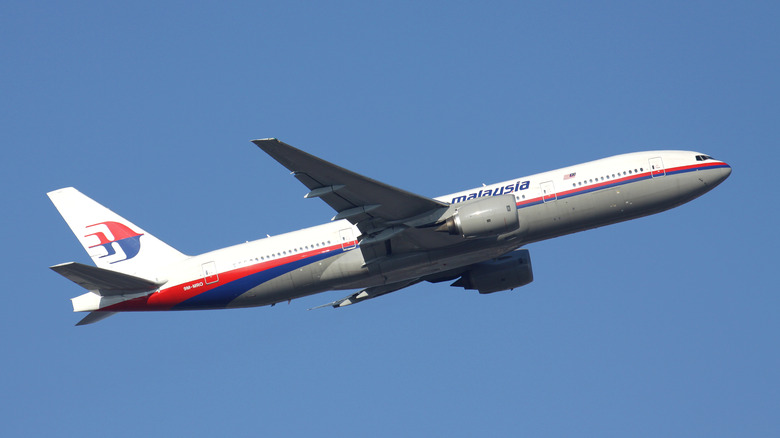
We'd almost expect ships at sea to vanish, considering how often it's happened in our collective human past, but a commercial airplane mysteriously vanishing while full of passengers seems like a bit of a stretch. When one just up and disappears one day, seemingly into the blue, it's even more far-fetched. A small private plane owned by the Russian mafia? Sure. A fighter jet in WWII? Most definitely. But a Boeing 777 fitted with all the high-end tracking and navigation technology the 21st century has to offer, with a cabin full of passengers? Seems a little sketchy. And, as far as we know, the disappearance of Flight 370 actually was pretty sketchy, to say the least.
Malaysia Airlines Flight 370 was carrying 239 people when it seemingly disappeared in March of 2014, taking the passengers with it. The flight left Kuala Lumpur, the capital of Malaysia, and was supposed to land in Beijing. Within an hour, the plane lost contact without so much as a quick message about what was happening on board — not even a distress signal. The disappearance is considered one of the biggest aviation mysteries to happen this millennium. How could one missing plane be so mysterious? That's the question that's been boggling investigators and one for which we might never have an answer. Here are some of the chilling details we do know about its mysterious disappearance.
Was the crash an act of terrorism?
In 2020, Malaysian leadership thought the incident to be a murder-suicide, but it was unclear who perpetrated it. If it were a terrorist hijacking, you'd think an organization would come forward and claim it; otherwise, there's really no point.
An attack by malicious hackers was another theory proposed that also falls short of credibility. According to some experts, the only option for hackers would be to take control of the plane through its satellite link, set the autopilot on to take it off course, and somehow keep the pilots from resuming control. Aside from that, there wasn't much of a possibility to exploit the flight system. Plus, that satellite link went down before the plane disappeared. So basically, that led investigators to conclude that any person or people responsible for Flight 370's disappearance had to be on the plane at the time it went down.
The black box would definitely help
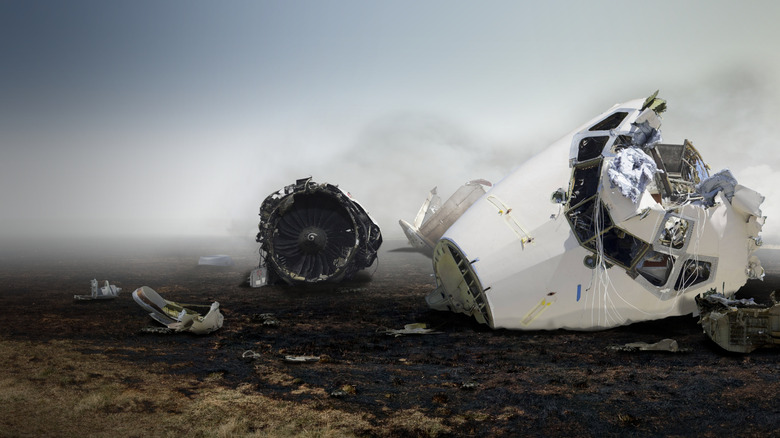
It might not be completely clear what happened to Malaysia Airlines Flight 370 until the plane's black box is recovered. Black boxes, also known as flight recorders, are government-mandated devices installed on all planes to track and record flight data in case of tragedies like MH370. The evidence stored within that particular recording device could be invaluable to understanding what occurred. If it's ever located, the wreckage of the flight itself might conceivably point investigators in the right direction to find the black box. But that's part of the problem: Investigators can't even seem to find the plane.
Furthermore, it was discovered a year after the flight's disappearance that the black box's battery on Flight 370 had expired more than a year prior. The battery was overdue for replacement, and while there was no indication that it was faulty and therefore unable to record data, the black box onboard Malaysia Airlines Flight 370 may have struggled to "ping" its location to searchers.
Horrifying possibilities for the lack of debris
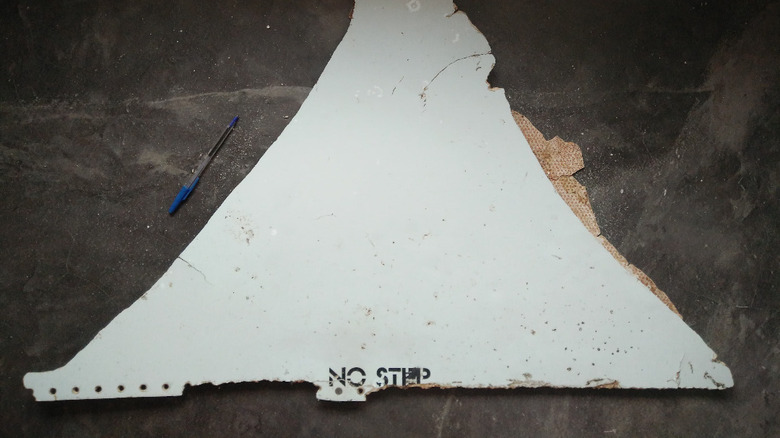
One major reason that the disappearance of Malaysia Airlines Flight 370 has generated so much mystery is that very little debris has been found. In 2015, a year after the incident, mathematician Goong Chen ran data through computer simulations to figure out why. His results concluded that a vertical crash would have caused the plane to sink rapidly to the bottom of the ocean floor, leaving it largely intact and therefore difficult to recover from the depths of the oceans to which it plunged (via CNN).
Over the years, almost two dozen fragments believed to be part of the plane have made it to the coasts of Madagascar. By far the most significant piece recovered has been the trunnion door of the landing gear, found in 2022. Damage to both the interior and exterior of the find indicates the grim reality that the equipment was extended before impact, which would only increase devastation.
The findings indicates a grim reality that whoever was flying the aircraft crashed it on purpose. In their report, "Debris Analysis — Main Landing Gear Trunnion Door Panel," Blaine Gibson and Richard Godfrey came to the horrific conclusion that whoever was flying the plane crashed it on purpose. They explained, "The combination of the high speed impact designed to break up the aircraft and the extended landing gear designed to sink the aircraft as fast as possible both show a clear intent to hide the evidence of the crash."
The disappearance was an international tragedy
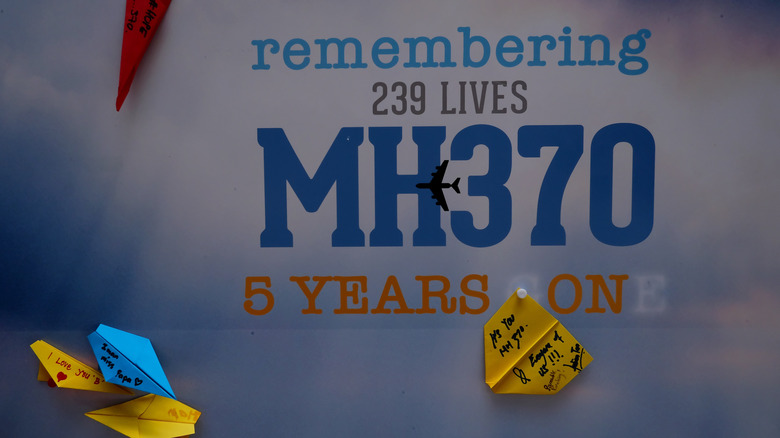
MH370 may have been a Malaysia Airlines flight leaving the country's capital city, Kuala Lumpur, and heading to Beijing, but most of the people on board were not Malaysian. Instead, the 227 passengers who mysteriously perished were from 14 different countries, leaving grieving family members across the globe with lots of unanswered questions about their missing loved ones. Most depressing of all is that five of the individuals on the flight were children.
Aside from the crew, there were only 38 Malaysians on board. Even fewer of the passengers were from Indonesia, Australia, India, France, the U.S., Iran, Ukraine, Canada, New Zealand, the Netherlands, Russia, and Taiwan. The rest, and the vast majority, were from China and presumably on their way home. Following the disaster, teams of law enforcement officials from both Malaysia and China carried out investigations of every single passenger with assistance from the FBI. All were cleared of suspicion, which means that if something nefarious occurred, none outside of the crew were involved and each one was an innocent victim.
Troubling details about one of the 12 crew members
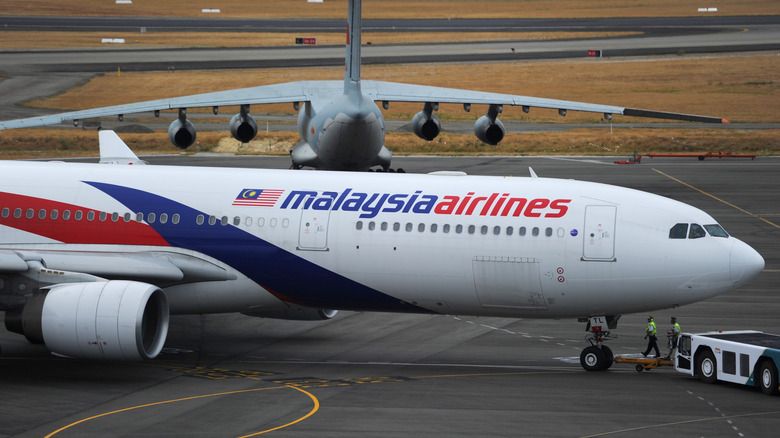
Of the two pilots on Malaysia Airlines Flight 370, the first was 27-year-old Fariq Hamid; the trip to Beijing was his last training flight before earning his certification. The remainder of the crew consisted of 10 flight attendants and the senior captain, Zaharie Ahmad Shah, who was one of the most experienced pilots in the country.
Among the crew, the one who had some very worrisome aspects about his background was Captain Zaharie. The 53-year-old lived alone since his kids had grown up and moved out, and his wife had also left with little chance that she would return. A close friend of Zaharie told The Atlantic, "Zaharie's marriage was bad. In the past he slept with some of the flight attendants. And so what? We all do. You're flying all over the world with these beautiful girls in the back. But his wife knew."
Because of this, more than one friend described Zaharie as being often sad, even bordering on depression. Far more disturbing were the results uncovered from forensic examinations of a flight simulator the pilot frequently used in his periods of isolation. In particular, there was a path he played through that had a trajectory eerily similar to that of MH370 before it vanished — as if he was practicing for the tragic flight. While no solid evidence has even been discovered that proves Zaharie was responsible, the same friend who knew about his marital issues did not rule out the possibility.
Did the captain create a hypoxia event to kill the passengers?
After electrical engineer Mike Exner thoroughly examined the radar data from Malaysia Airlines Flight 370, he came to an absolutely chilling conclusion that seemed to have solved at least part of the mysterious disappearance of MH370. At 40,000 feet, the emergency oxygen masks in the cabin no longer function effectively, and the plane flew at that height for more than enough time for a depressurization event to take full effect, causing the lethal condition called hypoxia to occur for everyone outside of the cockpit.
Federal Aviation Administration (FAA) guidelines require any flights above 10,000 feet to be pressurized. Otherwise, with what happens to your body on an airplane, passengers can be at risk of not getting enough oxygen to their blood, tissues, and cells for their bodies to function. The resulting hypoxia then creeps up unnoticed, causing passengers to first lose consciousness within a matter of minutes, followed by death not long after. If Captain Zaharie Ahmad Shah, or whoever was piloting the aircraft, purposefully flew at such a high altitude, it could have been done as the simplest — although definitely brutal — way to prevent the passengers from interfering.
The unlikely theory that fruit and lithium batteries caused a fire

In the desperate struggle to find answers for the vanishing of MH370, a bizarre, terrifying, and yet logical theory arose that a fire may have ignited in the cargo bay, leading to disaster. To spark the flames, the likely culprit was thought to be a container of lithium-ion batteries. This caused Boeing, the FAA, and most pilots to advocate for changes to how potentially dangerous goods would be stored in the future. Others voiced concern that a container held mangosteens that were out of season and contributed to the growing flames.
However, in 2018, an investigation was carried out by an international team from seven countries that examined the evidence and conducted comprehensive tests. In their "Safety Investigation Report," the investigators determined that not only was all of the cargo packaged safely, but also that mangosteens and lithium batteries are flown so frequently without incident that the items were unlikely to be responsible. Tests also confirmed that even if the two items came into contact, the flight's short duration made it nearly impossible for such a volatile reaction to occur.
Some have claimed to have seen the plane the day it disappeared
On the tragic day that Malaysia Airlines Flight 370 vanished, several people across a vast area stretching from Southeast Asia to the Maldives claimed to have seen the aircraft, and none of the accounts sounded like the flight was going according to plan. Most described an aircraft flying extremely low, while Mike McKay, a worker on an offshore oil rig near Vietnam, told Radio New Zealand (via CNN) that he observed an object in the sky that was on fire. In Indonesia, the state news agency Antara reported that there were sightings of a crash from local fishermen.
In 2022, after systems engineer Sergio Cavaiuolo used Inmarsat satellite data and flight path tracks to figure out the trajectory of the plane, he realized that his conclusion was backed up by accounts from several people in the Maldives (via Express). Putting the data and the sightings together, Cavaiuolo is certain that the aircraft collided with the ocean surface in the Veymandoo Channel of the South-Central Atolls, and that the heartbreaking underwater grave of the 239 people on board is located there at the bottom of the sea.
People in China immediately boycotted travel to Malaysia

Not long after MH370 went missing, a huge number of Chinese citizens were either furious with Malaysia or afraid to travel there out of fear of another fatal incident. Around two-thirds of the 227 passengers on the flight scheduled for Beijing were from China, which left many family members in the country unsatisfied with the lack of information about the fate of their loved ones. Two weeks after the plane disappeared in March 2014, fired-up protesters formed outside the Malaysian embassy in Beijing demanding answers, including about 200 relatives of the passengers.
The anger spread far beyond the capital as well, with a significant drop in Chinese tourism to Malaysia. The boycotts were fueled greatly by famous movie stars like Chen Kun and their millions of followers. On the social media site Weibo, he stated (via the South China Morning Post), "I ... will start a boycott from my inner heart on any commercials and travel relating to Malaysia. This will last ... until the Malaysian government takes down their clown-like mask and tells the truth."
The most expensive search operation in history was a failure
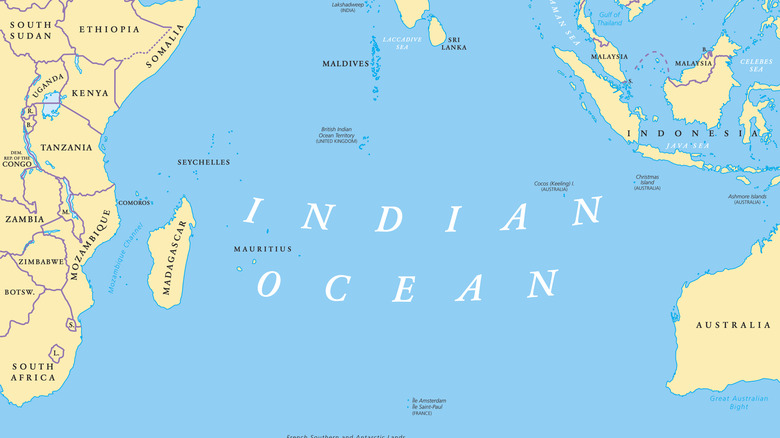
The fact that very little of the wreckage from MH370 has been recovered is even more disturbing because of the massive amount of time, money, and resources spent in the initial search operation. An international effort raised $150 million to fund crews from Malaysia, Australia, and China to scan the sea floor of one of the largest bodies of water in the world: the Indian Ocean.
In the end, the teams were able to cover a vast amount of territory that added up to 46,000 square miles, located 1,100 miles west of Australia. By 2017, officials had realized they were likely searching 200 miles too far south, but the governments supporting the operation decided that too much money had already been spent, so it was ended without finding any substantial evidence. The cost of the most expensive search in history may yet rise, as subsequent efforts by Ocean Infinity may cost the Malaysian government another $70 million, albeit on a "no-win, no-fee" contract.
The troubling disappearance of MH370 led to new technology

As is too often the case, the Malaysia Airlines Flight 370 tragedy changed aviation forever, forcing the aviation industry to adopt new measures that could have prevented the disaster in the first place. Possibly the most critical change, instituted by the International Civil Aviation Organization of the United Nations and developed by Aireon, was to create a technology that could track flights globally from orbit, no matter how remote the location.
When talking with CNN, CEO Don Thoma of Aireon said, "This will be the first time ever that all aircraft are being tracked around the world in real time." To pull this incredible feat off, the company only needs to use 66 satellites to cover the entire planet. Before, there was a frightening amount of territory that aircraft could get lost in, not just over oceans, but also equally isolated regions like deserts, mountains, and dense forests. Now, the interconnected devices in orbit make it far more difficult to lose track of a plane.
A new search was set for 2026
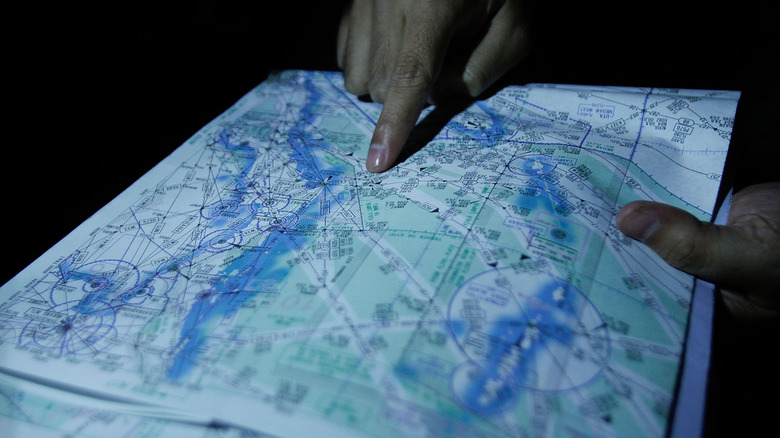
By the end of 2025, two major searches had been undertaken to find MH370, with practically nothing to show for it (the parts of the craft that have been recovered have largely washed ashore rather than been pulled from the ocean by search crews). The first attempt involved a wide array of people and crafts from 26 nations and ended in 2017. The second attempt, undertaken the next year, was organized by private company Ocean Infinity, a marine robotics operation. That, too, ended with little more than question marks after three months.
But Ocean Infinity wasn't done yet. Technically, it had begun the first steps of its second oceanic search in early 2025, but operators paused it due to poor weather. It picked back up later that year, with Ocean Infinity working under a "no find, no fee" agreement with the Malaysian government. If it can finally uncover the resting place of MH370 over the course of its search (set to happen periodically over 55 days), Ocean Infinity will receive $70 million.
The nearly 6,000-square-mile search area presents a daunting challenge, with rough seas and rugged underwater obstacles, such as volcanoes and crevasses that plummet more than 1,000 feet down. The company intends to use a slate of high-tech equipment, including autonomous underwater vehicles (AUVs) that will map the seafloor and are equipped with magnetometers that could detect a long-sunken plane buried in ocean sediment. These can also send a "point of interest" to a waiting ship above, from which operators can send down remotely operated vehicles (ROVs).
The Malaysian government faced criticism for its handling of the disappearance
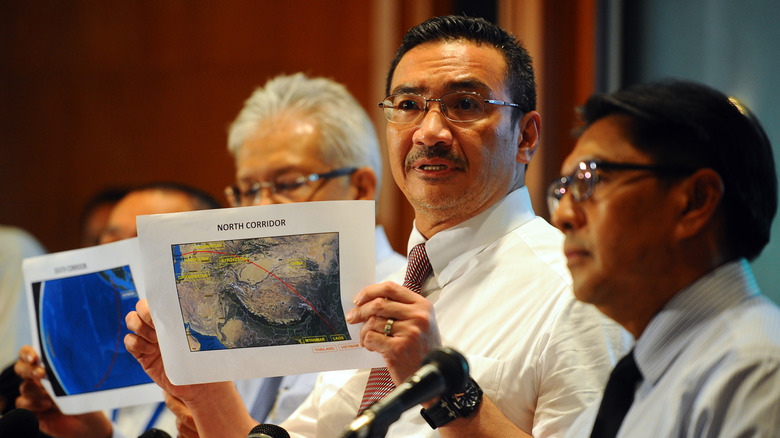
When MH370 abruptly disappeared, many turned to the Malaysian government for an explanation. Government officials soon came under fire for their handling of the incident, especially as far as family members of missing passengers were concerned. Much of their issues centered on the inconsistent delivery of often inaccurate information, such as when Malaysian officials rather coldly texted families that no one aboard MH370 survived, then followed that up with information suggesting that perhaps some passengers were still alive.
Others pointed to oddly sluggish responses to radar signals that indicated a search area far from where initial search efforts were undertaken. Delays in processing and sharing data, both with civilians and governments assisting in the search, wasted valuable time. It didn't help that Malaysian officials could be resistant to questions, and Malaysian media rankled nearby countries after publishing allegations that other nations could have shared radar data sooner.
This messy, even chaotic situation opened space for conspiracy theories to flourish. One such notion was a hijacking of the plane, supposedly linked to Malaysian opposition leader Anwar Ibrahim (a distant relative by marriage of MH370 pilot Zaharie Ahmad Shah). However, a hijacking scenario seems unlikely given that no group ever claimed responsibility, and motivations for rerouting over the Indian Ocean remain murky. This hijacking story was almost certainly a convenient political fiction that painted Anwar as a villain and was meant to make those in power, like Prime Minister Najib Razak, look better.
Changes to flight recorders are linked to MH370
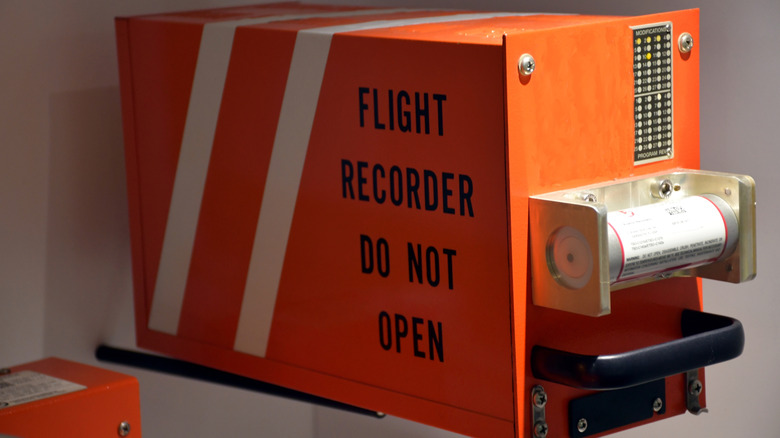
In the aftermath of the disappearance of MH370, many bemoaned the fact that the plane's flight recorder was so far out of reach. If only someone could recover it, investigators could glean incredibly important information about the craft's path, its condition over the course of the flight, and the state of the pilot and copilot. But, with the location of the plane unknown — besides the likely fact that it was deep below the waves — such a task has proven exceedingly difficult.
As a result, manufacturers have begun introducing technological advances that could ease the recovery of flight recorders. These include deployable recorders that would essentially be ejected from a downed plane and float, while transmitting a signal detectable by searchers. Proposed innovations include attached parachutes and airbags to slow descent and improve chances of retrieval, while some models even include a visual recording system that could send images of an aircraft and its environs to rescuers. In the years since MH370's disappearance, not all planes are equipped with deployable recorders, but some are, including military aircraft.
Beyond that, designers have come up with recorders that could transmit cockpit audio and flight data in real time, hopefully doing away with the need to recover a physical "black box" in the often chaotic aftermath of a crash. However, there are issues that have kept airlines and manufacturers from widely adopting real-time data transmission, including the expense of installation, costs associated with maintaining satellite connections (especially for near-continuous transmission), and privacy concerns expressed by pilots.
Some have suggested that barnacles may help find the plane

Could some of the humblest sea creatures help locate MH370? Farfetched as it may sound, barnacles could be holding key clues that are linked to the reason ships are often painted red on the bottom — specifically, gooseneck barnacles attached to some of the very few recovered pieces of the plane. When the right wing's flaperon was found on the island of Réunion in July 2015, it was also bearing a population of the crustaceans.
The barnacles (in this case, the Lepas anatifera species) start off life as free-floating larvae, but then must find something to attach to, ideally in deeper water and away from much sunlight. Gooseneck barnacles in particular are eager colonizers, finding organic and inorganic bits of flotsam to glue themselves to. With the right conditions, their growth patterns are so predictable that scientists can conceivably look at the oldest (and typically largest) barnacles on debris and get an idea of how long that substrate has been in the water, according to a study published in AGU Advances.
It's not quite a scientific slam-dunk, however. Barnacle growth rates are dependent on factors like ocean temperature and nutrient density, while the understanding of gooseneck barnacle growth and its applications for tracking time was in its infancy back in 2015. Further frustrating matters is the reluctance of the French government — which oversees Réunion and collected the flaperon and its barnacles — to turn over the largest barnacles for closer study. It also doesn't help that drift modeling of ocean currents hasn't been entirely reliable.
Wild theories about the disappearance remain hard to believe

In both the short- and long-term aftermath of MH370's disappearance, a crop of explanations that included conspiracy theories sprang up. Ranging from almost reasonable to downright bizarre, they reflected the public's need to have some sort of explanation for the tragedy. At first, tales swirled that the plane had landed in an undisclosed location, perhaps the Andaman Islands overseen by India or even north to Kazakhstan, Pakistan, or the Taklamakan Desert of China. Could hijackers perhaps have taken over and flown the plane to one of these locations? No, not really. Besides the daunting prospect of landing a Boeing 777 in remote areas, the plane would have had to evade radar detection on nearly all the proposed alternate routes.
What about a cyber attack that might have struck MH370's navigation or communications systems? Boeing took exception to that, saying early on that it was all but impossible for hackers to somehow take over or disable the plane. But one of the most out-there ideas was the notion that, somehow, the plane had been sucked into a black hole.
Then-CNN anchor Don Lemon dared to suggest such a thing, but when The Atlantic spoke to two scientists about it in 2014, the idea was soundly drubbed. Columbia astronomy professor David J. Helfand told the publication that "black holes comparable to the mass of an airplane or somewhat bigger that could attract and swallow a plane do not exist." Meanwhile, Stanford University physicist Peter Michelson was likewise skeptical, noting that many more things than a single Boeing 777 airliner would have disappeared into such a black hole.
Hydrophones might help pinpoint MH370's resting place
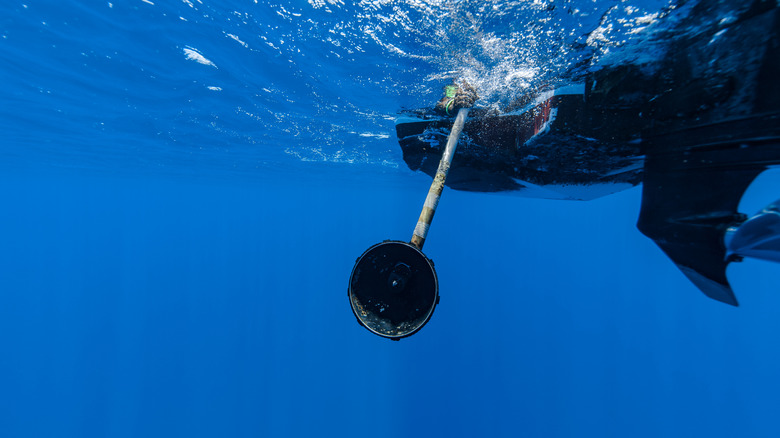
One might suppose that, if a large passenger jet were to crash into the ocean, it would make a pretty big sound. But was anyone around to hear MH370 do so? In immediate human terms, no. But what if we were to listen in on some electronic equipment? It's not science fiction — across our planet, underwater microphones known as hydrophones are listening to the ocean. Even if a hydrophone wasn't in the immediate vicinity, the distinctive acoustic signature of a crashing aircraft can travel surprisingly well through water, meaning it may have been detected by devices placed thousands of miles away. A careful study of hydrophone data from the suspected date of MH370's crash could yield significant results.
Of course, as with so many things about MH370, getting to the bottom of things isn't as easy as we might hope. A 2024 paper in Scientific Reports, which raised the idea of using hydrophones to pinpoint MH370, also notes that we need a better understanding of what a crashing aircraft really sounds like when it's picked up by these devices. Right now, none of the examined data clearly points to a likely location for the downed craft. Conducting experiments and analyzing historical data could have great benefit for future crashes, too, so the study's authors recommended that more work be done — potentially still with the hope of finding MH370.
The search made significant inroads into ocean science
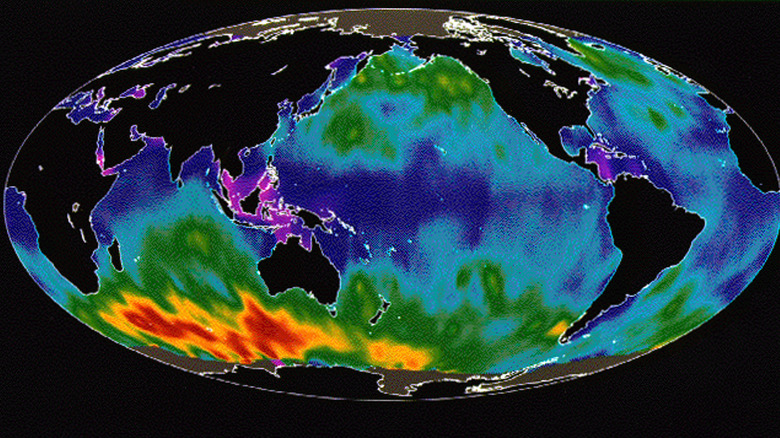
With multiple searches covering thousands of miles of ocean, it is assuredly frustrating, even heartbreaking, that no sign of MH370 has been recovered (apart from the scattering of pieces that have washed ashore). But, if there is any comfort to be taken from the seemingly fruitless search, it may be in the fact that it's seriously advanced our understanding of oceanography, from currents above to the seabed far below.
By 2017, searches had already produced high-quality sonar scans of the search area in the Indian Ocean, as well as data that can help researchers distinguish between sediment and harder areas of rock. The widely variant underwater landscape came into greater resolution, bringing out unique features like areas of volcanic activity, dramatic plateaus, ridges, and underwater mountains known as seamounts. In fact, a 2018 paper published in Marine Geology argued that the whole search area revealed a vastly more complex landscape than previously suspected. It also pointed out that the region contained four times more seamounts than expected prior to the search.
The search also significantly advanced the study of drift modeling, which works to understand and predict the paths of ocean currents. That's no easy task, given that currents are influenced by a wide and complex array of variables, from prevailing winds to both underwater and coastline geography. But, with data from sources like free-floating drift boats and satellite data that includes sea level measurements, scientists working to locate MH370 in this manner are learning valuable information about the movements of our planet's oceans.