

The Most Timeless Rock 'N' Roll Voices Of The '80s
The rock scene of the '80s was a vibrant collection of new and old acts, some of whom hit the charts for the first time and some of whom saw their early efforts from the late '70s finally pay off big time. With such an eclectic mix of genres and sounds emerging from the decade, the true and timeless rock voices that rang through the noise had a lasting impact on music fans for years to come. Even now, some of these peak performers are still rocking out on the nostalgia set, entertaining fans who've grown up with their tunes as a soundtrack to their lives.
How do you narrow down the five most timeless rock singers of the '80s, especially when there are so many fantastic acts to choose from? You select the voices that changed the music game for singers down the line and whose music still resonates whenever you hear it. Based on a combination of familiarity, longevity, recognized ability, and chart success, we've compiled a list of who we think are some of the greatest voices from 1980s rock 'n' roll.
Even 40 years or more down the line, these five peak performers represent some of the most significant singers from the era. See if you can read their profiles without hearing their far-reaching tunes resonate in your '80s-loving brain.
Pat Benatar
Rock and roll had very few female voices making the airwaves when Pat Benatar introduced her multi-octave range on her classic 1979 debut single, "Heartbreaker." The soaring melody and bone-crunching guitar work announced a new force in the world of music and established Benatar's trademark mix of vocal artistry and songwriting craftsmanship. By the early 1980s, she essentially ruled the airwaves with her powerful vocals, the result of operatic training combined with a keen rock sensibility.
Benatar enjoyed a string of high-rising hits that lasted the better part of the decade. Her unmistakable tones combined with a no-holds-barred lyrical sensibility created a template for what a rock goddess could achieve. Benatar alternated empowerment anthems like "Hit Me With Your Best Shot" and "Invincible" with tunes about tormented love like "Fire and Ice" and "Love Is a Battlefield." And her commitment to social justice produced "Hell Is for Children," which tackled child abuse head-on and in no uncertain terms.
When the subject of '80s nostalgia turns to the music scene, Benatar's voice is one of the first that springs to mind. Not only did she prove that women had a place in rock and roll, she shattered a glass ceiling that had kept others out of the boys' club, waving her fellow female rock singers into the arena in droves. The whole game changed thanks to this uncompromising talent and her limitless vocal abilities, which remain in a class all their own.
Steve Perry
There's no question that when your voice adorns one of the most popular empowerment songs of all time, you're a timeless rock singer of the 1980s. That honor belongs to Steve Perry, lead singer of Journey and the voice that implored generations, "Don't stop believin'" and helped lift the band to legendary status.
Perry had become a member of Journey in the 1970s but shared vocal duties with founding member Gregg Rolie during that decade's releases. By 1980, Rolie had departed and Perry took over as lead vocalist, aiming Journey for a more mainstream rock sound with the high-energy classic "Anyway You Want It" from the band's "Departure" album. Perry and crew reached soaring heights in 1981 when their seventh studio album, "Escape," hit the market. His stadium-ready vocals graced now-standard rock gems like "Who's Crying Now," the power ballad "Open Arms," and of course, "Don't Stop Believin'," an anthem to the working class people reaching for their dreams that never fails to get fists pumping whenever and wherever it shows up.
Other Journey hits from the era featuring Perry's timeless vocals include the pulsing "Separate Ways" and the aching tour bus love song, "Faithfully." Perry also enjoyed solo success with his 1984 single "Oh Sherrie" and continued with the band into the '90s. But it will forever be his '80s works that resonate most with music fans, echoing across the decades.
Bruce Springsteen
Even if Bruce Springsteen hated "Born to Run" at first, the now-classic 1975 tune got the engine turned on for his rock star act. But his career really revved into high gear in the '80s. Starting with "Hungry Heart" in 1980, the working class poet introduced a more mainstream sensibility into his songwriting that helped him find solid chart success. Four years later, the "Born in the U.S.A." album made his gravelly, growling bellow a staple on both radio and MTV. It was impossible to escape "Dancing in the Dark" once its synth-heavy ear candy caught your attention; it captured the sort of fun pop energy that the music of the era was known for and showed a more accommodating side of The Boss. It also led to his biggest successes and made him a household name.
His next release, "Tunnel of Love," cemented his hitmaker status and sealed his reputation as one of the most beloved singers of the era. His flexibility with songwriting textures and emotion took him beyond his working class roots, bringing his songs closer to elegant tune-smithing with a poetic heart.
Since Springsteen has never stopped touring, fans can still get an earful of his gravelly purr whenever the E Street Band pulls into town. It's a reminder of how the life struggles his music portrayed are the same no matter what age you are when you hear them.
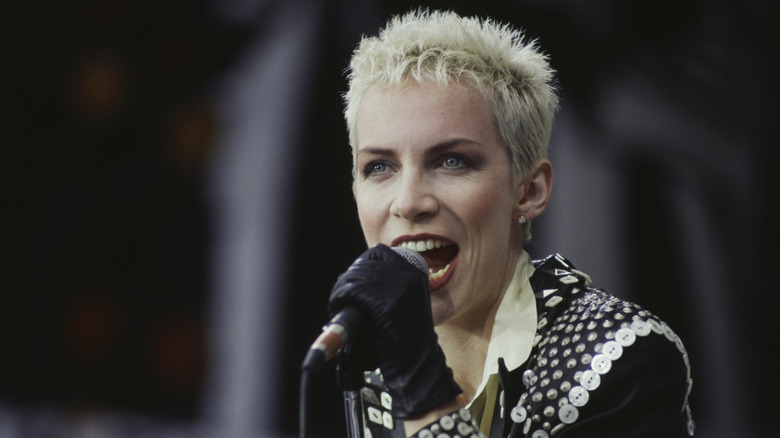
Annie Lennox
When the throbbing synth loop of Eurythmics' "Sweet Dreams (Are Made of This)" in 1983 gave way to the haunting dulcet tones of Annie Lennox, the world of rock music held its breath. Here was an angelic sound that simmered instead of shrieking but carried the same urgency of the best rock singers in the business. The fact that Lennox was surrounded by a lush electronic soundscape didn't diminish the fact that her voice was forged from rock and roll DNA, echoes of the art-rock band that gave her and partner Dave Stewart their start.
The band's early albums played with a more techno-pop sound, but by 1985, Lennox and partner Dave Stewart had brought the crisp crackle of authentic rock music into their aesthetic. The retro-sounding rocker "Would I Lie to You?" wrapped Lennox in a shimmering wall of sound Phil Spector would have been proud of, while "Sisters Are Doin' It for Themselves" gave Lennox the space to cut loose with soulful, rafter-shaking vocals that matched duetting partner Aretha Franklin note for note.
Bone-crunching rockers like "Missionary Man" and "I Need a Man" followed and established Lennox and her flexible pipes as one of the most enduring rock voices of the entire decade. Though Eurythmics had ended by the early '90s and Lennox went on to great success with a solo career that circled back to a more pop-oriented sound, her rock-era vocals remain some of the most thrilling sounds of their time.
Bono
Who could have predicted that the lead singer from a scrappy little Irish art-rock quartet called U2 would become one of the most revered and recognizable vocalists on the planet? Maybe Bono himself would have told you this was possible; after all, the band was unabashed about their goal in the 1980s to become the biggest band in the world, with Bono's sonic thunder leading the charge.
There's no turning away from the hypnotic circular guitar riff chiming from Edge's echo guitar on the rock standard "With or Without You" from the band's groundbreaking 1987 album, "The Joshua Tree." And when Bono's pleading, contained voice joins in and leads the listener into a hypnotic meditation on the confounding nature of love, the singer takes us on a slow-burning rise to the height of emotional angst. This became the trademark U2 template for the remainder of the '80s, during which Bono and his team explored the textures and possibilities of American rock music. It propelled the band into the stratosphere just like they wanted, and it made Bono's vocal talents a signature feature of the decade.
The success of U2 continued into the '90s and beyond as the band experimented with other sonic sandboxes. And though age has caused Bono to become embarrassed by U2 and some of his early vocal performances, the years haven't diminished the power and clarity of his voice, even as he makes music for the modern age.