

5 '70s Rock Songs We'll Be Blasting On Repeat 'Til The End Of Time
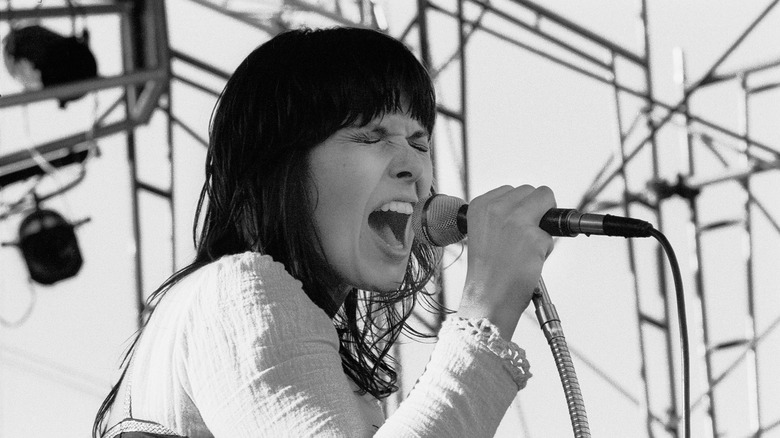
The 1970s produced a massive amount of incredible rock 'n' roll in a decade that included the continued success of bands like the Rolling Stones, as well as newer acts like Iggy and the Stooges that pushed the sonic needle in a brand-new direction. Due to the sheer amount of incredible songs to choose from, as well as the personal nature of music, narrowing down a decade's worth of output is no easy task.
We've listed five songs that shoot out of the starting gate with a driving beat and heavy guitar, with a distinctive sound that marks them as a singular musical journey that can only come from that one artist. When your favorite classic rock radio station plays a banger like Led Zeppelin's "Kashmir," you just have to crank up the volume, sing at the top of your lungs, and bang on the steering wheel trying to keep in time with John Bonham. Then there are those times when you're exercising and a tune like Heart's "Barracuda" comes on, pushing you to run a little faster or farther or crank out a few more reps, and requires being played on repeat. Indeed, these songs are all staying on repeat until the heat death of the universe.
The song Robert Plant called perfect Zeppelin
From the very first strains of Led Zeppelin's masterpiece "Kashmir," you know you're in for something unique, no matter how many times you hear it. The hypnotic guitar riff in rhythmic tension with John Bonham's drumming pushes the song forward, matching Robert Plant's lyrics about a physical and metaphorical journey. Meanwhile, John Paul Jones adds more layers with the mellotron, an electronic keyboard, adding to the song's mysterious feel. To cap it off, the band added orchestral touches written by Jones to beef it up even more.
The song was first conceived while Page and Plant were traveling through Morocco in 1973, and quickly found its footing in the studio back in London. "It was new music, no one had ever heard anything like it," Page recalled in an interview with Uncut. While groundbreaking at the time, the '70s rock song sounds even cooler today than when it was released in 1975, as part of the band's sprawling double album "Physical Graffiti." It would become one of the band's all-time favorites. "It's so right; there's nothing overblown, no vocal hysterics. Perfect Zeppelin,' Plant told Classic Rock. At more than eight minutes long, there really is a lot to love about "Kashmir."
Iggy and the Stooges go on a mission to search and destroy
When you need a full-throttle, no-holds-barred rollicking tune, the proto-punk Iggy and the Stooges' "Search and Destroy" is the one to go for. With James Williamson's dense, visceral, and distortion-heavy guitar work, along with Pop's voice that goes from growl to howl and starts with "I'm a street-walking cheetah with a heart full of napalm," you're in for a three-and-a-half-minute-long infusion of aural adrenaline.
"Search and Destroy" was the first song on the band's 1973 album "Raw Power," which marked Pop's comeback after the demise of the first incarnation of the Stooges in 1971, and was recorded at CBS studios in London with David Bowie producing. Bowie had sought out Pop and the two became close, with Bowie championing his new friend, and when Pop first heard the recording of the song in the studio, he knew they'd made something special. "I knew it was good and that it was something that would hold up in a particular way over a very long period of time," Pop said (via Apple Music). We fully agree, as would the many musicians who Iggy and the Stooges inspired, from the Clash to Kurt Cobain.
The heart of a barracuda
Heart's "Barracuda" begins with a chugging guitar rhythm before the sharp chiming lead guitar comes in. Then Ann Wilson's powerful voice begins to deliver the cutting lyrics about the sexism and sleaziness in the 1970s music business, all written with a universality that makes it relatable to anyone who's had to deal with two-faced people, backstabbers, or nasty encounters with sharp-toothed barracudas.
Heart, led by singer Ann Wilson and her sister Nancy Wilson on guitar and backing vocals, was formed in Seattle in 1974. "Barracuda" was the opening track on the Seattle-based band's second album, "Little Queen." The song came together quickly, with Ann writing the lyrics in one night after an off-color remark from a music business type, and the band came up with the music shortly after. "It was really powerful," Nancy Wilson recalled (via American Songwriter). "It just fell into place like the good ones usually do. It's sort of a galloping steed. It's a monster of a song." From Roger Fisher's chug-a-chug guitar riff to Wilson's searing delivery, this is a tune that needs to be played loud.
Springsteen's Born to Run drives on
"Born to Run" instantly gets you to your feet, starting with a machine-gun drumbeat that's quickly joined by piano and saxophone, before Bruce Springsteen's bright guitar sound cuts through the dense mix. The music has a relentless sense of movement that matches Springsteen's lyrics about escaping the confines of a mundane life and heading out into the unknown, while the refrain "Tramps like us, baby, we were born to run" requires you to sing along at the top of your lungs. Springsteen was on a tour bus in Tennessee when he woke up with the idea for the song, and that sense of racing down the road permeates the song's music and lyrics.
The chiming bell-like quality of the glockenspiel adds to the narrator's almost childlike call to adventure to his girlfriend Wendy. Indeed, Springsteen has said he was thinking of Wendy and Peter Pan while working on the song's lyrics. "Born to Run" was the Boss' first big hit and helped push the album of the same name up the charts, the latter of which Springsteen said was "full of possibilities, full of fear ... but that's life (via Rolling Stone). The album's eponymous anchor song has stood the test of time, feeling as relevant and timeless 50 years after it came out.
The Rolling Stones get serious
A thrumming clavinet, soon joined by Keith Richards' staccato rhythm guitar, kicks off "Doo Doo Doo Doo Doo (Heartbreaker)," a gritty Rolling Stones song that's bristling with righteous rage. The song, from the 1973 album "Goats Head Soup," isn't as well-known as other songs from the album, like "Angie," but it's a unique song that lyrically veers away from most of the band's catalogue. It's about the plight of two Black youths in New York City during the early 1970s, and in at least the case of the first, it's based on a true story: In April 1973, a New York City police officer with a record of brutality shot and killed an unarmed 10-year-old named Clifford Glover. The second verse is about a young girl who dies from a heroin overdose.
You can't help but feel the anger in the one and only rock star Mick Jagger's delivery, especially in the refrain "Heart breakers with your .44/I wanna tear your world apart/You a heart breaker with your .44/ I wanna tear your world a part," which is impossible not to sing along with. The song also features a driving horn section and funky bass line that pushes it into overdrive. The end result is a unique song that demands to be played on repeat and at high volume.