

5 Songs From 1976 That Define Rock History
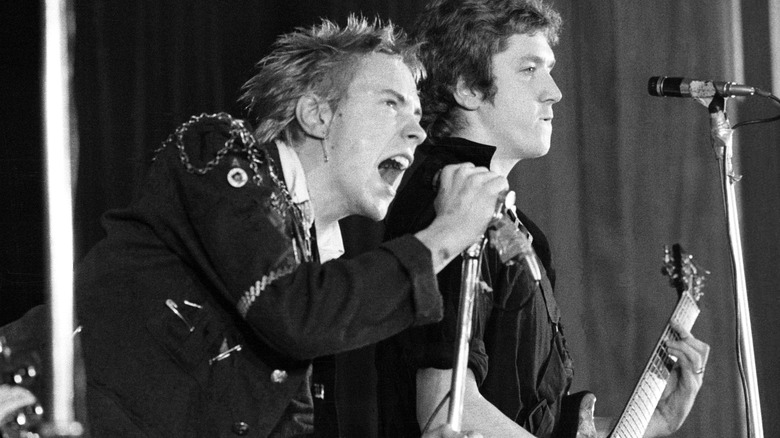
The 1970s were an absolute treasure trove of classic rock hits that not only defined the musical and cultural landscape of the time but also endure to this day. Bands like The Rolling Stones, The Who, The Doors, and The Beach Boys evolved to match and influence the times, while rock legends like Led Zeppelin, Eagles, Pink Floyd, David Bowie, Lynyrd Skynyrd, Fleetwood Mac, and many, many more took off and defined it. Each year bore its own fruitful hits, but 1976 proved an especially gonzo year for rock-defining classics.
But first, we've got to take a look at the state of rock come the second half of the '70s. The 1960s' countercultural movement had gone mainstream, overflowed on the musical front in the early '70s, and the second half of the decade was starting to segue into '80s arena rock and face competition from disco. Big hit songs from 1976 reflect this epoch, caught between rock's history and rock's future. They're tentpole tracks that form a portrait of rock that year and "define" its history, but don't necessarily cause it.
While the year produced loads of hits that reflect the time, like the "The Boys Are Back in Town" by Thin Lizzy, "Detroit Rock City" by KISS, "Dirty Deeds Done Dirt Cheap" by AC/DC, "Baby I Love Your Way" by Peter Frampton, "Fly Like an Eagle" by the Steve Miller Band, and "Carry On Wayward Son" by Kansas, a few songs stand out as more emblematic than the rest. This includes Boston's "More Than a Feeling," Queen's "Somebody to Love," and of course, Eagles' "Hotel California."
Hotel California
We really can't talk about music that defines rock history without talking about Eagles (not The Eagles, it should be noted). They were an enormous, massive force throughout the '70s, and claimed both the third and fourth spot in the decade's top 10 most sold albums, according to Best Selling Albums. They were so overwhelmingly popular, much more than the reader may even realize or remember, that they already released a greatest hits album in 1976 that covered a mere five years of the band's history. In 2018, that album became the highest selling album of all time, ever. And, Eagles put out another new album in 1976 aside from the greatest hits album, one that contained the ultra-hit to end all hits, "Hotel California." 1976 was indeed a mighty good year for the band.
What can we possibly say about "Hotel California," aka, "Mexican Reggae" by the original title (if you couldn't hear it in Don Henley's odd vocal delivery), that hasn't been said before? A stupendously structured song featuring magnificent storytelling, it's as eerie as it is inviting (much like its subject matter) and sounds very much like its fantastic imagery: dark desert highways, warm smells of colitas, pink champagne on ice, and so forth. No matter any personal opinions about Eagles, it's hard to deny that few songs are so evocative as they are catchy.
On top of its hidden meaning, "Hotel California" features one of the most iconic, dual-guitar solos (and dueling) in the history of rock, 1976 or otherwise. Plus, it's fantastic to hear folks sing this song at karaoke with such impassioned verve without knowing what the heck the song is actually about. Indeed, none of us can ever leave the memory of this song behind.
Anarchy in the UK
On the completely opposite side of the rock musical spectrum from Eagles, we've got a ruckus, rebellious, hack-and-slash musical foray that also defines 1976 to a T: "Anarchy in the U.K." by the Sex Pistols. For the purposes of this article, we're going to leave discussions of whether or not punk is rock to rambling, time-wasting forum posts and say, "Yes, it is," because it grew out of rock in the mid-70s. A stripped-down, ragged, raw middle finger to established rock conventions, punk (aka, "punk rock") took form in the U.S. and U.K. with bands like The Stooges, the Ramones, The Clash, and another "the" band, the Sex Pistols. Out of all the songs of all these bands, it's arguably "Anarchy in the U.K." that proved the most era-defining and influential.
"Anarchy in the U.K." wasn't just about singer Johnny Rotten's on-stage body contortions and wild-eyed ravings, or about self-destructive punk icon Sid Vicious, who died in 1979 three years after "Anarchy in the U.K." was released. The song was about its blunt-as-a-billy-club, anti-establishment attitude and lyrics like, "And I wanna be anarchist / I get p***ed, destroy." This is the moment when punk came to represent a revolt not just against stuffy musical niceties, but against, well ... everything. As the BBC quotes journalist Jon Savage at the time, "This is it. This is about the whole of the country."
The Sex Pistols were so bent on annihilation that they annihilated themselves in no short order. "Anarchy in the U.K." was so era-defining that folks might forget that it came off the only studio record that the Sex Pistols ever released, "Never Mind the Bollocks, Here's the Sex Pistols." Now that's punk.
Somebody to Love
"Bohemian Rhapsody" is an impossible song to follow up. Released in 1975 off of Queen's aptly-named "A Night at the Opera," "Bohemian Rhapsody" reached No. 9 on the Billboard Hot 100 the following year, in 1976. That same year, Queen charged ahead with their mad, incessant creative output and released their fifth full studio album, "A Day At the Races." Rather than rest on their laurels or fret about a follow-up (pun intended, guitar people) to their greatest hit, they went ahead and made "Somebody to Love." The song built on Queen's harmony-lush sound, tied their '70s and '80s careers together, did the same for rock decades on a whole, and helped the band continue their climb towards their place on rock band Olympus.
As a songwriting feat, the first few measures of "Somebody to Love" tell much of its story. The song wields six distinct vocal parts, e.g., baritone, tenor 1, tenor 2, etc., each of which are tripled, meaning three separate layers of the same line for extra thickness — that's 18 vocal tracks total. This type of textured harmonizing, the type famously employed on "Bohemian Rhapsody," plus some top-level Freddie Mercury vulnerability meets bravado, and a rhythmic ebb and flow reminiscent of gospel (Mercury took inspiration from Aretha Franklin for this track), drove "Somebody to Love" to No. 13 on the Billboard Hot 100.
If the reader listens to "Somebody to Love" and asks, "In what decade does this sound like it was written?" we're betting you wouldn't know (production values aside). In "Somebody to Love," Queen was already bridging the gap between the '70s and '80s, forging another link in their legacy and rock history.
More Than a Feeling
Boston was such a colossal band that it's easy to forget that they were basically a one-album wonder. Their self-titled, red UFO-emblazoned 1976 debut album became the biggest-selling rock debut ever and propelled the band to instant, unparalleled mega-stardom. The first song off this first album, "More Than a Feeling," drove the band's entire career. Their sound was huge and their songwriting anthemic, hooky, and perfectly suited to singalong arena shows, all of which presaged the Album-Oriented Rock (AOR) of the '80s to follow, thinking of bands like Journey, Bon Jovi, Def Leppard, etc.
This is all thanks to Tom Scholz, Boston's founder, producer, and multi-instrumentalist who wrote and did everything for the band. More of a tinkerer and engineer than anything else, he built his famed Rockman audio device in his home studio in his basement while crafting Boston's early sound. The Rockman was a truly revolutionary amp with built-in effects and headphone compatibility that could be used for recording or playing, and was small enough to fit in your hand. It got developed into its own product line, was used by the likes of ZZ Top, Joe Satriani, and Def Leppard, and still gets peddled around here and there online in used markets like eBay. In this way, Scholz represented a shift towards something that a lot of music lovers don't think about, but which has come more and more to define the music industry: production.
Scholz's perfectionism also crippled Boston's career. There was an eight-year gap between their second and third albums (1978 to 1986) and third and fourth albums (1986 to 1994). By then, times had changed, and the band's momentum was gone, though their impact remained.
(Don't Fear) the Reaper
Long before Will Ferrell was bangin' out more cowbell on Saturday Night Live, Blue Öyster Cult was a poetically-minded, weird and mystical, prog-adjacent band with a [blue oyster] cult following, something that scratched the same itch as King Crimson or Emerson, Lake, and Palmer. Not as big a band as the others on our list, Blue Öyster Cult still peaked at No. 12 on the Billboard Hot 100 in 1976 with the song that everyone knows them for, "(Don't Fear) The Reaper." This song helped define not only rock history, but also 1976, especially because of the flak that the band got for their song.
It seems obvious that "(Don't Fear) The Reaper" is a song about accepting the inevitability of death. The song cites Romeo and Juliet to do so, and romanticizes their story (incorrect to the text, yes) in lines like, "(Saying, "don't be afraid") Come on, baby / (And she had no fear) And she ran to him / (Then they started to fly) They looked backward and said goodbye." But, when "(Don't Fear) The Reaper" was released, some members of the public thought that the band was advocating suicide, and interpreted lines like the famous "40,000 men and women everyday" to conclude so. This came as a big shock to the band, who never expected to make it big.
Blue Öyster Cult and their place in rock history didn't fade, though. The "More Cowbell" 2000 SNL skit really did serve to renew and cement the band's fame. In an interview with Q104.3 (on Facebook), singer Buck Dharma says that "we owe a debt to SNL ..." and the band has "made our peace with the cowbell," although the band was never as serious about itself as folks thought, anyway.