

5 Love Songs That Will Have Every Boomer Crying Into Their Coffee
Boomers grew up in a time of immense musical change that covered everything from late '50s Elvis to late '80s Guns N' Roses, R&B and Motown, folk, country, the beginnings of rap, and every sliver of music in between, like disco in the late '70s. And just to show you that time and perception work in whacky ways, musicians like Ozzy Osbourne, Johnny Rotten of the Sex Pistols, and James Hetfield of Metallica are all boomers. None of those musicians crafted the love songs of their generation, though.
In general, "baby boomers" are folks born post-World War II, from 1946 to 1964, during a chunk of time characterized by unbridled optimism, economic growth, and a consequent boom in baby births — hence, boomers. It's accurate to say that these individuals mostly came of age in the '60s and '70s, with some generational overlap with the Silent Generation on the early end (born 1925 to 1945) and Gen X on the late end (from 1965 to 1979). It's also accurate to say that growing up in such a time might have contributed to the sincerity of its love songs.
When choosing songs for this article, we tried to cover the entire expanse of boomer-era decades. This means that while our love songs have a timeless quality, they also feel like they wouldn't be birthed in the present. And even though these songs will likely hold special significance for boomers, by no means can they only be enjoyed by boomers. This is true of the Righteous Brothers, Eric Clapton, Whitney Houston, or the other artists on our list.
Unchained Melody
Not that this is a song-ranking article, but really, is there a ballad more absolutely, profoundly moving and romantic than "Unchained Melody"? The widely-viewed, 1965 live version of the song, sung by one half of The Righteous Brothers, Bobby Hatfield, ought to sweep away the hearts of the dead, let alone the living. Hatfield's pitch-perfect emotional control over his voice, the virtuosic vocal runs, the clarity of his tone, let alone all the songwriting and heartfelt lyrics about a person wishing for the love of someone far away: Not only will people of the baby boomer generation be crying over this, but everyone else will, too.
But despite the song's intense emotionality, neither Hatfield nor the other Righteous Brother, Bill Medley, wrote "Unchained Melody." Songwriter and lyricist Alex North and Hy Zaret, respectively, assembled "Unchained Melody" for the 1955 movie "Unchained." Much like the song's lyrics imply, the movie is about an inmate who wants to get back to his wife and family. However, the lyrics are generally enough to be applicable towards any romantic situation, even an unrequited one. This might have helped the song appeal to so many people over so many generations, rather than chain its lyrics to a specific time and place.
In fact, several versions of "Unchained Melody" were recorded before The Righteous Brothers' 1965 version. Jimmy Young did a version in 1955, but without the swinging 6/8 time signature of the Righteous Brothers' version, its string accompaniment, or the soul in Hatfield's voice, Young's version doesn't hold a candle. There's a reason why the Righteous Brothers' version took off and touched the hearts of boomers and anyone else who's heard the song since.
Can't Help Falling in Love
Not only were boomers treated to the Righteous Brother's rendition of "Unchained Melody" at a young age, they also had Elvis Presley's perennial "Can't Help Falling In Love," a song so well-known and widely-loved that even now, in 2025 at the time of writing, it has over 1.2 billion listens on Spotify — 64 years after it was released in 1961. The youngest of baby boomers would have been teens when this song came out, and the oldest is still hearing it. The youngest also might have seen Presley perform it in "Blue Hawaii" when the film debuted, because like "Unchained Melody," "Can't Help Falling in Love" was written for a film. Since then, who knows how many couples have claimed "Can't Help Falling in Love" as their song?
Elvis didn't write "Can't Help Falling in Love," though. The song was a three-person task – Hugo Peretti, Luigi Creatore, and George Weiss — and was actually based on an 18th-century French folk song, of all things, "Plaisir d'Amour" (The Pleasure of Love, or Love's Pleasure), according to American Songwriter. That song was based on a poem, which itself was based on a novel by 18th-century writer Jean-Pierre Claris de Florian. And, the lyrics were originally written from a woman to a man. All in all, this lyrical lineage might help explain the poetics of lines like, "Like a river flows / Surely to the sea / Darling, so it goes / Some things are meant to be." But, it took Elvis' extreme vibrato and deep voice to pull the song off.
You Make Me Feel Brand New
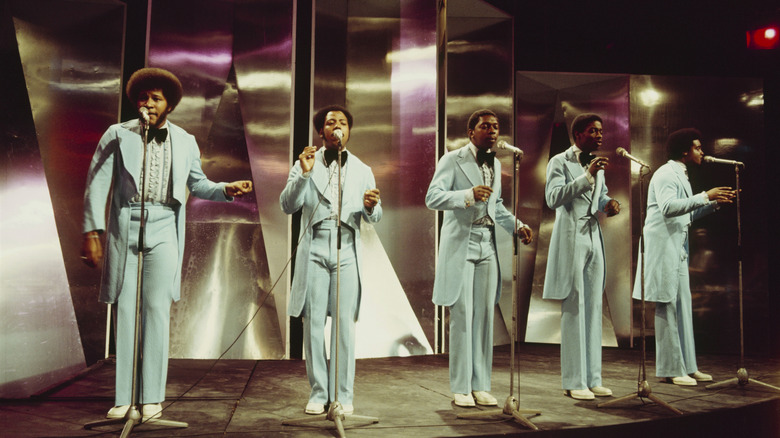
Probably the least known piece of music on our list, but no less deserving of our attention, "You Make Me Feel Brand New" by the Stylistics will do precisely as the title says. Released in 1974 and hitting No. 2 on the Billboard Hot 100, "You Make Me Feel Brand New" overflows with earnest feelings of love and endearment. Word and note placements are so deliberate and measured, and the song's instrumentation so lush and full, that every line drives home to the heart. Plus, while it's written in the second person like other songs on our list — speaking to "you" — it also sounds like a hand-written letter, which makes the lyrics feel especially personal.
"You Make Me Feel Brand New" isn't just a superb love song; it's a textbook-perfect example of Philadelphia soul, an easier-going, densely instrumental, less pop-driven cousin of Detroit's Motown. It comes with some serious songwriting credentials, too, as it was written by Thom Bell and Linda Creed, a producer-songwriter duo responsible for much of the Stylistics' catalogue. Creed, for instance, went on to co-write Whitney Houston's 1985 hit "The Greatest Love of All" along with Michael Masser.
But, in the hands of another artist besides the Stylistics, "You Make Me Feel Brand New" wouldn't carry the same beauty. Verses swap between Airrion Love, a baritone, and Russell Thompkins, Jr., with his amazing falsetto, while the entire group joins in for the chorus. Not only is a boomer likely to cry on cue when the song takes off, much like anyone who's experienced the type of love the song describes, but this song just might melt the most hardened of love-scorned hearts.
Wonderful Tonight
With "Wonderful Tonight," Slowhand indeed proves the power of a simple, deftly played, four-note motif. Released in 1977 on the album after which Eric Clapton got his nickname, "Slowhand," "Wonderful Tonight" absolutely oozes the precise, drippingly romantic, loving admiration described in its lyrics. Those lyrics might not look like much on paper — "And then she asks me, 'Do I look all right?'/ And I say, 'Yes, you look wonderful tonight'" — but when Clapton sings them along with the song's sparse accompaniment, the song's radiant feelings shine through. Boomers who heard this song in the '70s might have carried around these lyrics and Clapton's four-note, soaring motif in their hearts for all of the years since they first heard it.
"Wonderful Tonight" also tells a story that drives home its meaning. It's an extremely simple, fairly universal story told in an uncluttered way and with everyday vocabulary. Rather than croon about love in an abstract sense, "Wonderful Tonight" tells a concrete tale about a couple getting ready to go out, the guy complimenting the girl, the two walking into a party, everyone admiring the girl's beauty, and so forth. The song comes across as extremely heartfelt and shows immense appreciation from the man in the song towards his beloved.
The specificity of "Wonderful Tonight" runs contrary to the vague qualities of "Unchained Melody" and "Can't Help Falling In Love" that helped those songs achieve long-lasting popularity. And indeed, "Wonderful Tonight" feels more of its time than those other two songs, and isn't as widely-known outside of those who came of age hearing it. But each song has its role in the boomer song catalogue, including the ground-level storytelling of "Wonderful Tonight."
I Will Always Love You
Yes, we know that the Queen of Country herself, Dolly Parton, wrote and recorded "I Will Always Love You" in 1974. We've got to show honor and respect to her, the original songwriter. But, in the hands of Whitney Houston — or, the voice — the song was elevated to new emotional heights. Houston's version was released in 1992, making it the newest song on our list for boomers who were well into adulthood at the time. But really, Houston's rendition of "I Will Always Love You" retains the same timeless quality as other songs on our list. This just might be a facet of powerful love songs, in general, themselves being an extension of the universality of the experience of love itself.
Like "Unchained Melody" and "Can't Help Falling In Love," Houston's "I Will Always Love You" came with a film, 1992's "The Bodyguard." Kevin Costner, who co-starred in the film with Whitney Houston, had Houston listen to Linda Ronstadt's 1975 cover of Parton's song and suggested she use it in the film. You can still hear Ronstadt's version in the general rhythm and synth-laden, pop instrumentation of Houston's version. Parton's original song, by contrast, was an acoustic guitar-driven, country track complete with steel guitar.
Parton actually got involved in Houston's cover and let her use the song's final verse, which Ronstadt didn't use. This is the critical, "I hope life treats you kind / And I hope you have all you've dreamed of" verse that finishes the song's story. Even though the people described in its lyrics aren't together in the end, they'll still love each other, always. That's enough to make any aging boomer cry.