

5 Songs From The '60s That Have Aged Terribly
The 1960s were a different, but very exciting time for music. Rock 'n' roll was coming of age thanks to the British Invasion and, slightly later in the decade, the rise of garage rock and psychedelia. Combine that with the continued evolution of pop and other genres, and the '60s had no shortage of classics that even today's younger generations can appreciate. But since the '60s were also a different time in terms of attitudes toward women, dating, and various other topics, the decade also had many songs whose lyrics aren't quite copacetic when viewed through the lens of current values and culture.
Granted, there are so many 1960s songs that aged poorly, so a few factors stood out above others when choosing songs for this list. The first was whether the lyrics could have gotten the performers "canceled" in the present day. If not, do the lyrics express dated views on certain hot-button topics? Reddit posts, online articles, and of course, the songs' lyrics, were primary points of reference, but personal choice also played a role in the selection process.
To further narrow things down, the songs below were performed by well-known artists, and each of them aged poorly for distinct reasons, including, but not limited to, racially insensitive language, normalization of domestic violence, and general misogyny. So with all that out of the way, here are five songs from the '60s that aged like milk left out in the hot sun.
Run For Your Life — The Beatles
"Run For Your Life," the very last track on the Beatles' 1965 album "Rubber Soul," is problematic from the very first line. While the first line of the first verse (Well, I'd rather see you dead, little girl/Than to be with another man) is taken straight from Elvis Presley's 1955 track "Baby Let's Play House," John Lennon built on this already ominous snippet by writing an entire song around it.
Pretty much, the song's point-of-view character is depicted as an admittedly wicked, jealous individual who wouldn't mind taking the life of his girlfriend if he catches her fooling around with someone else. And while its defenders argue that "Run For Your Life" is meant to be viewed as a work of fiction, the lyrics hit way too close to home when you consider certain troubling aspects of Lennon's life, particularly his later admission that he used to be physically abusive toward his partners.
Years after the Fab Four disbanded, Lennon told Rolling Stone that "Run for Your Life" was his least favorite Beatles song because he felt he was ripping off Presley. Many fans, however, see things differently, with one Reddit user writing, "I get that it's art, but I don't feel artistic distance in the song, so it turns me off." And while other fans acknowledge that it's a catchy song, that hasn't stopped them from expressing discomfort with the track's lyrical themes.
He Hit Me (And It Felt Like a Kiss) — The Crystals
The Crystals have a generally feel-good discography, but the early-'60s girl group has one song that sticks out like a sore thumb, and it's 1962's "He Hit Me (And It Felt Like a Kiss)," which modern listeners may also recognize from Lana Del Rey's 2014 cover. And if you think the title isn't self-explanatory enough, the full lyrics (via Genius) lay it all out — "He hit me and it felt like a kiss/He hit me but it didn't hurt me/He couldn't stand to hear me say/That I'd been with someone new/And when I told him I had been untrue." This verse (and the two others that follow) reads as a justification for physical abuse as a means of showing love to one's partner. It doesn't help that the track was produced by Phil Spector, whose history of domestic violence is well-documented.
"He Hit Me (And It Felt Like a Kiss)" had some real-life inspiration, as songwriters Gerry Goffin and Carole King based it on the abusive relationship their babysitter, Eva Boyd (later Little Eva of "The Loco-Motion" fame), was going through at the time. But the fact that the lyrics excuse the boyfriend's behavior made the song controversial upon its release, and decades later, it still rubs listeners the wrong way for various reasons, such as Spector's involvement, the depiction of trauma bonding, and the dissonance between its carefree melody and disturbing lyrics.
If you or someone you know is dealing with domestic abuse, you can call the National Domestic Violence Hotline at 1−800−799−7233. You can also find more information, resources, and support at their website.
Tie Me Kangaroo Down, Sport — Rolf Harris
Even if you disregard the fact that Australian singer (and Billboard one-hit wonder) Rolf Harris went to prison for certain unspeakable acts, it's quite easy to see why his only major U.S. hit, 1963's "Tie Me Kangaroo Down, Sport," aged very poorly. In fact, it was just one year after the song's U.S. release when the song's fourth verse drew controversy in Harris' home country due to their perceived racist nature toward Australian Aboriginals. This resulted in the Australian Broadcasting Corporation banning the tune and announcing that it would only play instrumental versions going forward.
That ban lasted only one day, but decades after "Tie Me Kangaroo Down, Sport" enjoyed huge success on the Billboard Hot 100, listeners still cringe when reminded of that seemingly harmless little novelty about a dying stockman. Not surprisingly, most fans reference Harris' legal issues when explaining why they can't stand the song, with one Redditor writing, "Oof. Now residing in the 'we don't want to know where they are now' file, along with the complete works of Gary Glitter."
Other modern-day listeners are likewise bothered to this day by the song's fourth verse, with another Redditor recalling that as a fifth-grader in the '90s, they had to "omit some stanzas" when their class sang the song in assembly. "This [was in] 1995, so you know they were bad," they noted.
Young Girl — Gary Puckett & the Union Gap
Even if the song's narrator shows some self-awareness by telling the subject to "get out of my mind," Gary Puckett & the Union Gap's "Young Girl" stands out from other similar songs from the late '60s because of how the lyrics clearly suggest that the titular "girl" is not yet of legal age. There is very little subtlety in these lyrics, particularly the first verse (via Genius), which features the lines, "With all the charms of a woman/You've kept the secret of your youth/You led me to believe you're old enough/To give me love/And now it hurts to know the truth."
If its chart performance (No. 2 in April 1968) is any indication, the above lyrics didn't prevent "Young Girl" from becoming one of the top singles of the year. These days, though, the song is a mainstay of Reddit conversations about oldies with super-creepy lyrics, along with songs such as Benny Mardones' "Into the Night" and Winger's "Seventeen" — two '80s rock songs that aged terribly in a similar way. Even boomers who grew up with the song are uncomfortable with the tune in hindsight, with one Reddit user writing, "I always thought it was just an innocent, bubblegum part of the soundtrack of our youth. I'm a little weirded out right now."
Under My Thumb — The Rolling Stones
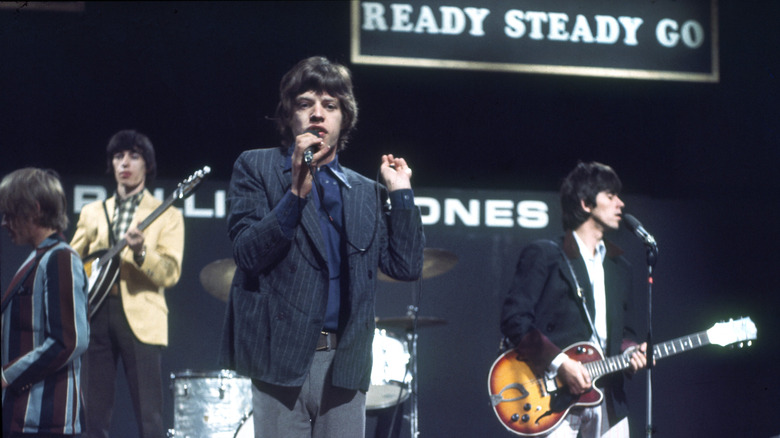
Although "Under My Thumb" was not among the tracks off the Rolling Stones' 1966 album "Aftermath" that cracked the Billboard Hot 100 that year, it has nonetheless become a staple of classic rock radio. Today's listeners might also recognize it from the soundtrack of 2010's "Scott Pilgrim vs. the World." While undeniably catchy with a strong main hook, the song's lyrics get more than a little troublesome at various points. Of course, there's the underlying thesis of how the narrator's girlfriend is fully subservient to him, but there's also the blatant double standard in the fourth verse. Here, Mick Jagger sings about how the woman in question knows better than to look at other men, while the narrator, on the other hand, is free to have a wandering eye — "Under my thumb/Her eyes are just kept to herself/Under my thumb/While I, I can still look at someone else" (via Genius).
Given its lyrics, "Under My Thumb" has understandably appeared in many discussions about misogynistic rock songs. Modern musicians, too, have expressed discomfort with the song. Appearing on Slate's "Studio 360" podcast, Bay Area musician Jules Indelicato talked about how they felt disgusted when they covered "Under My Thumb" for a San Francisco art project. "I realize that some of [the song's misogynistic nature] is kind of seeping into my body," they said. "Some of this pride, and some of this, like, snarky toxicity. I just felt so gross ... it kind of just made me really overwhelmed at how deeply hurt we are by pop culture."