

'70s Songs That Flopped But Deserved So Much Better
If a song is eventually considered a classic, can it really be described as a flop? Arguably not, but even some of the best songs ever released have had difficult releases, failing for one reason or another to receive the commercial success or critical acclaim they merited at the time. Looking back with half a century's hindsight to the 1970s, we can see that many of the era's defining songs deserved so much better.
The Billboard charts in the 1970s were hugely eclectic. It was also a time when the music industry was growing bigger than ever before. Increased television exposure, press coverage, and radio play of a wider range of musical styles should have meant that worthy artists of all stripes could crack the Hot 100 after finding their listenership. But sadly that wasn't always the case; indeed, even some of the decade's most acclaimed artists found the best tracks of their careers struggling to make a splash in the charts.
Choosing the biggest undeserved flops of any period isn't straightforward, and judging the worth of any musical release is obviously subjective. But these five recordings are all alike in having failed to attract mainstream attention back in the day, before going on to receive critical acclaim as classics of the '70s, as well as being among the finest songs in the artist's discography.
Gil Scott-Heron – The Bottle
Gil Scott-Heron is now remembered as one of the most important proto-rappers of the 1970s, whose politically charged songs like "The Revolution Will Not Be Televised" inspired generations of hip-hop artists, including Public Enemy, Q-Tip, and Kendrick Lamar. However, Scott-Heron's output often failed to generate the commercial success that its impact deserved. That was certainly the case with "The Bottle," an infectious 1974 soul track written in collaboration with musician Brian Jackson.
The song is typical of Scott-Heron's work in focusing on societal issues affecting the Black community, in this case the impact of alcoholism, with Scott-Heron's powerful lyrics metaphorically suggesting that those affected are trapped in a bottle themselves. Scott-Heron was open about his own addiction issues, and the song is notable for the speaker eventually admitting that they too are dependent on alcohol.
Despite the heaviness of its theme, "The Bottle" has become established as a reliable party track in the years since its release, and has been widely heralded as a dancefloor classic. However, it failed to chart at all as a single back in the day, and was overshadowed by Brother to Brother's cover version, which was released the same year and hit No. 46 on the Billboard Hot 100. That cover is little remembered now, and with hindsight it seems obvious that Scott-Heron's emotionally charged original deserved far more success than it received.
If you or anyone you know needs help with addiction issues, help is available. Visit the Substance Abuse and Mental Health Services Administration website or contact SAMHSA's National Helpline at 1-800-662-HELP (4357).
Curtis Mayfield – Move On Up
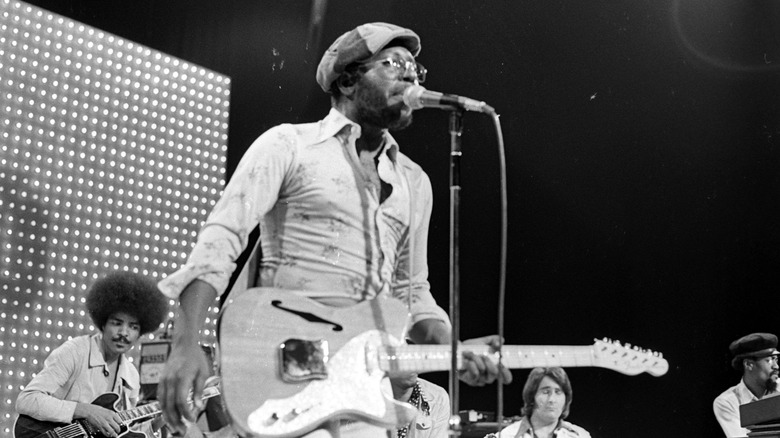
"Move On Up" is an uplifting and epic Black pride anthem that is counted among the 500 Greatest Songs of All Time by Rolling Stone. For a song that goes through so many movements, it has a flawlessness that is a testament to the quality of Curtis Mayfield's arrangement. Everything from the song's driving congas to Mayfield's funky guitar line and pitch-perfect vocal on the refrain is pure ear candy, and listening to it today, the esteem in which it has been held over the years is totally justifiable. The same can't be said for when it was released, at least as far as the charts were concerned.
The original version of the song found on Mayfield's debut album "Curtis" is almost nine minutes long, moving through several extended instrumental passages. Surprisingly, it was this version that the U.S. also received as a single, and it failed utterly to chart, most likely due to its length rendering it unplayable for many radio stations at the time. A slimmed-down version was released in the U.K., where it became a hit, peaking at No. 12 on the singles chart.
It seems in retrospect that the American release of the single was mishandled. "(Don't Worry) If There's Hell Below We're All Going to Go," Mayfield's darkly funky opener to his eponymous album, hit No. 29 and spent 12 weeks on the Billboard Hot 100, proving there was a mainstream appetite for Mayfield's stunning brand of funk and soul. As the years have passed, that song has been utterly overshadowed by "Move On Up," Mayfield's uplifting classic featuring epic instrumentation and arguably his greatest vocal performance, rivalled only by "Super Fly" in his extensive discography.
Shuggie Otis – Strawberry Letter 23
Cult soul artist Shuggie Otis enjoyed the biggest hit of his career in 1974, when the track "Inspiration Information" climbed up the R&B singles chart, but it's a once-overlooked album track from 1971 that single-handedly sustains his legacy: "Strawberry Letter 23." A laid-back and hypnotic soul number written for Otis' girlfriend, who would send him love letters on scented paper, the track demonstrates Otis' top-class guitar skills – he was talented enough as a youth to play guitar on his father Johnny Otis' records prior to his own recording career — and idiosyncratic songwriting style. There is even a meta aspect to the song; its chorus references "Strawberry Letter 22," rather than "23," suggesting the song itself serves as Otis' reply to his girlfriend's last love letter.
The track was not released as a single, but still caught the attention of several artists of the day. These included The Brothers Johnson , who had a major hit with a Quincy Jones-produced version of the track in 1977, which went to No. 5 on the Billboard Hot 100 chart. But it's a shame that Otis' lovingly performed original didn't reach such heights — though not as shiny as The Brothers Johnson number, it is shot through with authentic emotion and Otis' sweet vocal performance.
Otis is one of many artists whose immense talent never got the attention it deserved during his creative peak in the 1970s, but later critical reappraisal has seen him highlighted as a vital artist in the development of soul throughout that decade, though his work was barely heard by the general public. Thankfully, rereleases in the 21st century have seen him rediscovered by later generations of soul fans.
Link Wray – Fallin' Rain
The beautiful "Fallin' Rain" features on Link Wray's eponymous 1971 album, which dropped like a stone on its release. For those familiar with Wray's better-known work, "Fallin' Rain" is a must-listen, showing a uniquely somber and poetic side of the artist in one of the era's most effective protest songs.
Written at the height of protests against the Vietnam War, the song references the fatal shooting of student protesters at Kent State University. In its blending of simple poetic images — the falling rain of the title — and its evocation of real world events, it is comparable to the best of Bob Dylan's protest songs, and has gathered many admirers including indie legend Father John Misty and country star Karl Blau, both of whom have tapped into the tenderness at the song's core in recent cover versions.
Wray was one of the most important guitarists of the 1950s, most famous for his 1958 hit "Rumble," a low-tempo instrumental track that bristles with menace and was banned in some areas due to the belief that it was liable to spark rioting. It made him a beloved figure, but by the early 1970s he had retreated to his farm in Maryland, where he created a basic three-track studio in an old chicken shack. It was there that Wray finally recorded tracks for his self-titled album, including "Fallin' Rain." The change explains the more bucolic and folksy sound of the album, which alienated many fans of his early work and explains why "Fallin' Rain" has been slept on for so long. Down the years, the album has come to be considered a vital Wray record, featuring some of his best work.
Funkadelic – Maggot Brain
George Clinton's Funkadelic was one of the definitive groups of the psychedelic funk movement of the late 1960s and early 1970s, a genre that blended drug-inspired rock influences with the musicianship of soul groups, and trippy space-age imagery with biting social commentary. However, its commercial performance at the time was surprisingly poor, especially when it came to "Maggot Brain," the title track of which has grown hugely in critical stature since its release.
The track features a spoken-word intro followed by an exploratory, expressive solo by guitarist Eddie Hazel, whom Clinton instructed to play as though his mother had just died. Now considered one of the greatest guitar solos of all time, the track would likely never have been suitable for release as a single, but it is striking how little fanfare it received upon release. "Maggot Brain" was the group's third studio album, meaning critics were already accustomed to the genre-blending and risk-taking that defined Funkadelic's working methods. But they seemed unprepared for the release of "Maggot Brain," which garnered a muted response in the music press; indeed, some notable journalists dismissed the track as overblown and self-indulgent. Truly, Funkadelic was ahead of its time.