

5 Musicians From The '80s You Wouldn't Want To Meet IRL
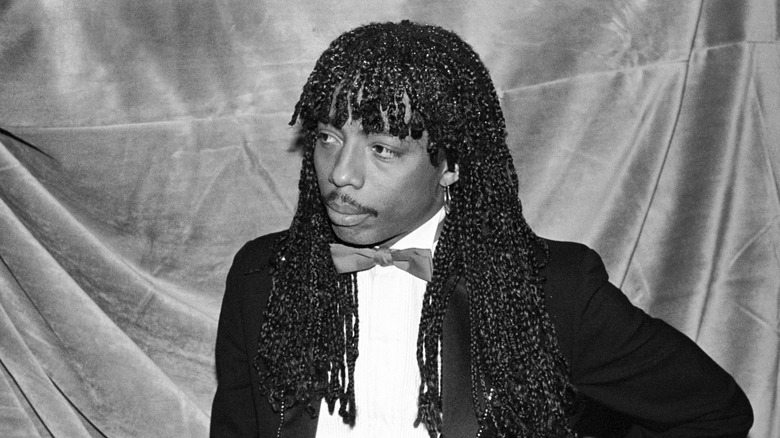
There's an old saying about the American public: voters tend not to choose who they think would best run the country, but who they like best personally and find most relatable. It's called the beer question, based on the "who would you rather have a beer with?" query that allegedly elevated George W. Bush over the ostensibly less fun-seeming Al Gore. (Of course, with the current president a lifelong teetotaler, the question is moot until 2028.)
But what if we apply this filter to rock stars of the 1980s? What if we thought not about how cool they were or how great their music was or how we wished we could get our hair like that, but what it would be like to sit with them for 15 minutes and just ... try to hang? With big talent often come big personalities, and fame, with the opportunities for sex, drugs, privilege, and attention that come with it, seldom acts as a calming influence. Some of the biggest names in '80s music were also abrasive, violent, erratic, or obnoxious people who, if you saw them coming in the front door of the bar, should make you scurry out the back before a situation unfolded. In the interest of fair play, we're considering only acts who were both famous for making music and at least probably intolerable during the 1980s: people whose fates or personalities soured later are out.
GG Allin
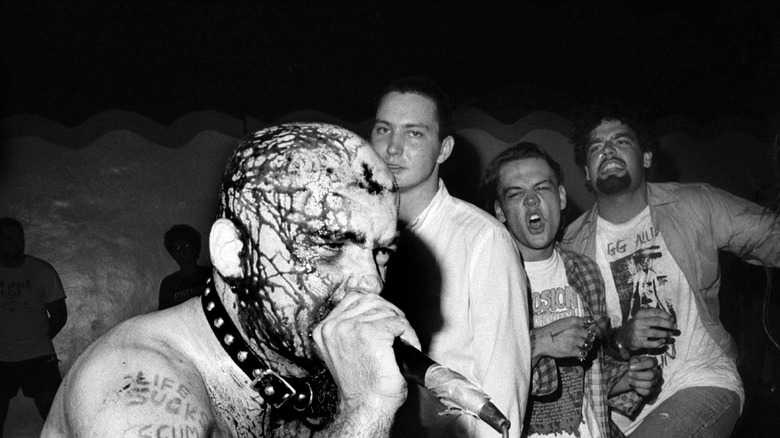
With a birth name like "Jesus Christ Allin," GG Allin may have been destined for a rough time. It's hard enough to be a plain-faced Helen or an Alexander who never conquers calculus, much less Persia, but if your namesake has his own religion, you're bound to feel you've fallen short. Nevertheless, Allin rose (or rather sank) to the challenge, cycling through a number of bands and becoming one of the most shocking stage performers of the '80s and early '90s punk scene through his notoriously obscene onstage antics.
Allin would regularly defecate on stage, reportedly taking laxatives beforehand to ensure that he would be able to, er, "perform." Allin also injured himself deliberately, breaking glasses or bottles and rolling on the shards, unmindful of the obvious infection risk and bleeding freely through his performances. He would regularly assault members of the audience, grabbing and striking anyone who hadn't retreated after the fecal onslaught. These shows were not about the music but about the spectacle, with audiences fleeing the shrieking, reeking Allin and law enforcement often clearing the scene.
Note that these are only the relatively printable lowlights of a GG Allin show; he regularly got up to worse things in the same general genres of fluids and assaults. As abrasive and crude as he was on stage, he may have had some redeeming qualities off stage. A reporter who once interviewed him wrote in The Austin Chronicle that during that interview, Allin "was intelligent, well-read, friendly, and on top of business." He died of an overdose in 1993.
Ted Nugent

Ted Nugent has always been Ted Nugent, and whether you think that's a good thing or a bad thing will depend largely on your own personality. A hard-right rock star is an unusual spectacle, but the Nuge has every right to express whatever opinion he wishes, though this goes hand in hand with the obligation to accept whatever pushback he gets. Whatever your politics and however they jive with Nugent's, however, the "Cat Scratch Fever" singer has given off stank vibes his whole career.
Ted Nugent was born in 1948, making him 33 in 1981 when he released "Jailbait," a song about wanting to have relations with (read: assault) a 13-year-old. Gross, but not every song is about something people actually do or want to do, right? Sure! But while the Boomtown Rats never shot anyone and Dolly Parton never jumped off a bridge, Ted Nugent has been accused of "relationships" with underage girls his whole career, and has alluded to the practice in other songs. Though Nugent denied that he "adopted" his 17-year-old girlfriend when he was 30 on Joe Rogan's Podcast, per VH1's Behind the Music, her mother signed legal guardianship over to him. Whatever the legalities, Nugent never denied the relationship with a teenager when he was over 30.
Mötley Crüe

Say whatever you want about Mötley Crüe (and plenty of people have), but for good or ill, they're rock stars. The hair, the bad behavior, the intermittent shirtlessness, the umlauts for no reason, the mediocre tattoos: they all add up to the image of hard-living infamy that helped birth parental advisory stickers.
All of the band's members put their guardian angels through a workout, but the hardest-working cherub in show business was probably the one assigned to Nikki Sixx, who nearly died from a heroin overdose, was revived at the hospital, got a ride home, and kept partying. This happened three years after Vince Neil had been behind the wheel in a drunk-driving crash that claimed the life of Razzle, the drummer of Finnish glam-rock band Hanoi Rocks. While the combination of all this substance-abuse trauma encouraged the band to clean up at least long enough to put together their most commercially successful album, "Dr. Feelgood," the chaos and apparent unconcern with human mortality Mötley Crüe displayed during this era mean they were best enjoyed from a distance.
Rick James
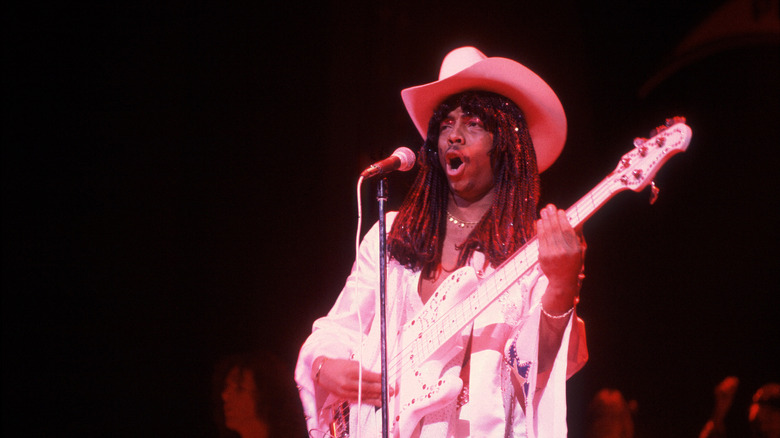
He's Rick James, b*tch, but that's not necessarily the endorsement you might think it is. While addiction is, truly, a disease, it's also a disease that can have intense negative effects not only on the direct sufferer but on all those in his or her orbit. James, who opened the '80s with the smashing success of "Super Freak," was famous and successful enough to let his jonesing for drugs, women, and perhaps most fatally, attention, sour his life and career.
James's daughter Ty (who, to her credit, loved her father and understood his weaknesses) has spoken of her attempts to monitor the flow of drugs into James' house and having to literally step over random women some mornings as the ladies dozed where they had tapped out. For her trouble, he threw a glass at her and married a woman who, at 17, was Ty's own age. (James was a should-know-better 39.)
James' reputation and behavior worsened in the 1990s, when he was jailed in the notorious (but musically historical) Folsom Prison for kidnapping and assault charges. His career never really recovered, and nor did his body, giving out in 2004 when James was 56.
Morrissey

Of course, Morrissey is on this list. Unlike the other entries, Morrissey isn't especially volatile, dangerous, or erratic. You are likely to survive having a beer with Morrissey without being physically injured or even being subjected to an unusually bad smell. But fundamentally, could you drink a whole beer with Morrissey without begging the Lord to bring you home? The success of Morrissey's band the Smiths mean that he's been financially comfortable and professionally successful longer than many people reading this have been alive. And yet since his time in the Smiths, he complains, and complains, and complains.
Morrissey is a scolding vegan who occasionally refuses to identify as a "vegan" for whatever reason and specifically opposes kosher and halal meat in terms that a significant number of people have found racist. Morrissey doesn't like dance music. Morrissey continues to play a tedious game of "oh but maybe I'm gaaaay" into the 2020s, when most people care neither about homosexuality in general nor about whatever his relationship to it may be; yes, sexuality is often fluid, but he's in his 60s and could have set a good example of being open to queerness at any point. One thing seems clear: if you got through a beer with Morrissey, you'd immediately need another one.