

These Are The 5 Worst No. 1 Hits Of The 1980s
In the relatively small club of hit No. 1 singles, the 1980s delivered some all-time classics that have stood the test of time — along with some absolute stinkers. Sure, there are the variously bubbly, catchy, profound, moving, and hard-rocking chart-topping bangers by the likes of Michael Jackson, Whitney Houston, Kool & the Gang, George Michael, Guns N' Roses, and Van Halen. But the decade is also riddled with duds that make us, the infinitely more tasteful and discerning listeners looking back from the more advanced year of 2025, wonder just what record buyers and radio programmers were thinking back in the '80s. These songs are just that terrible.
What makes them so bad? Their lyrics are corny, unpleasant, or haven't aged well. These are the songs that exist to perpetuate a smug, self-congratulatory agenda of the artist or their associates. Some seem to have been cynically created as a cash grab to make a quick and dirty million bucks. These songs are also so poorly constructed and have such rotten bones that when divorced from their '80s production techniques, there's not much left. With all that in mind, there are the worst songs from the 1980s that somehow happened to go to No. 1 on the pop chart, ranked from least bad to most bad.
Abracadabra
Throughout the 1970s, the Steve Miller Band was a solid hard rock outfit. Most every hit from the group included its titular member showing off on the guitar, such as in "Jet Airliner" and "Take the Money and Run." The band also played around with the lyrics a bit, generating some of the most memorable and often baffling lines found in classic rock. In "The Joker," Miller speaks of "the pompatus of love" (whatever that is), and in "Fly Like an Eagle," he speaks about how "time keeps on slippin', slippin' into the future."
But when the '80s came, the Steve Miller Band decided to adopt a new sound for the new decade, half-heartedly embracing superficial elements of new wave. "Abracadabra," the lead single from the 1982 album of the same name, is devoid of everything that made the Steve Miller Band fun. There's so much keyboard work on this No. 1 hit that it drowns out what little guitar is left, which includes possibly the least impressive solo of all time — a few janky notes awkwardly played out of rhythm. But what makes "Abracadabra" as bad as it is are the lyrics. Miller alternately employs the simplest rhymes, the dumbest turns of phrase, and couplets that are uncomfortably forced. The song pairs "'round it goes" with "where it stops nobody knows," inexplicably connects "your love" to "velvet glove," and worst of all, rhymes "abracadabra" with "reach out and grab ya."
Don't Worry, Be Happy
How can something be both insipid and dangerous? When it's Bobby McFerrin's 1988 No. 1 hit "Don't Worry, Be Happy." McFerrin's unique vocalization skills are legitimately amazing: The song has no instruments on it whatsoever. It's a multi-tracked a cappella-style recording of the artist imitating instruments and percussive tools with his voice, as well as providing all the melody, harmony, lyrical lines, and scatting. The result is a little bit calypso, a little bit reggae, and a little bit the kind of thing you'd hear at a college music department's showcase night.
It's grating and tedious, and that's just the music. The message of "Don't Worry, Be Happy" is infuriating. Earnestly meant as a cheer-up anthem, it plays out as ordering someone to just not feel sad because it's making them uncomfortable. Don't feel your feelings and process them, McFerrin says, even though sadness and fretting are the appropriate reactions to many life events, big and small. He'd rather you act like an emotionally avoidant buffoon, bury those so-called negative feelings, and grin vapidly through it.
We Didn't Start the Fire
Billy Joel's "We Didn't Start the Fire," which spent two weeks at No. 1 in December 1989, captured the affections of American pop music fans. Impressive, considering its flimsy, sing-songy melody that repeats on virtually every line of its far too many verses, supported by Joel playing braying keyboards as if he were a guitarist with a monster riff. That can all be theoretically and reasonably ignored, though, because "We Didn't Start the Fire" is all about its lyrics. Joel, a self-described history buff, wrote the song about the time he was 40 and freaking out about the passage of time. He was inspired by a 20-something who proclaimed that no important events took place in the decades of the musician's youth.
Even though it was taught in American classrooms as a fun history lesson, "We Didn't Start the Fire" lacks any real educational material. There's no context or explanation provided, just a list of major world events from the '50s, '60s, '70s, and '80s. Joel named 59 people in "We Didn't Start the Fire," but he doesn't say what any of them did that requires their respectful acknowledgment. The song is an exercise in boomer self-aggrandizement: Joel presents all the amazing things, good and bad, that happened in his lifetime as being the work of his generation. But he also absolves his cohort of blame — boomers "didn't start the fire," or the march of history, after all.
Kokomo
By 1988, it looked like the story of The Beach Boys was nearing its end. The band was in shambles, with no hit singles for more than a decade, and the group was without a record label. Desperate to return to the spotlight it had enjoyed in the 1960s for its brilliant surf songs and Brian Wilson compositions, the band conjured up "Kokomo," a tropical-adjacent song for the tropical-adjacent Tom Cruise bartending movie "Cocktail." The name refers to a fictional island paradise that The Beach Boys yearn to visit.
"Kokomo" briefly allowed for a Beach Boys comeback, but it's an undeniably cheesy song. Processed and produced and digitized within an inch of its life, it sounds like robots playing obviously fake beachy instruments that fail to imitate the group's sound effectively. All in all, "Kokomo" sounds like a poor attempt at a Jimmy Buffett song. The most memorable piece of the track is also its most notorious and insufferable: There's a repetitive, inane earworm of a chorus in which the band lists and chants the names of Caribbean locations in a collective whine that's supposed to be harmony. One can almost hear the self-congratulatory smirk when the group follows "we'll get there fast" with "and then we'll take it slow." It also emerges that "Kokomo" is a come-on to a woman, to whom the Beach Boys refer with a cringe-worthy "pretty mama."
Batdance
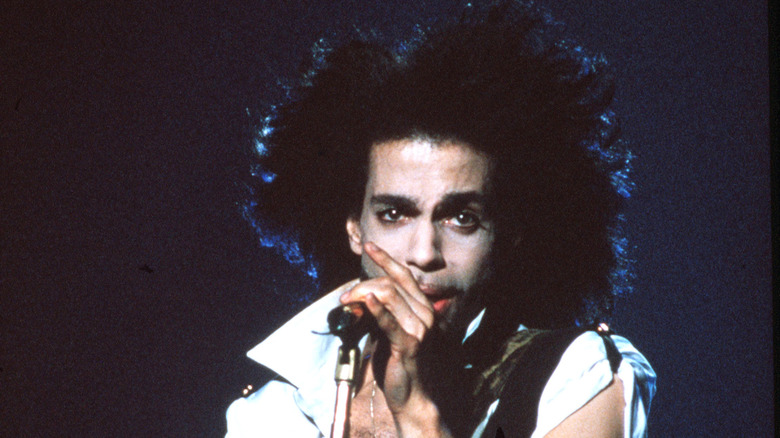
By the late 1980s, Prince was so widely respected and beloved — and could sell so many records — that he was allowed to do whatever he wanted musically. Producers of the big-budget 1989 "Batman" movie asked the singer/songwriter/multi-instrumentalist to contribute a few songs to the film's soundtrack, so instead, he made an entire "Batman" album. The single was released to both drive sales of the Prince album and hype up the masses for the "Batman" movie (just like the scores of merchandise flooding stores in the summer of 1989). Unfortunately, it sounds like one guy messing around in a studio and no one daring to edit him because he'd so widely been declared a genius.
But the "Batman" cultural and commercial juggernaut was such that "Batdance," Prince's disjointed and disarming sound collage, topped the pop chart for a week. It's a sonically violent meditation on Batman, with Prince throwing everything into the mix he could come up with, operating from the thesis of "Prince likes Batman." There are clips from the "Batman" movie, clips from the 1960s "Batman" TV show, and all kinds of instrumental riffs that have no business being there. It's not even a song — it's a mess — but it goes on and on for nearly seven minutes.