

These 5 Songs Define '90s Grunge
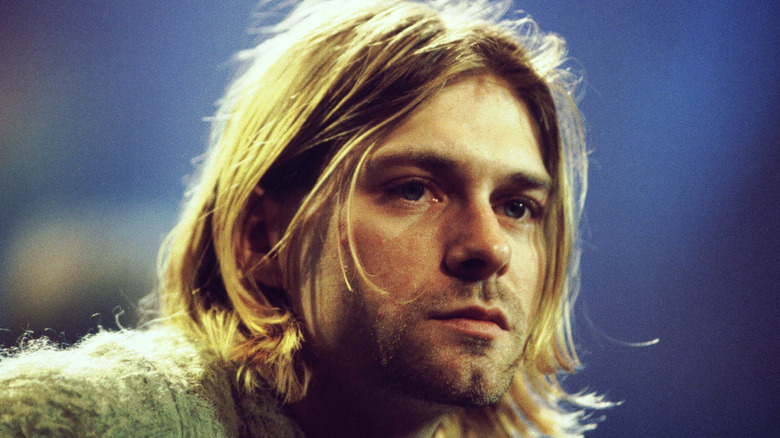
Looking back at the 1990s, the rise of grunge rock now seems both surreal and inevitable. Wrinkled flannel shirts were suddenly a fashion craze as Seattle became music's ground zero, with band after band churning out guitar-heavy rock that sounded simultaneously familiar yet like nothing that had come before. "Seattle was doing something different. We were very aware of that," Soundgarden guitarist Kim Thayil observed in an interview with Pete Thorn. At that time, however, that singular Seattle sound had yet to be labeled. "We didn't think it was grunge," Thayil explained. "That became some marketing thing later."
Blending elements of punk, Led Zeppelin-style guitar bombast, and a tendency toward dark subject matter, the grunge sound soon became inescapable — as did the grunge attitude. An extended middle finger to the synthesizer-heavy music that had ruled radio during the previous decade, grunge was an open-handed slap in the face to vapid pop, bland boy bands, and Baby Boomer groups charging fans a fortune to regurgitate their '70s hits in concert.
Grunge had a good run, albeit a short one, ultimately collapsing under its own weight in the mid-1990s, after Nirvana ended abruptly with the death of Kurt Cobain. While many of the songs that came from that era have gone on to become classics, defining what it is and isn't grunge is open to a huge degree of interpretation. That said, it's safe to say that these five songs define '90s grunge.
Smells Like Teen Spirit — Nirvana
If one had to single out just one song that captured the sound, feel, and ethos of '90s grunge, there is one obvious choice: "Smells Like Teen Spirit," the breakout single from Nirvana's groundbreaking 1991 album "Nevermind." As subversive as the album's cover art was — a naked baby swimming underwater, seemingly chasing a dollar bill affixed to a hook on a fishing line — the music contained on the album itself was even more so, pure nihilistic teen rebellion.
The lyrics, written by frontman Kurt Cobain, tapped into the inherent awkwardness of adolescence when he sang, "Here we are now, entertain us / I feel stupid and contagious." Combining rage with ambivalence, Cobain caps the song off by declaring "Oh well, whatever, never mind," before returning to the chorus, in which "hello" morphs into "how low."
Sonically, the song set a template that would serve Nirvana — and, to be fair, many of their imitators — well: beginning quietly, the musical tension slowly builds until it finally explodes in a burst of ear-splitting guitar distortion. And while the song's title was Cobain's joking comment on the titular deodorant marketed to teenagers, the lyrics were intended to shake up the indifferent youth of an apathetic nation. "It has revolutionary themes, but I don't really mean it in a militant [light]," Cobain said in a 1991 interview, via "Nirvana: The Chosen Rejects." "The generation's apathy is getting out of hand. [I'm] pleading to the kids, 'Wake up!'"
Even Flow — Pearl Jam
Another band to emerge from the Seattle grunge scene, Pearl Jam rose from the ashes of two earlier bands — Green River and Mother Love Bone — with San Diego import Eddie Vedder providing the secret sauce as frontman. When considering the untold truth of Pearl Jam, it's important to remember that the band's debut album, "Ten," was released shortly before Nirvana's "Nevermind." The album contained a smorgasbord of songs that would become classics, including "Alive," "Black," and "Jeremy." However, standing above all those was the album's towering triumph, "Even Flow."
Kicking off with a thunderous guitar riff from Stone Gossard, fellow guitarist Mike McCready adds bluesy licks and various accents. While listeners didn't realize it at the time, they were listening to a song that embodies all the elements that would eventually come to define grunge, including heavily distorted guitars, Vedder's booming and intense vocals, and a sense of controlled chaos demonstrated in the song's dynamic shifts from dark to light.
When recording the song, "Even Flow," took numerous takes to get right, something that Gossard blamed on his perfectionism. "It was overthinking," he said when the band was interviewed on "The Howard Stern Show." "You know, when you're working on something that you're in love with, and you think, 'Well, it's not quite there yet,' and then you look back on it and go, 'It was probably any one of those first five takes would've been fine."
Black Hole Sun — Soundgarden
The same Seattle grunge scene that nurtured Nirvana and Pearl Jam also brought us Soundgarden. Featuring lead guitarist Kim Thayil and vocalist Chris Cornell, the band's third album, "Badmotorfinger," dropped in 1991, bolstered by hit singles "Jesus Christ Pose," "New Damage," and "Rusty Cage." It was their next album, though, that really broke through, largely on the strength of the single "Black Hole Sun."
With a title like that, it's not surprising that the song oozes darkness, a slow, plodding dirge that showcases Cornell's stunning vocals as it builds to a crescendo. Unlike anything the band had done before, the song was nevertheless unmistakably Soundgarden. "Superunknown" producer Michael Beinhorn realized "Black Hole Sun" was something special, more than just the sum of its parts.
He told UnCut: "When so many elements that are exceptional in a piece of music converge on one point and interweave so beautifully ... The melodic nature, the unusual chord structure, the way he starts with these arpeggios that cannon through the whole thing. And then there's the mood. There's something beautiful about it, something wistful and something dark too."
"Black Hole Sun" quickly became the band's biggest hit, taking the band into the mainstream; as Soundgarden bass player Ben Shepherd jokingly told UnCut, it was "the sound of the underground going overground." The song's timelessness was demonstrated in 2024, when media frenzy over a solar eclipse led "Black Hole Run" to return to the charts, ultimately hitting No. 1.
Would? — Alice in Chains
Led by singer Layne Staley and guitarist Jerry Cantrell, grunge pioneers Alice in Chains adopted a harder-edged sound than many of their contemporaries, drawing inspiration from heavy metal. When the band's debut album, "Facelift," was released in 1990, the album paved the way for the other Seattle bands that would follow them to fame — the single "Man in the Box," in fact, received a Grammy nomination for best hard rock performance. It was the band's follow-up, though, 1992's "Dirt," that really established the band's unique sound. Taken together, those two albums can now be seen as prime examples of early-'90s grunge, and the song that encapsulates all of it is "Would?"
"Would?" immediately takes listeners on an emotional journey, thanks to Staley's moody and emotive vocals. Driven by Cantrell's droning guitar, the song is both haunting and powerful, conjuring up a dark and brooding atmosphere (the song was inspired by the death of Cantrell's close friend Andrew Wood, lead singer of seminal Seattle group Mother Love Bone and its offshoot, Temple of the Dog).
"Would?" is a deeply dark song, the centerpiece of a dark album, something Cantrell acknowledged in an interview with Metal Hammer. "It's probably the most focused we've ever been, the most complete record we've made, it's a brutal record with some real force, and I mean that in a very good way," he said. "It's an amazing record, it's probably our crowning achievement."
Plush — Stone Temple Pilots
One of the rare grunge bands to originate in a place other than Seattle, Stone Temple Pilots was founded in sunny San Diego. While there are different camps on whether they are true grunge, the early music the band produced was easily categorized as grunge as demonstrated by the band's 1992 debut album, "Core." The album was an out-of-the-box hit, spawning four hit singles: "Sex Type Thing," "Wicked Garden," "Creep," and "Plush." The latter song became the band's breakout, rocketing to No. 1 on Billboard's Mainstream Rock chart.
The song propels the listener forward with a slow, relentless riff, heavy metal with a tinge of glam. Interviewed by Rick Beato, STP guitarist Robert DeLeo (who co-wrote the song with frontman Scott Weiland) explained he left the chord progression basic so the other instruments could stand out as well. "It's very simple," DeLeo said while strumming the "Plush" chords on an acoustic guitar. "It's almost like a country song."
When Weiland's voice enters, however, his powerful pipes propel "Plush" to a whole other level. To describe the song's lyrics as dark is an understatement, hinting at some horrific circumstances when he sings, "I feel when the dogs begin to smell her / Will she smell alone?" As Weiland explained when introducing "Plush" on "VH1 Storytellers," the lyrics were inspired by a story he'd read about a girl who was kidnapped and murdered. "However, this song is not about that, really; it's sort of a metaphor for a lost, obsessive relationship," he explained.