

5 Country Songs We Know Would Go Hard As Rock Covers
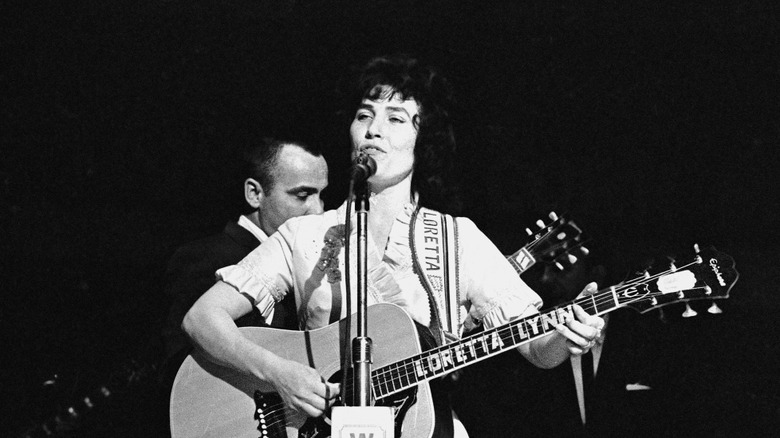
A new-genre cover can completely reinvent a song: think Whitney Houston's belting showpiece version of Dolly Parton's intimate tearjerker "I Will Always Love You" or Johnny Cash's creepier-than-the-original cover of Depeche Mode's "Personal Jesus." Rock and country, with their shared roots and overlapping, avid fanbases, provide some great opportunities for bold artists to take a country song, mess its hair up a little bit, and send it onstage as a rock anthem.
The songs here would stand up to a harder beat, faster rhythm, and more aggressive vocals while still recognizably being versions of the originals, and they speak to broad enough themes that rock fans would give them a listen (we're not doing a lot about trucks here). We're avoiding borderline crossover hits like "The Night the Lights Went Out in Georgia" (on which Reba McEntire absolutely does rock) and Elvis Presley's early stuff; the line between country and rock isn't hard and fast, so we're picking songs that more clearly fall on the country side of the line. Some of these may well have received a "rock cover" at some point, but none of them have a particularly famous one. The gauntlet is down, rockers. Can y'all pick up where Patsy Cline left off?
Walkin' After Midnight — Patsy Cline
Patsy Cline knew exactly how to use her voice to its most devastating effect: the same woman who yelps, growls, and yodels on her early recordings is the same one who murmurs the broken, aching "oh" as she begins the refrain to "Crazy." "Walkin' After Midnight," the song of restless obsession and late-night wandering, brought her to the country's attention as her star was rising in the late 1950s and was one of her three biggest hits, along with the slower, sadder "Crazy" and "I Fall to Pieces."
The relentless rhythm of "Walkin' After Midnight" could speed up just a tad, turning the walk from an amble into an antsy, nervous pacing. An artist with a little scratch or gravel in their voice to differentiate their version from Cline's satin-smooth vocals, and who could really sell the key change as it swings into the higher register before the finish, could get a whole stadium on their feet at any hour of the day or night.
Fist City — Loretta Lynn
Loretta Lynn didn't have an easy life, but for every sad song about the hard times, she gave fans at least one funny, ironic, or energetic one. "Fist City" is all three. The song narrates a confrontation, with a woman giving her romantic rival a last warning before it gets physical. The lyrics are witty and aggressive: "But the man I love, when he picks up trash/ He puts it in a garbage can" is the tip of the rancorous iceberg. This other woman is on Lynn's territory, and she'll be moving along, with the only question being if the door hits her in the butt on the way out.
"Fist City" is a great cover opportunity for a singer who knows, like Lynn did, how to play. Modern audiences might be tempted to blame the man, but Lynn didn't need you to like her song's narrator; she needed you to root for her. Sure, you might not want to sit next to this woman on the verge of starting a bar fight, but we all know where she's coming from. A singer who can play it with a wink could top the charts, and flipping some pronouns to build a queer love triangle could make the song even spicier for a modern crowd.
Whiskey River — Willie Nelson
Without whiskey, rock music would have had a very different history. Without heartbreak, arguably we wouldn't have country music at all. So Willie Nelson's "Whiskey River," about flushing a woman out of your memory with as much booze as it takes, is a clear choice for a rock cover that takes Nelson's wry, not-yet-pitiful-but-getting-there and ups the anger without getting maudlin.
Nelson has performed the song at different tempos throughout his career, with the faster versions being drinks-in-the-air, holler-along bench-clearers: People absolutely love yelling "Whiskey River take my mind," especially once they've begun that very process. Imagine a version by a big-voiced belter who can coat the delivery with a layer of sarcasm. Most people may not actually want to get drunk because they're sad over a woman, but many have, just to get that deal out of their head for a night. Show us a version from someone who resents that he's still thinking about her.
The King is Gone (So Are You) — George Jones
"The King is Gone (So Are You)" sounds more like a fever dream than a minor hit. According to the lyrics, George Jones, sad over a woman who's left him, pours whiskey out of a bottle with Elvis Presley on it into a jelly bean glass bearing Fred Flintstone's image. Eventually, he gets so drunk that he asks the King and Bedrock's most famous citizen for their advice (which is not especially good). It sounds terrible, but it's perfectly tailored to Jones' style. Plus, everyone knew Jones had issues with alcohol and had tanked his marriage to Tammy Wynette, so the lyrical content rang truer than Jones may have wished.
The Highwaymen and Blake Shelton both covered the tune, but they don't really cross into rock. While Elvis and Fred Flintstone have remained perfectly relevant touchstones, a playful version could pour a new artist's worth of whiskey into a different cartoon character glass. The artist who talks about his romantic woes with Homer Simpson and Jones' own ghost could transcend the novelty value with a punchy delivery (and, perhaps, a tabloid history of their own relationship train wrecks).
Stand By Your Man — Tammy Wynette
Tammy Wynette released "Stand By Your Man" in 1968, the year before her ultimately unsuccessful marriage to George Jones, which must have come to seem like a grim prophecy as she tried to make things work with her fellow country star. The pitiful — some might say doormat — lyrics alienated some listeners despite the track's success, and it remained enough of a cultural phenomenon 24 years later that Hillary Clinton swiped at Wynette in a televised interview in 1992. (Wynette, to her credit, clapped back.)
But what if you replaced Wynette's plangent vocals and forgiving delivery with something much sharper? What if a singer with a talent for phrasing and the necessary vocal control to deliver some elegant savagery turned the appeal into a question — stand by my man? Really? After he pulled this? An acidic, satirical take — a perfect fit for rock — could update Wynette's hit for a modern audience less interested in through-thick-or-thin devotion than in standing up for oneself. By the end of her life, and five husbands later, Wynette might even have agreed.