

The Most Controversial Songs Of 1975
Many of the songs you'll find on today's Billboard Hot 100 would have caused an uproar were they released 50 years ago, when the idea of openly adult themes, the use of curse words, or the idea that a song might simply be in bad taste sometimes caused tracks to be banned by radio stations and pulled from record shelves. That doesn't really seem to be the case today — just look at the incredibly explicit "WAP" by Cardi B and Megan Thee Stallion — the controversy helped take the track straight to No. 1.
But go back half a century and you'll find that songs that today sound utterly innocuous attracted a barrage of criticism back in the day. Culture was changing at a rapid pace in the 1970s, a time when certain rock bands were accused of being Satanic (we're looking at you, Black Sabbath) or else were considered to be a little too suggestive in their performances (Led Zeppelin, for one). Here are five tracks that rattled the cages of listeners by either pushing the boundaries of taste and, in doing so, helping shape the culture of today, or else wrestling with social issues in a way that made some uneasy. And in one notable instance, a song that was once a hit has become so controversial that its creator no longer plays it.
Loretta Lynn — The Pill
Loretta Lynn was both a darling of the Nashville country music scene and an artist who was always willing to go her own way. And nothing in her discography demonstrates her willingness to address real world topics and be direct with her audience as "The Pill."
Tapping into her own experiences of being tied down with children at a young age while her adulterous husband was free to do as he pleased, "The Pill" was a celebration of the liberation that young women could enjoy as a result of the new breakthrough in contraception. Though she hadn't benefited from the contraceptive pill herself, Lynn was open about the fact she would have used it if she'd had the chance, telling People magazine at the time: "If I'd had the pill back when I was havin' babies, I'd have taken 'em like popcorn" ... "The pill is good for people. I wouldn't trade my kids for anyone's. But I wouldn't necessarily have had six, and I sure would have spaced 'em better" (via Country Reunion Music).
The song was popular, hitting No. 5 in 1975 on the country chart and No. 70 on the Billboard Hot 100, her highest chart placing at that point. According to Billboard, pop DJs had become interested in the song after news that some country stations had banned the song, considering the content offensive. Meanwhile, the famous Grand Ole Opry was seemingly discussing whether to bar Lynn from singing the song on its stage. While Lynn may or may not have meant the song to be tied to women's reproductive rights, audiences saw it that way, and conservatives weren't ready for a song that celebrated women's liberation. The singer herself was nonplussed, telling Song Facts in 2016: "I didn't have the money to take it when they put it out, but I couldn't understand why they were raising such a fuss over taking the pill."
Bob Dylan – Hurricane
Bob Dylan quickly made a reputation for himself in the early years of his career for being able to craft deeply affecting, attention-grabbing protest songs that focus on real-life injustices, with his songs fitting into his greater activism in support of the Civil Rights Movement. His 1975 classic, "Hurricane," was a later protest song effort, co-written with Jacques Levy, which tells the story of Rubin "Hurricane" Carter, a promising boxer who was falsely imprisoned after being found guilty of murder in 1966. Carter's supporters were convinced the boxer was innocent, and Dylan, who read Carter's autobiography, was moved to visit him in prison. After becoming convinced Carter was innocent, he wrote the song arguing that there had been a racially-motivated conspiracy to frame him.
The song remains somewhat controversial today for Dylan's use of a racial slur in the song. Though it is put in the mouth of a racist character within the song, some would consider even artistic use of such words offensive, and broadcasters have debated whether the song is suitable for the airwaves. And while it is now widely accepted that the boxer was wronged by the legal system, at the time, Carter's case and Dylan's support of it were controversial because others remained certain that he was deserving of his sentence; even after pressure from campaigners for a retrial, Carter's sentence was upheld in 1976. Dylan's song spooked his record label, which feared that it might be libelous, and indeed, in 1979, eyewitness Patricia Valentine, who testified as an eyewitness in Carter's trial, sued Dylan, Levy, CBS Records, and Warner Brothers Publications Inc. for defamation of character and invasion of privacy, though a federal appeals court ruled against her. Carter was finally released in 1985, after serving nearly 20 years in prison.
Donna Summer – Love to Love You Baby
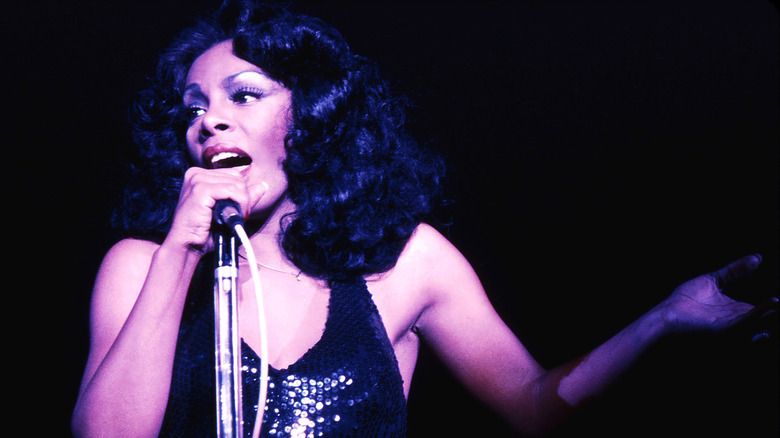
The disco boom of the mid-1970s may have been inoffensive to most (except swathes of rockers who hated the new genre with a passion), but one track from 1975 caused outrage like no other. Donna Summer's seductive "Love to Love You Baby," a gently uptempo track which alternates between Summer's siren-like repetition of the refrain, hushed exhortations to a would-be lover, and what can only be described as intentionally suggestive moans of pleasure.
The original version stretched to nearly 17 minutes and caused a wave of excitement in the American music press , during which Time magazine counted 22, let's say, climactic moments. Though the single version clocks in at around four and a half minutes, there are plenty in the short version, too. Summer and her team had modeled the song on the shamelessly intimate "Je T'Aime," which had been a hit for Jane Birkin and Serge Gainsbourg in 1969.
But while "Love to Love You Baby" became a classic, it faced some controversy on its release. Most notably, it was banned by the BBC, to little effect in terms of its chart performance. The single peaked at No. 4 in the U.K., while staying on the Billboard Hot 100 for 18 weeks, climbing all the way to No. 2
Alice Cooper – Only Women Bleed
Alice Cooper may be one of rock music's cuddlier veteran figures nowadays, but in 1975, he had the power to rustle some feathers, as he did with the song "Only Women Bleed." The track features on Cooper's debut solo album "Welcome to My Nightmare," and was written with co-writer Dick Wagner. Wagner had first drafted the music as early as 1968, but had been unable to come up with good enough lyrics to match it. Cooper had been considering writing a song with the title "Only Women Bleed" for some time, and drafted his lyrics after hearing Wagner's work. The result was an affecting ballad that confirmed Cooper's position as a mid-'70s star, hitting No. 12 on the Billboard Hot 100.
Though it's now considered a classic in Cooper's oeuvre, it created a wave of controversy upon release, when it was believed that the title referred crudely to menstruation or was treating violence against women flippantly. Indeed, in some markets, the title was considered so brazen that it was listed simply as "Only Women." But listen closer, and the song in fact carries an anti-domestic violence message, and for years "Only Women Bleed" remained a mainstay of Cooper's stage shows, in which it provided an empathetic change of tone from the shock rock tracks that populated his set lists.