

Elton John Predicted Queen's Biggest Hit Would Fail. His Diss Is What Made The Song Iconic
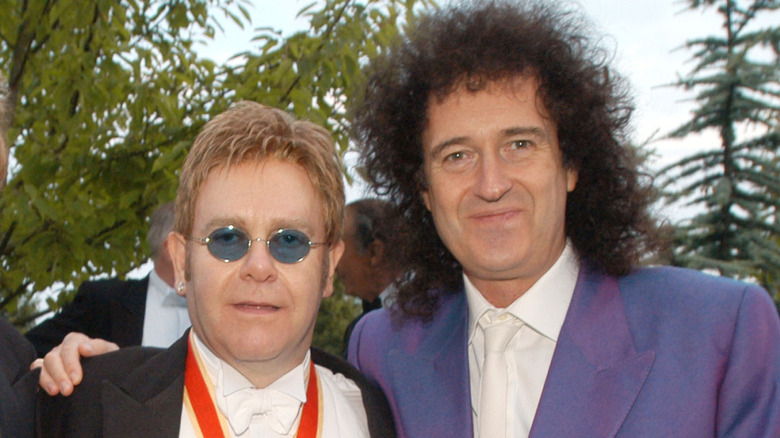
Probably nobody knew the temperature of rock in the mid-1970s as well as Elton John did, as he was the biggest superstar of the era — his opinions could be taken as fact. However, his dismissal of an ambitious song by an up and coming rock band wasn't just completely wrong, it's what helped propel the tune to the charts and legendary status. The 1970s music industry was just that messed up: a song as monumentally famous, important, and popular as "Bohemian Rhapsody" by Queen just as easily could've never been released if enough people heeded the warning of one established rock star.
"Bohemian Rhapsody" is the third-best-selling single in U.K. history from two separate chart runs, one in 1975 and the other in 1991, shortly after the day that frontman Freddie Mercury died. In the U.S., it was a Top 10 hit and sold half a million copies in '75, and in 1992, it came back to peak at No. 2 after it was prominently featured in the comedy film "Wayne's World." It frequently appears high on lists ranking the best songs ever made. John and Mercury were even very good friends, with the former performing at the latter's posthumous tribute concert. What Queen song did John sing? "Bohemian Rhapsody." He'd apparently changed his tune after the world proved him wrong. Here's how "Bohemian Rhapsody" became one of the biggest songs of all time despite John's insistence that it would flop.
Elton John thought Bohemian Rhapsody was perilously lengthy
While prog bands like Pink Floyd were pushing rock in new directions, short and direct songs remained the standard in the mid-1970s. But then Queen got to work on "Bohemian Rhapsody," a six-minute rock epic. It consists of several parts: a capella section, a piano ballad, a call-and-response operatic bit, a total rock-out, and a melancholy coda. Through it all, Freddie Mercury belts out lyrics that are convoluted and strange. He once told a friend his words were "rhyming nonsense" (via Rolling Stone), an idea bolstered by the use of obscure terms like "Scaramouche," "fandango," and "magnifico." Studio techniques were utilized to stack guitar tracks and voices, giving the impression that as many as 200 singers participated. "We really enjoyed the silliness of it," drummer Roger Taylor told Rolling Stone. Record executives thought "Bohemian Rhapsody" was a bit too long to be commercially viable, but they didn't deny a release.
Only one prominent musical figure stated his distaste for the track. John Reid, Queen's manager of only a few months at that time, was in a relationship with Elton John, whom he made privy to the "Bohemian Rhapsody" process. "He said, 'Are you f***ing crazy?'" Reid remembered. "'That will never be a hit. It's too long!' He was adamant." But the opinions of a manager's boyfriend are not contractually binding, so Reid and Queen ignored John's comments. "Bohemian Rhapsody" hit the airwaves in the U.K. in 1975, and it was an instant smash.