

5 Songs From 1978 That Define Rock History
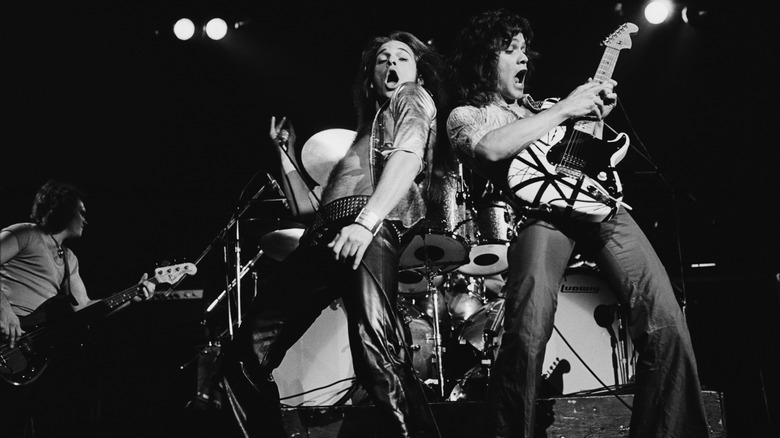
Although the 1970s was unquestioningly dominated by rock, the genre changed quite a lot over the course of the decade. 1973, for instance, saw major rock releases from the likes of David Bowie, Led Zeppelin, Pink Floyd, Lynyrd Skynyrd, and Aerosmith. A mere five years later, in 1978, we've got Talking Heads, Kate Bush, The Cars, The Clash, and The Police, to name a few. The classic rock of the '60s was all but gone by then, and the transition to the '80s was well underway. In such a state of flux, certain songs rose to the top to define rock history.
Because rock was in an odd place come 1978, not what it was nor fully what it would be, our songs have to exemplify that time. Rock was also dividing further into new wave, punk from both sides of the Atlantic, glam and nascent hair bands, roots rock, rock-enough synth-pop, etc. We've got to sample all such flavors in our article. And while our song choices might have influenced the course of rock history, they "defined" it in that they represent a snapshot of the times. Finally, we've got to consider everything from guitar technique and songcraft to artistic ethos and musical influences.
With all of that in mind, it goes without saying that Van Halen's "Eruption" fashioned the mold for all '80s hair bands to come and overhauled what guitarists thought playable on their instruments. Meanwhile, a song like "Miss You" from The Rolling Stones showed that established acts could update themselves for the times and draw from non-rock influences (disco, in their case). Songs from Bob Seger & The Silver Bullet Band, The Police, and Cheap Trick complete our portrait of the year.
Eruption — Van Halen
Accuse Van Halen of being puffed-up narcissists all you like, but the band wrought the template for '80s bands to come, right down to the frizzy hair, preoccupation with flash and pomp (and taking things too far), fretboard fireworks, and indulgence in the holy trinity of sex, drugs, and rock n' roll. The group released its self-titled debut album in 1978, which didn't catch on immediately but snowballed in impact and popularity to sell over 10 million copies. Right after the first song sat an unassuming, micro-length instrumental piece that changed guitar playing forever: "Eruption."
Mention "Eruption" to any guitarist, and you're likely to see the person swoon or gush. At less than two minutes long, the track is essentially a guitar solo without the rest of its song. Featuring Eddie Van Halen and Eddie Van Halen only, "Eruption" single-handedly (or two-handed tappedly) ushered in an entirely new, inventive method of playing the guitar that relied on the kind of hammer-ons/pull-offs that lead guitarists today take for granted in their repertoire. "Eruption" is arguably overwrought, but Van Halen's guitar work is undeniably talented, especially for a guy who never learned to read sheet music one whit.
We can take "Eruption" as indicative of the musical desire to stretch the limits of physical, mechanical playing without expanding composition in a proggy, '70s way. The ending stretch of the song practically sounds like Bach but also threatens to shred your face clean off. "Eruption" also foreshadowed '80s cockiness and showmanship, full of glitz and pizzazz that, in the hands of musicians of a lesser caliber than Van Halen, would prove little more than hollow and hardened by hairspray.
Miss You — The Rolling Stones
It's odd to think that the same band that wrote 1968's "Sympathy for the Devil" also wrote 1978's "Miss You." The former is a piano-driven track laden with congas and complex percussion, while the latter is basically a disco track with a groovy, syncopated bassline. But then again, there's something that ties the two Rolling Stones outings together: danceability. It's not that the Stones sold out or morphed beyond recognition with "Miss You" — it's more that the group allowed late '70s musical trends to seep into its music and produce a contemporary song that still retained the band's sound. That's one reason why the Stones stuck around as other older rock bands shrank into irrelevancy.
This description ought to make it clear why "Miss You" defined rock in 1978 and in the late 70s, writ large. The times they were a-changin', and the musical world was well beyond 1967's wild Summer of Love, 1969's Woodstock, and the '60s entire counterculture, no matter how its music shaped the rock of the '70s. Bands like The Rolling Stones, which released its first album in 1964, the year after The Beatles' debut, ran the risk of falling out of fashion. But with "Miss You," the Stones bridged the past and present while proving that neither needed to compromise the integrity of the other.
"Miss You" smashed the Stones' expectations and reached No. 1 on the Billboard Hot 100. It did so because the band members followed their instincts when writing it. As Ultimate Classic Rock quotes guitarist Ronnie Wood: "We thought just about the beat, you know?" This approach and result are quintessentially Stones as much as they are rock, come 1978 or any year.
Old Time Rock & Roll — Bob Seger & The Silver Bullet Band
On the completely opposite side of the rock spectrum from The Rolling Stones, we've got Bob Seger & The Silver Bullet Band's 1978 smash hit "Old Time Rock & Roll" from "Stranger in Town." Rather than soak in the times, Seger rejected them. "Old Time Rock & Roll" is a direct, defiant snub of modern musical trends, right down to lines like, "Don't try to take me to a disco / You'll never even get me out on the floor." Yet despite this defiance, the song is jovial and sounds more like a Little Richard '50s piano blues bopper than anything else. It's a romp that recaptures, in music, the youthful energy and luster that it reveres.
But Seger didn't even write the music. He was in his mid-30s at the time, needed a hit following 1976's "Night Moves," was in danger of fading into obscurity (much like classic rock itself), and agreed to include "Old Time Rock & Roll" on "Stranger in Town." Alabama's famed Muscle Shoals Rhythm Section delivered the song to Seger, who reworked the verse lyrics into some of the song's most memorable lines, like "Just take those old records off the shelf / I'll sit and listen to 'em by myself." The song did fine, but it really took off once a young and pantsless Tom Cruise danced to it in 1983's "Risky Business." This is how "Old Time Rock & Roll" stood at the intersection of musical periods — longing for what came before but needing the present to stay alive. Now, it's all but the most iconic of classic rock songs, speaking for all of those who pine for lost glory days.
Roxanne — The Police
Even as old rock outfits struggled to find their place in a changing, late-70s musical landscape, new hybrid acts emerged with completely different takes on what "rock" meant. And while this window of time through the '80s produced a bevy of new wave acts, we've got to give our nod to The Police for hitting the zeitgeist at just the perfect time. The group's 1978 debut album, "Outlandos D'Amour," perfectly encapsulated the need for something new amongst the music-listening public, especially its first single, the reggae-leaning pop-rock track "Roxanne."
No matter that "Roxanne" originally reached No. 32 on the Billboard Hot 100, put The Police on the map, and opened the door further for other new wave groups, it had difficulty getting off the ground. It wasn't a high-tempo, blazing punk track, was weirdly proggy-jazzy, and generally didn't fit neatly into any one category. It was also banned by the BBC (a butt-clenching reaction not new to rock) because it was basically a song about sex workers inspired by Sting's real late-night wanderings through Paris' red-light district.
Critics loved "Roxanne," the British establishment canned it, and it took some roundabout radio station airplay for the song to take off — in Texas, no less. The Police didn't even have a U.S. record deal at the time, and America's A&M approached the group once "Roxanne" reached Boston radio stations. So it was that the debut single from The Police took off in a kind of grassroots, non-corporate way that mirrored the soul of rock in a new wave garb and relied on public opinion for success.
Surrender — Cheap Trick
Few songs so perfectly define rock's nascent pop-punk branch come 1978 than Cheap Trick's "Surrender" from the album "Heaven Tonight." Laid back but not dull, energetic but not frantic in a Sex Pistols kind of punk way, pared-back and hooky but instrumentally lush enough to carry emotional weight — "Surrender" is probably the best example of radio-friendly, accessible rock music from the late '70s. It's even got a unique, oddly heartwarming message rooted in misunderstandings between parents and children. And since rock has always held tension across generations, this meaning gives the song another feather in its cap.
Indeed, Cheap Trick wound up speaking for every teen alive when guitarist and songwriter Rick Nielsen penned lyrics like, "Mommy's alright, Daddy's alright / They just seem a little weird." As he told Rolling Stone, "I [had] to go back and put myself in the head of a 14-year-old." Everyone at that age, he told Uproxx, always called each other's parents weird. "Hey, you want to come over to my house?," "No, your parents are weird," he cited. As "Surrender's" lyrics say, these parents were a by-product of their generation's conflicts: "Before we married, Mommy served in the WACs in the Philippines / Now I had heard the WACs recruited old maids for the war." But, as Nielsen explains on Uproxx, "You've got to listen to them [your parents], but you don't always have to heed it. That's 'Surrender' — don't give yourself away."
Few sentiments could so perfectly encapsulate rock in the late '70s, as a new generation of young people were trying to find their way through life with music as their constant companion. This, plus the song's aforementioned musical merits, round out rock history in 1978.