

5 Covers Of '70s Tracks That Became High School Hits For Millennials
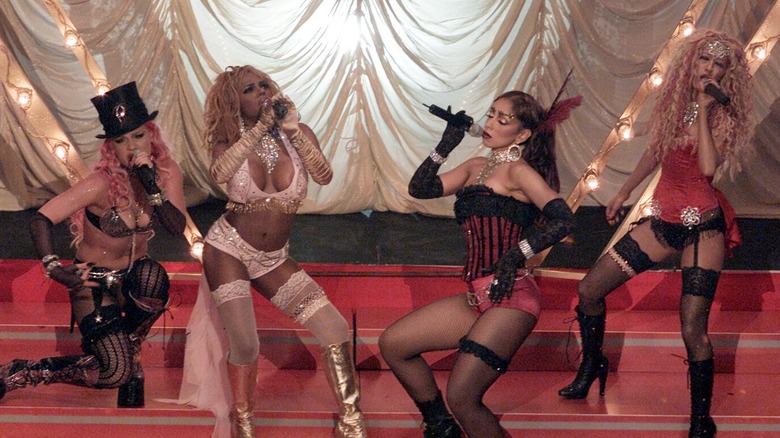
Humanity's love for music knows no age boundaries, but each generation would understandably have its own favorite songs, especially while growing up. Millennials (people born between 1980 and 1996) are certainly no exception. With that said, not all songs that millennials grew up listening to were new; a fair number were actually covers of '70s songs. During the high school years of millennials, so-called for coming of age at the turn of the millennium (from the latter half of the '90s to the early 2010s), some musicians put their own spin on those decades-old songs, incorporating sultry vocals and pop beats into classic rhythms with meaningful lyrics.
Much like our list of high school hits every teen of the '90s will remember forever, this list doesn't attempt to cover every single '70s song cover that came out during millennials' high school years. Instead, we selected '70s originals that received significant attention, did really well on the charts, or simply felt like you couldn't turn a corner or enter a music store without hearing them. Additionally, we didn't factor in critical reception: Not all the covers on this list were well-received by music connoisseurs at the time of their release, and some were even deemed to be inferior to their '70s counterparts.
Without further ado, these are the '70s songs that made it onto many millennials' playlists when the Walkman and Discman were gradually giving way to MP3 players and iPods.
Fugees - Killing Me Softly With His Song
In 1972, Lori Lieberman released "Killing Me Softly With His Song" as part of her self-titled album. A year later, Roberta Flack recorded her take on it, which became the better-received and more recognizable version. More than two decades later, in 1996, the hip-hop group Fugees put their own spin on the classic, infusing the emotional ballad with an all-new energy and introducing it to a new generation of listeners.
Lieberman's original version was a slow folk song, while Flack's was a soul jazz song with a powerful yet melancholic vibe. In the Fugees rendition, Lauryn Hill starts singing the words in a mellow tone, until the hip-hop beat kicks in half a minute into the song. Hill's bandmate Wyclef Jean punctuates Hill's excellent performance of the original lines with short, playful chants ("One time! Two time!"). The entire song is an irresistible bop, the kind that you wouldn't be able to resist nodding your head to. Unsurprisingly, it became their most successful track from "The Score," the album they released that year.
"Killing Me Softly With His Song" has an undeniably timeless appeal, with the Fugees version perfectly fitting in with modern music sensibilities. Proof of this is the fact that, when Hill and Jean performed it at the 2026 Grammys, the audience — which included many celebrities who, no doubt, listened to this song in their youth — found themselves singing to the 30-year-old cover.
Christina Aguilera, P!nk, Mya, & Lil' Kim - Lady Marmalade
The 2001 film "Moulin Rouge!" provided an opportunity for four popular female performers to bring their signature styles together and create an updated version of a 1974 hit. Originally popularized by girl group Labelle, "Lady Marmalade" topped the Billboard Hot 100 upon its release. Similarly, the collaborative rendition by Christina Aguilera, P!nk, Mya, and Lil' Kim claimed the No. 1 spot on the Hot 100 for weeks.
The biggest change in the 2001 version is the addition of an entire rap verse for Lil' Kim. Apart from that, the diverse and unmistakable vocal styles of Aguilera, P!nk, and Mya successfully capture what made "Lady Marmalade" a hit, while giving it a fresh new sound and some slightly amended lyrics (which original singer Patti LaBelle reportedly uses now whenever she performs the song). Despite the fact that not all critics received it positively, it undeniably resonated with millennial listeners.
There's just something about the energy of this movie tie-in cover that feels so youthful and empowering; it's the right mix of raunchy and rock-and-roll, precisely the kind that gets young music-lovers singing and even dancing along. If you're among the millennials who were high schoolers when this version of "Lady Marmalade" hit the airwaves, don't be afraid to admit that this was the kind of song that had you confidently belting out "Voulez-vous coucher avec moi, ce soir?" even without knowing a lick of French.
Destiny's Child - Emotion
Destiny's Child's 2001 take on "Emotion" made it to our list of cover songs that sound better than the '70s original version – and if, at the time of this song's release, you were a high-school-age millennial who was familiar with both this and the 1978 original by Samantha Sang and the Bee Gees, you'd probably agree, too. Alternatively, you may also be among the people who didn't know that this was a cover, unless your baby boomer parents happened to listen to it with you and told you about the original.
A major reason why the 2001 version of "Emotion" became a ubiquitous musical presence that year was that it became a mournful anthem of sorts following the September 11 attacks, with its sad and soulful lyrics unintentionally capturing the fragility and uncertainty that gripped many of America's youth. Perhaps it's the harmonious way that the voices of Beyoncé, Kelly Rowland, and Michelle Williams blended together; a beautiful union that approaches the song differently from the give-and-take rendition of Sang (with her mellow, breathy lines and almost-whispers) and the Bee Gees' Barry Gibb (with his iconic falsetto).
Another factor in Beyoncé, Rowland, and Williams' "Emotion" successfully resonating with young millennials was the music video, which showed the trio in heartbreaking situations (a loved one leaving, perhaps for good; a dying relative; and an unfaithful partner caught in the act) that teenagers could easily relate to.
Toploader - Dancing in the Moonlight
Originally recorded in 1970 by American band Boffalongo, "Dancing in the Moonlight" was covered by French-American rock band King Harvest and released two years later, achieving a moderate level of success. But it was English rock band Toploader's 2000 cover — an undeniably peppy, albeit arguably overproduced, earworm — that truly made the song an inescapable hit in the U.K. and in other parts of the world.
While Boffalongo's version has a country-meets-pop-rock vibe and King Harvest's rendition blends soft rock and jazz, Toploader cranks the energy up to 11. Leading with a keyboard intro that somehow manages to strike a balance between "Christmas melody" and "elevator music," the band swiftly takes the song into techno-dance-pop territory, transforming rhymes that pine for an ideal world into a literal party anthem. In other words, exactly the kind of song that teenage millennials would leave on loop in their MP3 players.
Toploader's "Dancing in the Moonlight" has its fair share of haters, who criticize the mindless delivery of its lyrics and its supposedly cringe-inducing opening melody. Some have even observed that "Dancing in the Moonlight" is Toploader's sole hit. Still, there's nothing wrong with enjoying an instrument-heavy cover of a song that, for some inexplicable reason, fills you with a sense of nostalgia for simpler times. For jaded millennials, a reminder of their youth can be a supernatural delight.
Counting Crows - Big Yellow Taxi
Ask a random millennial to name their favorite Counting Crows song from their high school years, and there's a decent chance they'd tell you it's "Big Yellow Taxi." A song that, by the recollection of many, received significant airtime in the early 2000s, the band collaborated with Vanessa Carlton to release this 2002 cover of Joni Mitchell's 1970 environmental protest song. This updated version achieved middling success on the Billboard Hot 100, yet still became one of the band's most recognizable hits.
Disregarding the fact that Counting Crows committed the egregious sin of underutilizing Carlton's vocal and instrumental talents, the band succeeded in making its version of "Big Yellow Taxi" unmistakably its own. Singer Adam Duritz's distinct vocals sharply contrast Mitchell's emotive rawness, and the accompanying instruments make the song louder yet mellower than the original's folky guitars. However, this had the unfortunate side effect of burying the strong anti-establishment message of "Big Yellow Taxi" under a sea of faux-optimistic strumming and carefree ooh-bop-bop-bops; it's less "pro-environment rally" and more "overpriced coffee shop."
Still, it's hard to completely trash this pop-rock take on "Big Yellow Taxi," especially if you're the kind of young millennial listener who just wants to vibe to smooth jams on a lazy weekend afternoon. And if we're being honest here, that description probably fits the majority of millennial high school music lovers to a T.