

Strange Things About The Monkees You Don't Know
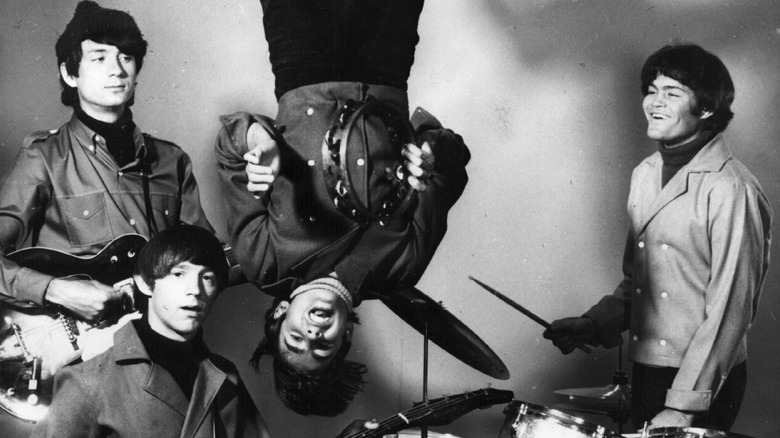
The Monkees were intact for only a few years in the late 1960s, but it was long enough to craft a story that's weird, surprising, and full of strange episodes and interactions. As far as popularity, the pop charts, and name recognition are concerned, the Monkees were among the most important rock bands of the 1960s, even though it wasn't actually a real rock band. For the first and most significant chunk of the Monkees' existence, Micky Dolenz, Davy Jones, Peter Tork, and Michael Nesmith only pretended to be a rock band, individually hired by producers for their charisma, appeal, and ability to pretend to play songs written and recorded by music industry professionals. It was all a calculated attempt to replicate the success of the Beatles with American talent, including a sitcom — also called "The Monkees" — that won an Emmy for outstanding comedy series.
After the four forced their overseers to let them make their own kind of music, the project fell apart and into the annals of nostalgia. But for when the Monkees were a going concern, roughly 1966 to 1968, there were few things in music or TV as big. It was a whirlwind time, full of bizarre experiences and sometimes dark anecdotes.
The Monkees were all accomplished performers
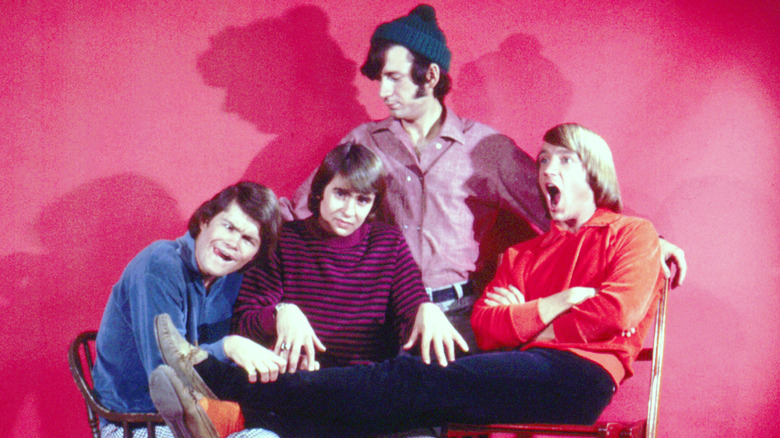
To project the idea that the Monkees were a real rock band, handlers had to present the four individual musicians and actors as unknowns. That may have helped sell the Monkees to its intended target audience of young Americans, but older adults, at least those with some modicum of pop culture awareness in the late 1960s, may have been confused or put off by the show or band when they recognized its members from previous high-profile projects.
Only about two years before the Monkees began, Davy Jones made a splash on Broadway in the showy role of the Artful Dodger in a hit production of "Oliver!," for which he was nominated for a Tony Award for best featured actor in a musical. Micky Dolenz had a long resume of acting roles, including the title role on the primetime TV series "Circus Boy" when he was 10 years old. Michael Nesmith was already active in the Los Angeles music scene prior to the Monkees, and had released a few singles and written songs for other artists, including "Different Drum," a hit for the Stone Poneys, a part of the early history of Linda Ronstadt. Finally, Peter Tork was a major figure in the thriving Greenwich Village folk scene of the early 1960s.
Each Monkee won the role thanks to their musical abilities, though oddly, they all may have been more comfortable with different roles in the band. For example, frequent lead vocalist Jones was a decent drummer, while bassist Tork was an excellent guitarist.
Those intimate Monkee interviews were priceless filler
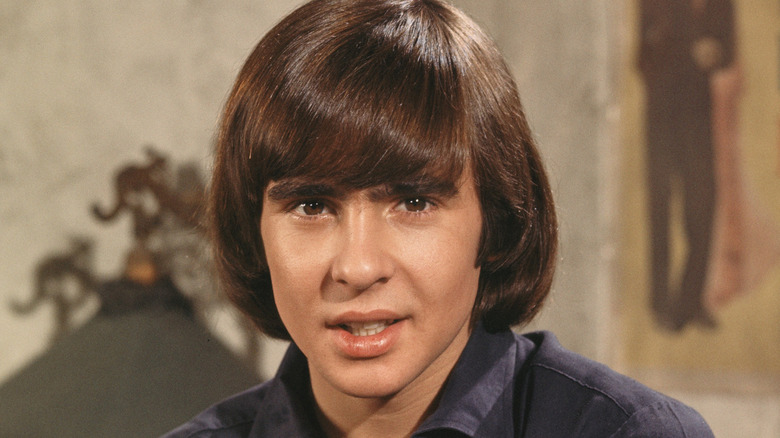
Among the ways that "The Monkees" television series was so innovative was how it mixed fiction with reality. Each member of the Monkees played a character with whom they shared a name and acted out scripted scenarios. They'd also ostensibly let down the facade and portray themselves in little segments that began appearing in episodes of "The Monkees" at the end of the show's first season. After editors had compiled the final cut of one installment, it was one minute too short, prompting producer Bob Rafelson, as an uncredited off-screen question-poser, to film off-the-cuff interviews with each of the Monkees. They responded truthfully and out of character to a serious query about what they'd do if the Monkees were to suddenly end.
In Season 2 of "The Monkees," the unscripted moments were included more often than not. They ranged from Peter Tork talking about the countercultural movement to Davy Jones talking about soul music with composer Charlie Smalls. Originally created to fill time, those bits showed off the real personalities of the Monkees, making them more engaging to the audience.
The Monkees were the Three Stooges for the '60s
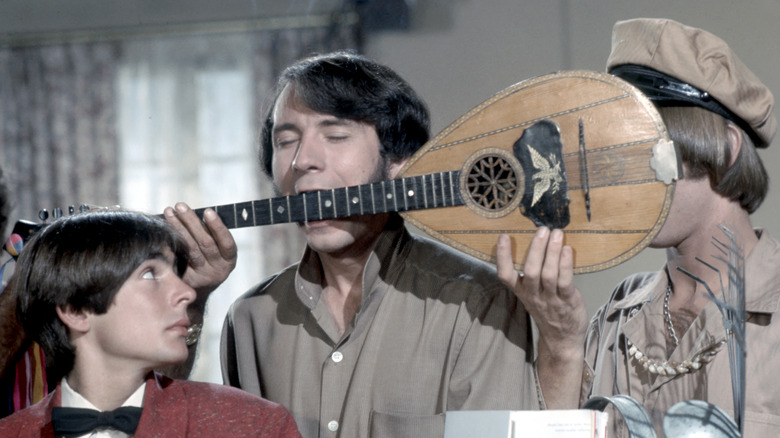
The story of "The Three Stooges" lived on well past the 1950s, when the trio stopped making theatrical slapstick shorts, and its successor was the Monkees in several different ways. Bob Rafelson and Bert Schneider, producers of the TV sitcom "The Monkees," saw to it that the four guys hired to play the eponymous anarchic rock band had an education in broad-screen comedy. "Before we started filming Bob and Bert had sat us down and screened movies by the Marx Brothers, Laurel and Hardy, the Three Stooges," Micky Dolenz wrote in "I'm a Believer: My Life of Monkees, Music, and Madness." "But they didn't want us to emulate anyone else, they wanted us to develop our own personalities."
Be that as it may, the influence of "The Three Stooges" manifested in other areas. "The Monkees" was made by Screen Gems, a division of Columbia Pictures, a historic Hollywood studio and producer of dozens of "Three Stooges" films from the 1930s to the 1950s. Countless costumes and props used on those shorts were still hanging around the complex where "The Monkees" was filmed, and the production frequently made use of them.
The deal with Michael Nesmith's hat
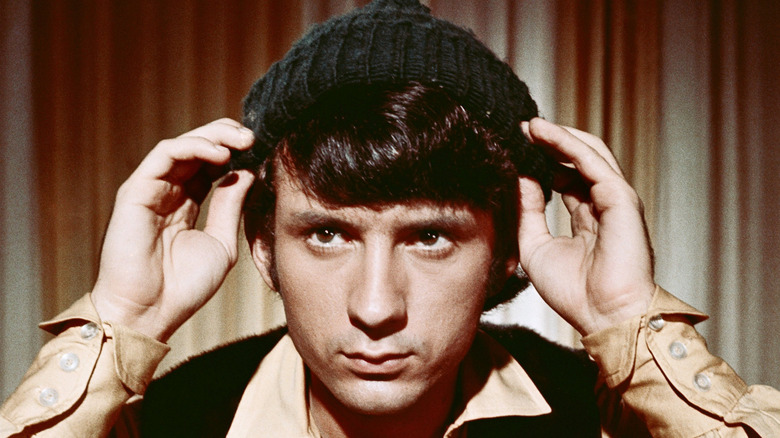
The opening credits and an ending sequence of every episode of "The Monkees" included a refresher on the band's members, allowing fans to put a face to the name. But Michael Nesmith will probably forever be known, at least informally, as the Monkee with the wool hat. He was rarely photographed or filmed without his warm winter cap — for which he'd paid $1.50 — and it's an element largely derived from happenstance.
Nesmith wore a green wool cap to his Monkees audition; he rode his motorcycle to the appointment, and the hat was to keep his hair safely in place. Producers immediately saw this as a visual hook, to the point where they thought it could be Nesmith's on-screen persona's entire personality. There was talk of naming his "Monkees" character "Wool Hat," until he threatened to quit. After the Monkees became hugely successful, mass-produced replicas of Nesmith's hat were sold to the public at around $2 a pop.
They tried to keep the Monkees locked up and out of the way
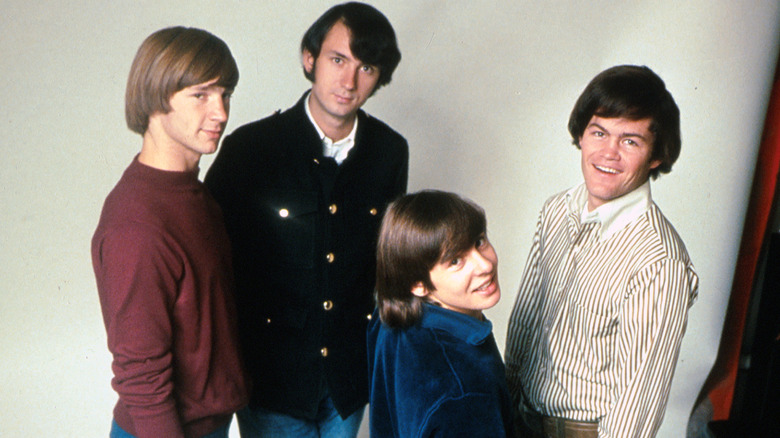
The members of the Monkees were initially not allowed to write their own musical material or play the instruments on the albums bearing their names and images. Furthermore, they were treated like an annoyance on the set of their titular TV show.
Instead of being given well-appointed dressing rooms or luxurious trailers to hang out in between shooting scenes, all four of the Monkees were watched over in a strange area at the Screen Gems production facility known as "The Black Box." Constructed beneath soundstages, the black-painted basement room afforded the Monkees a space where they could pass the time however they saw fit. Each Monkee got their own corner and their own call light — when it started blinking, it meant that they were needed on the set upstairs immediately.
Spending their days in a bizarre holding cell had a lasting effect on the performers. In 1968, after they'd been given some creative control over the Monkees brand, the foursome made the surreal, experimental, episodic movie "Head." Co-written by future three-time Oscar-winning actor Jack Nicholson, "Head" features some scenes with the Monkees stuck in a black box. Micky Dolenz told Mojo that all that was a "metaphor" for being in the Monkees, where all of the musicians' movements were determined and watched by handlers, but it also re-creates an exact situation the performers endured.
A Monkee spread a myth about the band's success, but it wasn't totally false
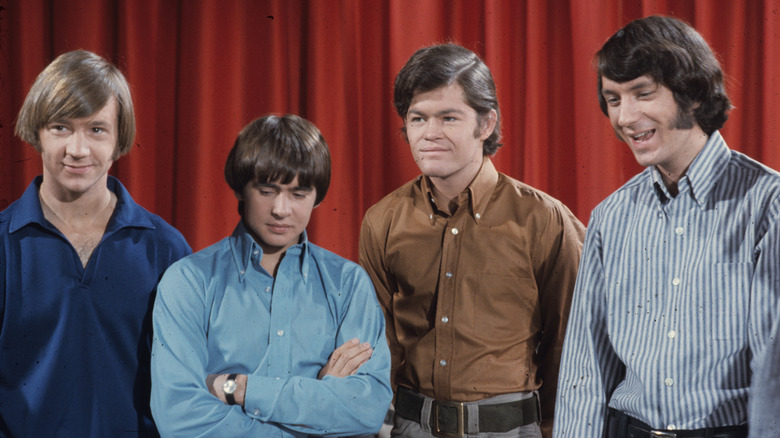
More than a few articles looking back on the time when the Monkees were a massive pop cultural phenomenon cite an eyebrow-raising stat, one that might hammer home just how massively successful the not-really-a-real-band was in the late 1960s. According to this bit of astounding and contextualizing trivia, in 1967, the Monkees sold more records than the two bands most associated with rock in that era, the Beatles and the Rolling Stones, put together.
That factoid was let loose courtesy of impish Monkees member Michael Nesmith, who concocted it out of thin air. During a late-1960s interview with an Australian reporter, he admitted that he was going to make stuff up. "I wonder how far this is gonna make it in the media stream," he recalled thinking to Studio 10. "He said, 'So the Monkees, very popular, how many records did you guys sell?' I said, '35 million. That's bigger than the Rolling Stones and Beatles combined.'"
While Nesmith was purposely lying, his information wasn't completely untethered from reality. While the Monkees may not have outsold the Beatles and the Rolling Stones, the band scored four No. 1 albums in 1967, something no other act in American pop music history has done before or since.
The Monkees inspired an even faker band
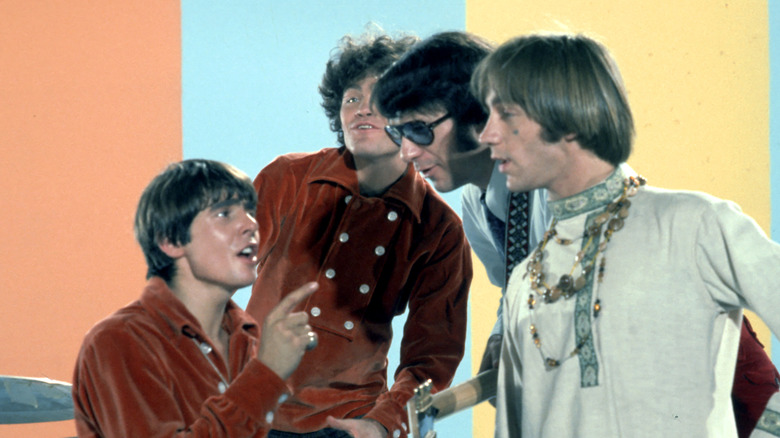
Producer Don Kirshner oversaw the Monkees' musical pursuits, and that's who the four performers clashed with when they angled for more creative control, having grown tired of singing along to pop-rock written and recorded by others. After presenting the band with the gold record award for "I'm a Believer," he asked them to record "Sugar, Sugar," a song co-written and produced by Jeff Barry. "Mike and Peter said, 'It's a piece of junk, we're never gonna do this.' Mike proceeded to put his fist through the wall," Kirscher said in "Soundtrack of the Century: Modern Pop."
Some time later, Kirschner noticed his son reading Archie comics, and it gave him an idea for an assembled band like the Monkees, but one that couldn't possibly fight for creative control because fictional, animated characters weren't capable. "I said to myself, if I could give Archie, Jughead, and Veronica voices, I could wind up with a group that don't talk back, I don't have to take any nonsense, I would control whatever I put out and do it my way," Kirscher said.
"The Archie Show" hit Saturday morning TV in 1968, and in 1969, a band of low-key studio musicians, led by longtime Kirschner collaborator Ron Dante on vocals, recorded "Sugar Sugar." It spent four weeks at No. 1, sold 3 million copies, and Billboard named it the year's top song.
The post-Monkees years weren't kind to Peter Tork
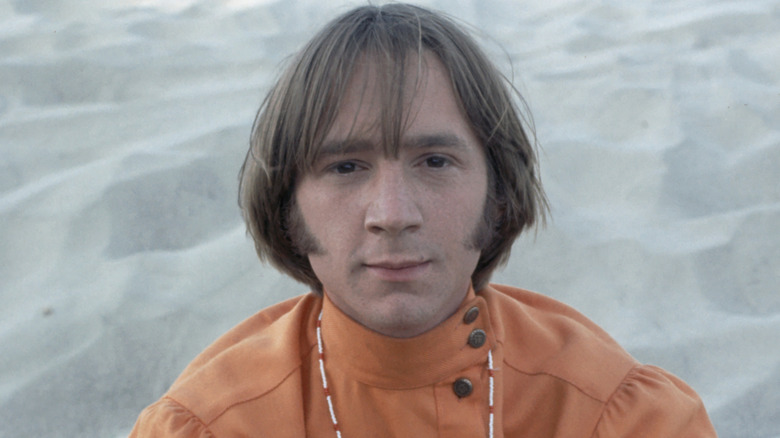
The joyful juggernaut that was the Monkees began its final unraveling in December 1968. After filming the TV special "33 1/3 Revolutions Per Monkee," Peter Tork, the Monkees' scripted goofball and bass player, walked away from the entire enterprise. At a press conference, Tork revealed that he'd been miserable for quite some time. "I hated the work. It was tough and I didn't like it. The pressure was awful," he said (via Glenn Baker's "Monkeemania: The True Story of the Monkees"). "I was constantly pushing for rehearsals and they were constantly saying, later. We could never get together. Also, we didn't play any new music on this recent tour. It was all old tunes, a bore."
Yearning to more authentically compose, record, and perform, just like he'd done in the early 1960s in the Greenwich Village folk scene, Tork left. But it would cost him: Because the Monkees was a business arrangement more than it was a creative endeavor, he had to buy out his contract to the tune of $160,000, and that left him essentially broke. His attempts to earn a living with music didn't pan out. He formed a band called Peter Tork And/Or Release, which couldn't land a recording contract. By the mid-1970s, Tork was a teacher in Los Angeles.
Two Monkees could've been Fonzie
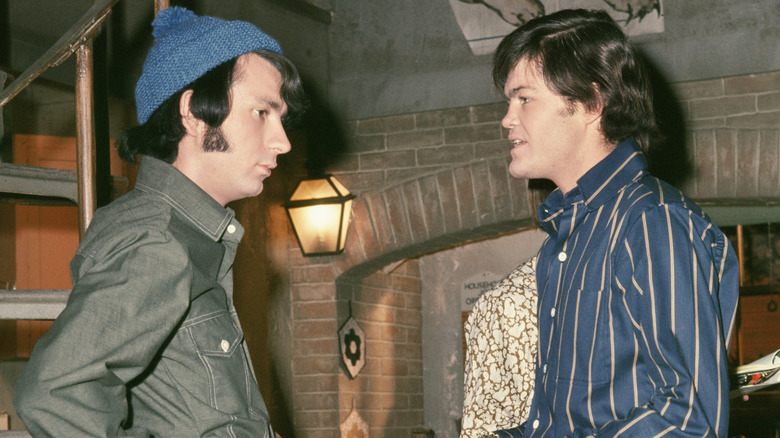
Debuting in the middle of the 1973-1974 TV season, "Happy Days" capitalized on the late 1950s and early 1960s nostalgia taking hold over Americans at the time. The show depicted the supposedly idyllic and innocent days of yesteryear, but the breakout character was leather-jacket-wearing, motorcycle-riding Arthur Fonzarelli, aka Fonzie. "Happy Days" was nearly renamed "Fonzie's Happy Days" as a result of Henry Winkler's star-making performance. TV hadn't enjoyed such a groundswell of youthful adoration for a character since "The Monkees" — and that late-'60s comedy nearly had an even more direct impact on "Happy Days."
Winkler's audition initially failed to impress producers (they thought he was too short to play Fonzie), so they brought in several more performers to read for the role, among them two fondly remembered TV stars of the past: Michael Nesmith and Micky Dolenz of the Monkees. The former child star and Monkees drummer nearly landed the gig, too. "Supposedly it was between me and Henry," Dolenz told People. "I was definitely not as good as he was."
The Monkees made up the music video
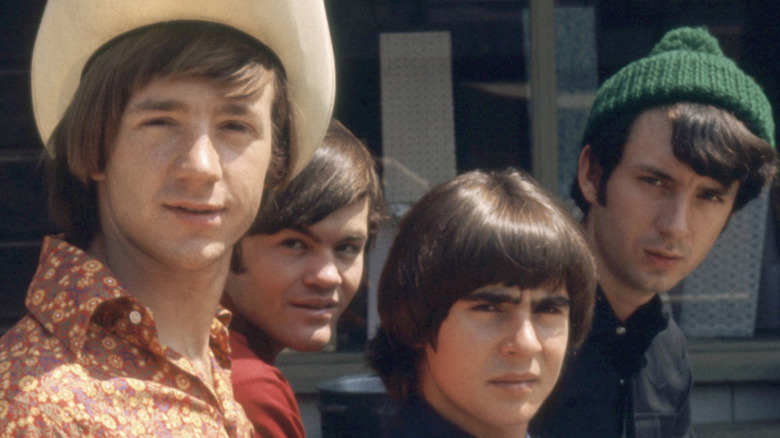
"The Monkees" employed techniques not generally seen in '60s sitcoms, like characters being aware they're in a show, rapid cuts, and something that house director Jim Frawley called "romps." He tasked handheld camera operators with following the Monkees around as they played in the ocean, bounced sets, or got into fake fights, then cut the footage to Monkees songs. Those were inserted into episodes of "The Monkees" that they'd later be known as music videos, and one Monkee helped popularize them.
Michael Nesmith left the Monkees in 1969, and went on to self-release albums through his company, Pacific Arts, which in the late 1970s became a music video production house. (The first clip he made was for his single "Rio.") Other artists were making videos, too, and Nesmith thought the market could sustain a whole cable channel of them. Nesmith — independently wealthy after inheriting $25 million from his mother, Bette Nesmith Graham, the inventor of Wite Out precursor Liquid Paper — approached several communications companies about his idea, and Warner Bros. showed the most interest.
The conglomerate's cable TV division, which was paying for but not actively using a satellite transponder to beam out content around the world, thought a music video network would slot right in. It paid Nesmith a hefty fee for the idea and then hired him to oversee the creation of what would hit cable TV systems in 1981 under the name MTV, short for music television.
The '80s Monkees revival was over quickly
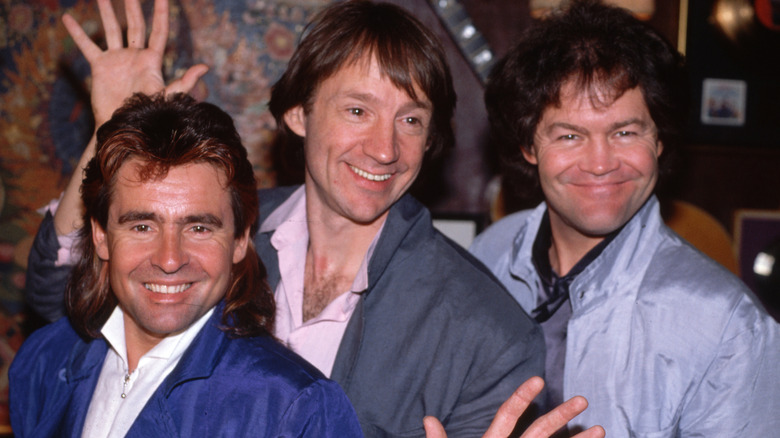
Former Monkee Michael Nesmith helped make MTV what it was, and in 1986, the network revived Nesmith's old show. The channel aired "The Monkees" as a weekend marathon, and got such a good response that it started airing the show more often. The attention generated plenty of interest in a previously planned 20th anniversary reunion tour, while MTV airplay of the video helped the new single "That Was Then, This Is Now," a hit rock song from the '80s that no one remembers today, reach the Top 20.
The Monkees were supposed to appear at MTV's January 1987 Super Bowl special, but hadn't been told, and the band no-showed. MTV was so miffed it refused to play "Heart and Soul," the video for the first single from the Monkees' first new album in two decades, "Pool It!" Reruns of "The Monkees" disappeared too, and the sudden media blackout meant that "Heart and Soul" gave out at No. 87 on the pop chart and "Pool It!" only made it to No. 72 on the LP chart. Just like that, the heralded Monkees reboot became one of the most disastrous band reunions in history.
There was little hope for "New Monkees" when it rolled around in the fall of 1987, casting four new musician-comedians as a struggling rock band living in a wacky house together. It was canceled after 13 episodes.