

We Bet You've Never Heard These Underrated Bob Dylan Songs
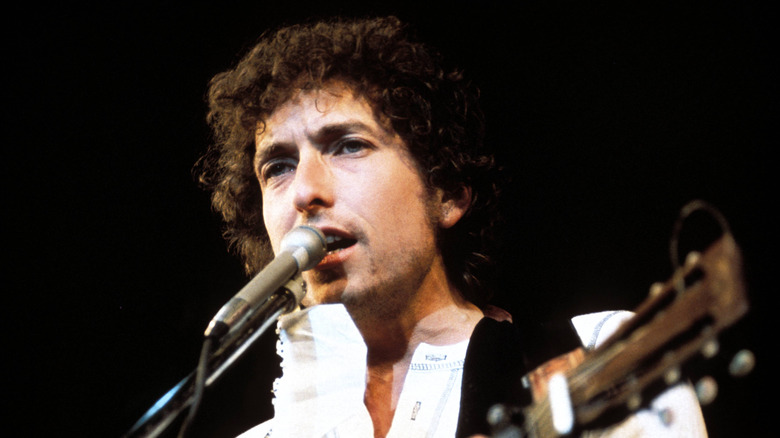
There are few artists as lauded as Bob Dylan. In a discography as loaded as his, both in quantity and in quality, it's nearly impossible to be familiar with every song or even every album. The vast array of bootleg and unreleased tracks that have seen light over the years doesn't make the task any easier. And though we can be satisfied enough with the hit albums, such as "Highway 61 Revisited," "Blood on the Tracks," and "Blonde on Blonde," there's a lot more gold to be found, if you only go looking.
Though Dylan's most successful songs were certainly popular for a reason, some of which — such as "Like a Rolling Stone" or "Knockin' On Heaven's Door" — are among the greatest rock songs of all time, his best work is arguably away from the hits, having been overshadowed in some way. The songs we've chosen are buried in overlooked albums, on demo tapes of songs later recorded to greater popularity, or forgotten cuts from successful albums.
In this list, we'll dive into the depths of Dylan's body of work, digging up tracks that only his superfans may know all of. Whether it's the enigmatic Dylan's folk-rock '60s, masterful '70s, or' 80s-and-beyond sounds you're looking for, we'll tackle them all.
When I Paint My Masterpiece - Demo
You may already know "When I Paint My Masterpiece" from its inclusion on The Band's 1971 record, "Cahoots," or its many live performances by the group and Dylan, but this demo version from the bootleg record "Another Self Portrait" may be the prettiest example of the song. Dylan, accompanied by only a piano, sings this narrative ballad tenderly, and the recording is incredibly sentimental and moving.
The three verses paint a cold and lonely vignette of European cities, where Dylan narrates a wandering in chase of a masterpiece, beginning: "Oh, the streets of Rome are filled with rubble / Ancient footprints are everywhere / You can almost think that you're seein' double / On a cold, dark night on the Spanish Stairs." It's a quintessential old-school Dylan folksy odyssey, and its reckoning with art and meaning can be felt deeply in both the lyrics and vocal delivery. This version wasn't released until 2013, but it's a gem in this vault of over 50 songs. There are some other highlights on the project, like Dylan's recording of "Railroad Bill," but this rendition of "When I Paint My Masterpiece" is an excellent ballad that's worth its own listen.
Changing of the Guards
"Street-Legal," released in 1978 as a compilation of Dylan's Santa Monica sessions before his turn to gospel music, has often been forgotten behind mid and late-'70s albums like "Desire" and "Blood on the Tracks." The record is filled with fun and quality songs, but the one that stands out is the opening track. At nearly seven minutes, "Changing of the Guards" may seem its own daunting task, but it finds Dylan at his most groovy and danceable. Backed by vocalists, as he is on much of this album, who respond to each of his lyrics in repetition, "Changing of the Guards" is suave and catchy as the music swells and fades through the verses.
The lyrics follow a classic epic yet abstract tale, one up for interpretation, but likely a poetic retelling of his own journey in music, opening with: "Sixteen years, sixteen banners united over the fields." Instrumentally, Dylan mixes his blues and gospel influences with a late '70s classic rock sound, which complement each other harmoniously. As a result, "Changing of the Guards" is easy to rock out to and analyze alike, just like many of Dylan's other best.
Brownsville Girl
"Knocked Out Loaded," released in 1986, is another largely forgotten album, in between Dylan's peaks of the '70s and his comeback in the '90s. At only eight songs, it's among the shorter Dylan albums. "Brownsville Girl" is the standout of the album, an eleven-minute meditative, sentimental ballad featuring nearly spoken-word verses and saxophone-backed, harmonic choruses.
The track builds and builds through Western-imaged verses, revolving around a movie and Gregory Peck, as Dylan paints a lost and yearning narrator for the "Brownsville Girl" he's searching for. Its lyrics in the chorus wail a simple but romantic message, but the sincerity of emotion behind the vocals and backing tracks creates the experience: "Brownsville girl with your Brownsville curls / Teeth like pearls shining like the moon above / Brownsville girl, show me all around the world / Brownsville girl, you're my honey love." It's among the most dramatic — and arguably best — of the reverb-soaked '80s, and captures a unique, sorrowful yet hopeful melancholy across its lengthy span.
Sad-Eyed Lady of the Lowlands
Though it closes out "Blonde on Blonde," one of Bob Dylan's most successful and acclaimed albums, the 11-minute-long "Sad-Eyed Lady of the Lowlands" is not as often consumed as other hits from the 1966 project. Poetically and lyrically, it's among Dylan's best, written and recorded during the rapid-fire mid-'60s years that yielded a number of memorable, lasting songs. With a slow Nashville swing, drawn-out verses, and grand buildups to its chorus, "Sad-Eyed Lady of the Lowlands" is a trancelike track that doesn't wear its runtime badly.
The lyrics likely allude to Dylan's first wife, whom he paints uniquely and romantically in the complex but resonating lyrics: "With your mercury mouth in the missionary times / And your eyes like smoke and your prayers like rhymes / And your silver cross, and your voice like chimes / Oh, who do they think could bury you?" As it meanders on, some verses may become more abstract, but the overall emotional message of the song is clear and moving. Instrumentally, it's as laid-back and pretty as any Dylan song of this era, and though the hits of "Blonde on Blonde" may lend themselves to more listens, "Sad-Eyed Lady of the Lowlands" is worth the dive, as it's among Dylan's artistic best.
I Shall Be Released - Live 1975
The Rolling Thunder Revue is one of the most mythologized tours in rock history, as Bob Dylan took the road joined by the likes of Robbie Robertson, Joni Mitchell, Joan Baez, and others. A live album compiling 22 tracks from this tour was released in 2002, featuring recorded performances from Boston, Cambridge, and Montreal. Though there's not a dull track among the nearly two-hour album, among the best is "I Shall Be Released," a classic fan-favorite Dylan track that never got an official release.
Sung in duet with frequent Dylan collaborator Joan Baez, "I Shall Be Released" captures a soulful and almost country twang over gorgeous live instrumentation. Their voices blend harmoniously in this classic tune, and the lyrics they sing have a timeless, universally applicable feel: "I see my light come shining / From the west down to the east / Any day now, any day now / I shall be released." This track is among Dylan's best live recordings, as its warmth and spirit are nearly rapturous, and it's among the most hidden of gems in Dylan's discography.