

These Classic Rock Stars' Biggest Flop Songs Aren't All That Bad
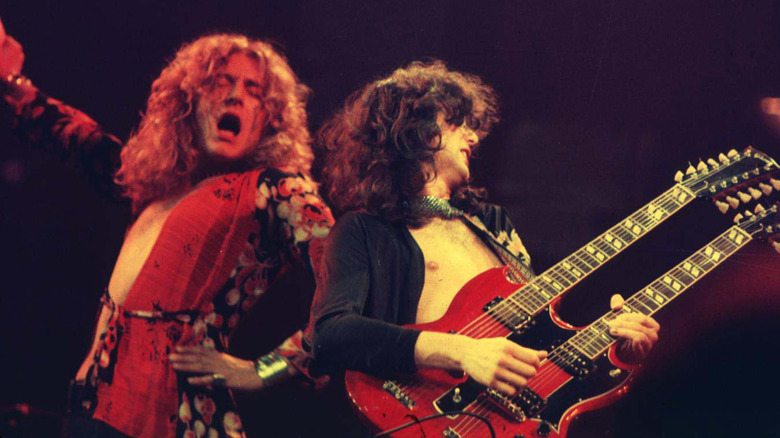
Classic rock is known for its legendary songwriters and the deep catalog of iconic tracks they've produced. Names like Joni Mitchell, Paul McCartney, Elton John, and Bob Dylan have been celebrated for their lyrical canon enough to become immortalized, and yet even they aren't immune to the occasional commercial failure. Indeed, there isn't a single classic rock artist that can say they never released a flop song (sometimes even derailing their entire careers), even if some didn't quite deserve to bomb like they did.
Within the graveyard of failed singles from the classic rock greats, there are thousands of songs entombed, and for some, that may be the most appropriate destiny. For others, their deaths were premature, and they're worth revisiting. Whether due to risking too much musically, coming ahead of their time, having too big of shoes to fill, or simply being misunderstood, these songs from classic rock stars flopped. By "flopped," we specifically mean failed to meet commercial and chart expectations, whether that means not charting as highly as the artists had hoped or even not charting at all. In either case, none of these songs are all that bad, and each of them is worth another listen to prove it.
Lynyrd Skynyrd — That Smell
It's a crime that Lynyrd Skynyrd's expertly crafted ode to excess and tragedy, "That Smell," never charted despite its release as a single off of "Street Survivors." The song is notorious for the two real-world incidents surrounding it: The car crash of guitarist Gary Rossington that inspired the track's creation and the tragic plane crash involving the band that occurred only three days after "Street Survivors" was released, making "That Smell" seem almost prophetic in hindsight. The song stands tall on its own musical merit, though, and it didn't deserve to flop, regardless of why it did.
Lynyrd Skynyrd has always been known for its lead guitar work, and "That Smell" has some of the group's best. The guitars are out of phase and messily distorted, sounding even skunkier than the band's usual. The way the notes are allowed to ring out until they feed back makes them sound like either painful wails or sirens, and in any case, the tone is fitting. Likewise, lyrics like "Say you'll be alright come tomorrow / But tomorrow might not be here for you / Yeah, you" are Skynyrd's most haunting, even without any real-world context. The overall effect is a chilling ballad, equal parts poignant and dangerous, and far from deserving of flop status.
The Stooges — I Wanna Be Your Dog
It's been decades since frontman Iggy Pop and The Stooges were enshrined in the annals of rock music as some of punk music's first and most influential pioneers, but that doesn't mean that their talent was immediately obvious. When the group released its 1969 self-titled debut album and led off with "I Wanna Be Your Dog" as the first single, it was largely met with crickets. And of those that did take notice, many were less than enthused.
The Rolling Stone review for "The Stooges" famously ends by calling the album "loud, boring, tasteless, unimaginative, childish, [and] obnoxious," a fair approximation of many reviews at the time. Likewise, "I Wanna Be Your Dog" only charted for two weeks in the U.K., peaking at No. 78 for one of them, making it a commercial dud. However, a large factor in the single's failure to land was simply that it was ahead of its time.
The Stooges played simple, quick, distorted, and sneering pop. In later years, this formula would go on to define the punk rock genre, but in '69, it was not yet a known entity. Both "I Wanna Be Your Dog" and the album it came on were commercial flops, but only because Iggy Pop was too cool for his time. In reality, "I Wanna Be Your Dog" is awesome, like an old blues track but ablaze with hellfire, and it's well worth another listen.
The Kinks — The Village Green Preservation Society
In a sense, The Kinks took a very stereotypical route for a British band in the '60s: It emerged into the early decade as a squeaky-clean pop act and ended it experimenting with world music, extended arrangements, concept albums, and everything else tangentially hippy. In a larger sense, the constant evolution of the band can be traced to whatever whim caught main songwriter Ray Davies' interest at a given moment in time. In either case, one spot in the act's development that flopped upon release was 1968's "The Kinks Are the Village Green Preservation Society," both the single and the album of the same name, despite being examples of some of the group's best songwriting.
Davies has come to be known for the exceptional degree of poetry in his songwriting, and "The Village Green Preservation Society" is a clear example. Despite his insistence that the lyrics are a sincere celebration of the band's commitment to niceness, many others have noted the sarcasm that pervades them. The repeated plea for God to "save strawberry jam and all the different varieties" might be earnest, if inane, but it's hard to read the band's appeal to save famous villains "Fu Manchu, Moriarty, and Dracula" as heartfelt. Demonstrating Davies' prowess as a writer, the song can be interpreted either way without losing its meaning, and in either case, it's a pleasant and thought-provoking listen.
Pink Floyd — Sheep
Pink Floyd's 1977 concept album and masterpiece, "Animals," is an excellent example of relative success. There's no denying the album made money — it is, after all, a multi-platinum album from one of the best-selling artists of all time. But it's precisely the band's success that makes "Animals" feel like a flop. As a follow-up to the iconic "Wish You Were Here" and a prelude to "The Wall" (the best-selling double album ever), and with not one single released, "Animals" is a relative flop for Pink Floyd smack in the middle of the group's most celebrated period. It's too bad, because potential singles like "Sheep" are up there with the group's most fun.
Picking a likely single for "Animals" is especially tricky, given that its songs range from one minute, 24 seconds, to a whopping 17-plus minutes. Surprisingly, the 10-plus minute "Sheep" is the most normal in between. The song's length is part of its charm, though, as it steadily, rhythmically lulls listeners into an almost hypnotized state, a reflection of its titular sheeple.
Part of Pink Floyd's own distaste for the album comes from the members' increasingly strained relationships while recording and touring for it. Yet even though a real sense of anger permeates the record, so does a twisted sense of fun. "Sheep," in particular, plays around with soundscapes and quirky guitar parts that sound like the "baas," grunts, and barks of its subject animals, and that interplay between fun and frightening makes "Sheep" deserving of a better legacy.
Led Zeppelin — Over The Hills and Far Away
It's not hard to figure out why Led Zeppelin's "Over the Hills and Far Away" might not have hit as big as the group's past singles. The album it was on, 1973's "Houses of the Holy," received a lukewarm, confused reception, and it's likely that its lead single caught the same bad rap. "Over the Hills and Far Away" is also guilty by association with the album's other single, the unfortunate "D'yer Mak'er," and its even more lamentable B-side, "The Crunge." Even still, it's a quintessential Zeppelin track.
It's true that "Houses of the Holy" is a surprise from one moment to the next and not always a good one, but when it shines, it shines as bright as Zeppelin ever did. Songs like "The Song Remains the Same" and "No Quarter" are near-perfect Zeppelin tunes, and if there is a single perfect Zeppelin tune, it might be "Over the Hills and Far Away." Though it only hit No. 51 on the Billboard Hot 100 chart, the song encapsulates so much of what makes Zeppelin great.
"Over the Hills and Far Away" has a rambling, open-road energy, but one that only builds up after quaint acoustic guitar lines that feel at home on a farm. Indeed, as the band would likely enjoy hearing, the song feels like it's on an adventure, having left a cozy little Shire to travel the length of the (Middle) Earth. "Over the Hills and Far Away" has all the sleazy guitar, swaying rhythms, and soaring vocals of Zeppelin at their best, and it deserves better than to be known as a flop.