

Rock Bands Who Lost Their Guitarists To Mega-Successful Artists
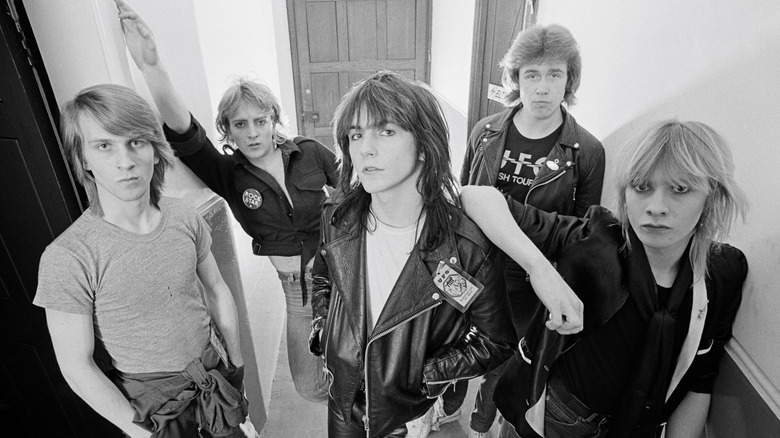
It isn't easy to keep a rock band together, and, in a genre dominated by the sound of electric guitars, few things imperil the existence of a band more than the loss of a great guitarist. The truth is that when talented individuals come together to create music, egos can often soar, and while band members are expected to pull together, they often find themselves going their own way in pursuit of greater glory. Throughout the history of rock music, musicians have had their heads turned not just by the tempting prospect of a solo career and a greater portion of the spotlight, but also by the chance to join another band entirely, taking their talents to another level that their original group couldn't achieve.
Here, then, are four bands that found themselves in the lurch after the guitarists on whom they depended decided to leave and decamp to another, bigger rock outfit. In each of these examples, the guitarist in question was undoubtedly justified in making the jump for the sake of their career, but you can't help but feel a little sorry for the bands they left behind.
Message
Hair metal guitar supremo Richie Sambora has become an icon among fans of Bon Jovi, the platinum-selling band that has been a constant radio presence since enjoying a huge breakthrough in the mid-1980s. Sambora cut his teeth as a guitarist in Message, a New Jersey hard rock band that he founded with Dean Fasano, which released a single album in the early '80s but struggled to find an audience. Sambora soon began looking for new opportunities, and after a failed audition for Kiss, he successfully gained the attention of Jon Bon Jovi.
Sambora was instrumental in crafting the commercially appealing yet credibly hard-edged guitar sound of Bon Jovi, and his work helped the band reach a wide audience. By the late 1980s, Bon Jovi had sold millions of records and Sambora was one of rock's most respected guitarists, with a solo career of his own. The one album he recorded with Message would be re-released in 1995, while Fasano would finally reform the band to release fresh material in 1998.
Sambora abruptly left Bon Jovi in 2013, a decision that dismayed fans and led to years of speculation about its cause, before Sambora delivered an apology for the move in 2024. Though his affiliation with Bon Jovi may have ended on a sour note, Sambora must surely be proud of his decisive role in one of the most commercially successful rock bands of recent decades.
John Mayall and the Bluesbreakers
John Mayall and the Bluesbreakers is one of those legendary feeder bands that once boasted some of the biggest names in rock. Founded by Mayall in the early 1960s, it became a hugely influential blues outfit, spearheading a boom in the popularity of blues music in Britain that laid the foundations for the sound of hard rock throughout the 1970s. The band boasted among its members none other than Eric Clapton, who featured in its most successful album, "Blues Breakers," in 1966, with his name credited below Mayall's on the album cover. Clapton was frustrated by the narrow blues Mayall insisted on, however, and soon left to form the blues rock trio Cream, bringing him to a new level of critical acclaim.
Another Mayall line-up consisted of three members of what would later become Fleetwood Mac: Peter Green, John McVie, and Mick Fleetwood. An exceptionally talented blues guitarist, Green had come into the band as a replacement for Clapton, but by 1967 had grown tired of the Bluesbreakers, and eventually convinced McVie, who was skeptical of Mayall's growing jazz elements, and Fleetwood to join him in the new splinter group.
In both of these cases, musicians stepped out of the Bluesbreakers and straight into groups that utterly overshadowed the work they did with Mayall, but all started from scratch with their new outfits. However, there was also an instance when one of the biggest bands on the planet came calling and poached a guitarist straight from Mayall. The band in question was the Rolling Stones, who in 1969 caught the attention of Mick Taylor, who had been Mayall's lead guitarist since Green's departure in 1967. Of course, Taylor made the jump, performing on "Let It Bleed" and several later albums.
Girl
Girl was a short-lived British glam rock outfit that gained a following in London after its formation in 1979, and went on to score a debut album, "Sheer Greed," which broke into the Top 40 of the U.K. charts in 1980. Though the band's androgynous appearance was eye-catching and made it stand out in the post-punk, heavy-metal-dominated landscape of the day, Girl received a mauling from critics, with the band failing to actually deliver the goods when it came to live shows.
The band fell apart shortly after the release of its disappointing second album in 1982, when guitarist Phil Collen abruptly upped sticks to join another budding British group: Def Leppard. While Girl disbanded altogether, Collen saw his new band go from strength to strength, with his aggressive guitar style helping Def Leppard define its sound to become a legendary rock group by the end of the decade.
Quiet Riot
Former Quiet Riot guitarist Randy Rhoads was a prodigious talent who seemingly had a stellar career ahead of him. Tragically, Rhoads died in a plane crash at the age of just 25, but even at that young age, he had already played with some of the biggest rock acts of the 1980s.
Rhoads first rose to prominence as a member of Quiet Riot, the heavy metal band he founded alongside frontman Kevin DuBrow back in 1975. The band released two albums in the late '70s, both of which were released only in Japan. However, Rhoads' talent as a heavy metal guitarist didn't go unnoticed. After an audition in 1979, he was poached by Ozzy Osbourne, who had just been fired from Black Sabbath, to join the legendary vocalist's solo band. Rhoads, of course, jumped at the offer, touring widely with Ozzy and performing on key solo tracks such as "Crazy Train" and "Mr. Crowley."
Though Rhoads would have been a profound loss to Quiet Riot, which didn't release an album for several years after his departure, the band eventually found its feet again. Quiet Riot's 1983 album "Metal Health" was a phenomenon, hitting the top of the Billboard 200 and making DuBrow a superstar. Though Quiet Riot would never reach that height again, it stands as an example of a band rolling with the punches and recovering after the loss of a key founding member.