

These 5 Underrated Music Venues Are Treasure Troves Of Rock History
There's something special about going to a place that not only holds real music history within its walls, but still makes a point of showing working musicians on a regular basis. Some of the best rock venues are easy to name and find — think Greenwich Village's Cafe Wha?, a fave of Jimi Hendrix; the wild Whiskey a Go Go; or Seattle's Crocodile Cafe that acted as the epicenter of the '90s grunge revolution. But why not go off the beaten path? Amongst all the big names, some smaller rock venues should get more attention.
What makes a venue "underrated," anyway? That's tricky to pin down, but we think it can fairly apply to places that don't make the lists of legendary high-capacity venues like Madison Square Garden or the Hollywood Bowl, and that haven't become quite as synonymous with rock history as LA's Troubadour or New York's CBGB. These spots might still draw in a fair amount of locals or devoted scene-heads, yet they might not immediately ping the radar of your more casual fan.
They absolutely should, though. These venues have some real history to them, and though they might be in some out-of-the-way locales or at least lesser-known corners of big cities, we'd argue that they're well worth a visit. Want to see the place that once grossed out Joey Ramone? The spot where Sid Vicious decided it was time to punch a wall? A humble stage that's hosted the likes of Patti Smith, Bob Dylan, and Neil Young, to name just a few? Then it's time to put on your walking (or is that rocking?) shoes and check out these history-packed yet oftentimes underrated rock venues.
Cain's Ballroom
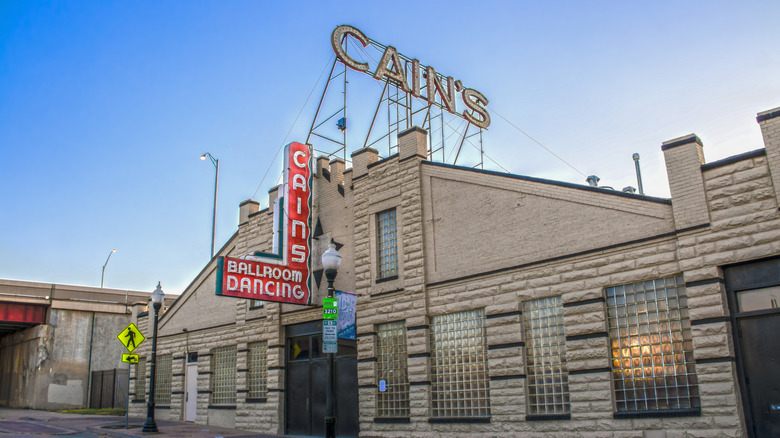
You might get the impression that Cain's Ballroom is more of a swing and country place and not exactly a bastion of rock and roll, but think again. This Tulsa, Oklahoma, institution has been around for over a century, and after its 1976 purchase by concert organizer Larry Shaeffer, began hosting rock acts too. These included notables like Metallica, Van Halen, and future stadium regulars U2, as well as multiple shows with Oklahoma native Leon Russell, whose performing and songwriting career spanned decades and included countless session hours with seemingly everyone in the music industry, from Frank Sinatra to Bob Dylan. Today, Jack White favors the spot and has performed there multiple times, including a surprise show in 2024.
When it comes to rock history at Cain's Ballroom, though, none has made more of a mark than the Sex Pistols. The group's first North American tour in 1978 often featured such hostile audience reactions to the controversy-courting British band (who even feuded with the Rolling Stones) that its members didn't exactly look back on the time with fondness. Drummer Paul Cook even told The Times in 2025 that he "thought someone was going to get killed." Perhaps that's partially why bassist Sid Vicious punched a hole in the dressing room wall at Cain's (though his heavy substance use likely didn't help). Whatever Shaeffer and other venue employees thought at the time, the damaged wall has become something of an artifact. As co-owner Chad Rodgers told Public Radio Tulsa in 2024, that Vicious-damaged bit of wall was framed and now sits in the venue's office.
Double Door
If nothing else, people knew Double Door by its sign. The club in Chicago's Wicker Park neighborhood was housed in a former liquor store which sported a 16-foot-tall sign that stuck around when the space was converted to a rock venue. Only, when Double Door opened in 1994, the front of house was still the country-focused Main Street Tavern. Its tenants were so put out by the new club that they allegedly put glue in the Double Door's locks.
In its time, Double Door hosted performances that included the Rolling Stones, the Smashing Pumpkins, and Sonic Youth. The club's first rock show, courtesy of the bands Throw and Wade, was so loud that it caused dust to sprinkle down from the vintage tin ceiling. It even popped up in "High Fidelity," when John Cusack's character briefly presented himself as a Double Door DJ. Only, things went awry in 2017, when the property's landlord evicted Double Door.
It isn't a cheat to include the club on this list, as the Double Door isn't necessarily down for the count just yet. After its closure, there was much talk of a relocation and reopening, though spendy renovation proposals meant a planned spot in Chicago's Uptown neighborhood never materialized. But a February 2026 Facebook post from co-owner Sean Mulroney stated that "this isn't an ending — it's a pivot." Mulroney even hinted that another promising location was in the works. In the interim, Mulroney noted that the Double Door continued through pop-up events and collaborations, hopefully keeping the flame going until the legendary club can settle into a new brick-and-mortar location.
Strand Ballroom & Theatre
You may have heard about the music scenes and performance venues of large cities like New York and Chicago ... but Providence? If you're a rock fan, don't sleep on this town (which is the capital of Rhode Island, to be fair). When it comes to venues, one of the most historic in the city has to be the Strand Ballroom & Theatre, previously known as Lupo's Heartbreak Hotel. When Lupo's opened in 1975, Providence was considered by some to be a bit of a cultural dud, but that was to change — and Lupo's would be at the heart of the transformation. Rich Lupo, who first opened the place, originally planned for it to be a hangout spot, perhaps with the occasional performance or two. That morphed into a lineup of rock acts that could make your head swirl, including a 1978 residency by Bo Diddley and, eventually, the Ramones (with Joey Ramone reportedly calling the band room there utterly disgusting), Dead Kennedys, Radiohead, the Smashing Pumpkins, the Pretenders, and, of course, hometown faves Talking Heads.
That growing scene cred didn't make things easy for Lupo's, however, as downtown development projects pushed the club out of its first brick-and-mortar home in 1988. Then, it happened again, as the re-established Lupo's was nearly pushed out of its second spot over a decade later. By 2003, it was in the Strand Theatre building, but Lupo sold it in 2017. Under new developers, the space underwent renovations and relaunched as the Strand Ballroom and Theatre in 2017.
The Bitter End
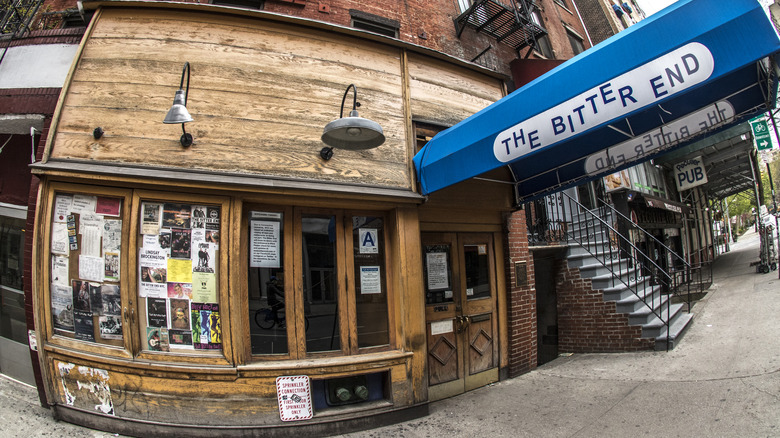
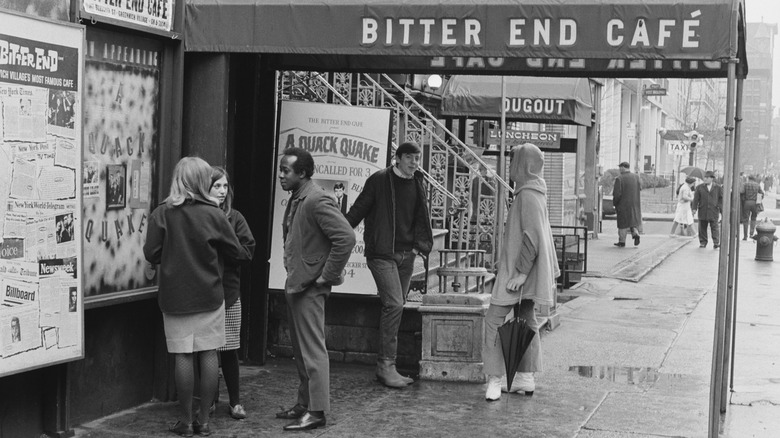
When in New York City, you may find that there are more music venues with deep history than you can really comprehend. And in a city that contains both top-tier examples of big venues and intimate bars with a stage, what gets really underrated? To ask some, The Bitter End fits that bill. The little spot in Greenwich Village has been around for a while — so long, in fact, that it claims the title of oldest rock and roll club in the whole dang city, having opened in 1961. It's hosted a veritable who's who of music history, including Bob Dylan, Stevie Wonder, Jackson Browne, Neil Young, and Patti Smith. According to owner Paul Colby's 2002 memoir "The Bitter End: Hanging Out at America's Nightclub," Van Morrison once got so wild during a performance at the venue that his backup singers walked offstage, grabbed their coats, and left mid-show.
Though newer acts like an early-career Lady Gaga and Norah Jones have also played there, a newer generation has yet to fully rediscover the place, thereby landing The Bitter End in "underrated" territory. But those who do enter the club, with its characteristic blue awning and wood facade, soon find it's still got something special that Madison Square Garden just can't muster. Maybe it's the smaller, more intimate space; maybe it's the decades of history and the lingering presence of rock greats who played in front of its unadorned brick wall. Whatever the case, the many who have played at The Bitter End or who have been entranced by a show there will tell you, this spot is worth a visit.
The Surf Ballroom
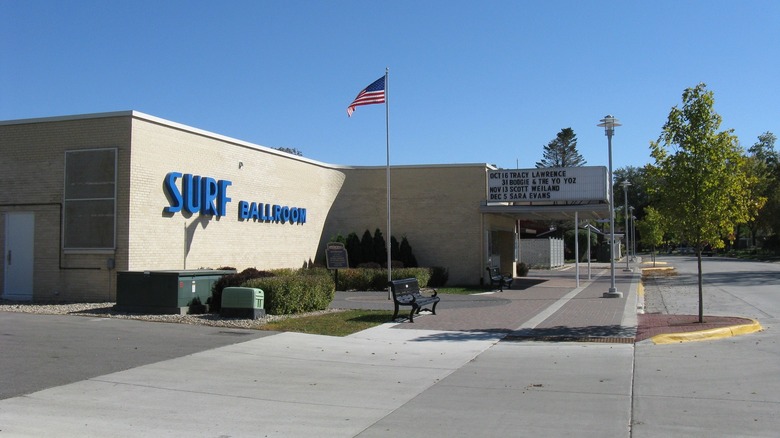
With a name like The Surf Ballroom, it may seem odd to come across this venue in the rather un-beachy landscape of Clear Lake, Iowa. And, yes, it's got an attached museum and is even a Historic Rock and Roll Landmark and a National Historic Landmark. That said, it's very definitely a place for enjoying an old-school rock concert or two, including at its free summer concert series.
The Surf, as it's called, opened in 1933, but it's what happened there the evening of February 2, 1959, that gave the venue a place in rock and roll legend — albeit a dark one. That night, the ballroom hosted the Winter Dance Party that included performances from Buddy Holly, Ritchie Valens, and J.P. "The Big Bopper" Richardson. The concert went off quite nicely for the budding stars, but serious issues arose afterward. Dealing with a malfunctioning tour bus, Holly chartered a plane to get to the next stop. He was joined by Richardson (who was ill with the flu and given his spot by a young Waylon Jennings) and Valens (who won a coin toss for his seat). After takeoff around 1 a.m., the plane went down due to bad weather and pilot error. All aboard were tragically killed.
This left the Surf Ballroom a rock and roll memorial (quite a few Holly artifacts are housed there today) yet still an active music venue. Go there for the concerts, to be certain, but don't forget to pay honor to the deep music history that's an indelible part of the Surf's story.