

5 Songs From 1973 That Nail The Meaning Of Life
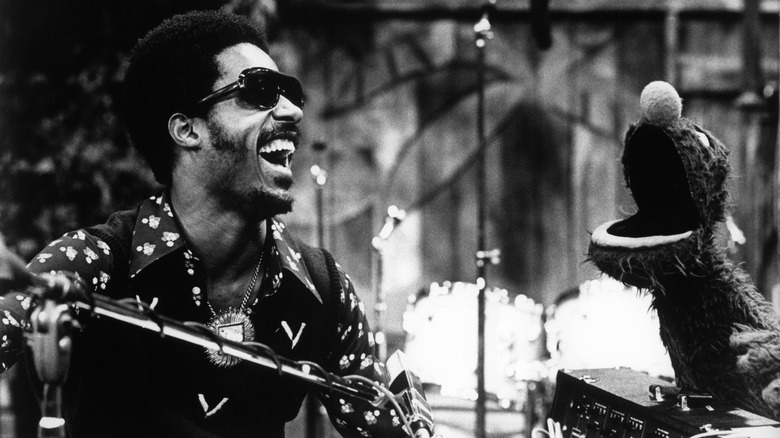
Even though lots of iconic artists, including David Bowie, Marvin Gaye, and Black Sabbath, released fine, career-defining work in 1973, some songs that came out that year nail the meaning of life better than others. The "meaning of life," however, is such an overarching (and potentially overreaching) topic that we've got to try and avoid veering into abstract, pompous, or pseudo-intellectual territory.
We've got to stay grounded in universal human experience, which means selecting songs that revolve around the most fundamental aspects of life: falling in (or out) of love, growing old, struggling with regret or grief, basking in good times, and so forth. The '70s were a good decade for exploring these topics through music, as the music-driven, society-changing counterculture of the '60s had gone mainstream and left behind lingering questions about what had happened and where to go. Also, we're not going to limit ourselves to any particular genre or form of music, but since we're talking about the meaning of life, lyrics take the forefront.
On that note, no song other than "Time" from Pink Floyd could better encapsulate a problem we all face: squandering time. Stevie Wonder's "Higher Ground," meanwhile, embodies the need to carry on with one's life regardless of what's happening around you. Other songs from Bob Marley & The Wailers, Tom Waits, and Earth, Wind & Fire delve into other aspects of life's meaning.
Time — Pink Floyd
There's a reason why Pink Floyd's monumental 1973 opus, "The Dark Side of the Moon," became the highest-selling album of the '70s and took its place as one of the greatest rock albums in history. In a case of acclaim actually matching merit, the album really is that good. Its spacey, dark soundscape ebbs and flows across the album's length, peaking with stand-out tracks like "Breathe (In the Air)," "Time," and "Money" that basically have infinite replay value. But aside from musical composition, these tracks' lyrics connect to listeners because they're so spot-on regarding the meaning of life. This is especially true for "Time," a song that will always garner boomer bragging rights.
Let's let the lyrics from "Time" do the talking: "Ticking away / The moments that make up a dull day / You fritter and waste the hours / In an offhand way," "Every year is getting shorter / Never seem to find the time / Plans that either come to naught / Or half a page of scribbled lines." Those lines might not click with the very young, but those with the weight of life under their belts know how precious time is, how quickly it drains, and how important it is to focus on what's important. This is an integral, if not the most integral, realization that dawns on us all as we age.
Floyd bassist Roger Waters wrote "Time" when he was 29. As he told Rolling Stone in 2019, he suddenly realized, "F*** me. It's the middle of life. I've been told that I was preparing for something," but didn't know what it was. Can't get more human than that.
Higher Ground — Stevie Wonder
Forget for a moment that the Red Hot Chili Peppers covered "Higher Ground" in 1989 — we can't hold that against Stevie Wonder. The original from 1973's "Innervisions" does what the best songs do: Wields well-crafted, cool music to tell a meaningful tale that everyone can understand. In Wonder's hands (and voice), this means a supremely funky clavinet (electronic piano) loop, groovy rhythm section, shimmeringly clean electric guitar, and lyrics about bettering oneself even as the world continues its shenanigans around you. Is anyone going to argue that learning to separate responsibility to oneself and responsibility to others isn't crucial to life?
As Wonder writes in "Higher Ground," "People, keep on learning / Soldiers, keep on warring," "Powers keep on lying / While your people keep on dying," "Teachers, keep on teaching / Preachers, keep on preaching," with each couplet ending in, "World, keep on turning / 'Cause it won't be too long." It's pretty on-the-nose, but couldn't be more universal. The only lyric that might throw people off is the "it won't be too long" bit. This line lyrically connects to divine oversight, karmic improvement in the cycles of life, a belief in second chances, and generally just a happier tomorrow while staying appreciative in the present.
In a twist of absolute irony, Wonder wrote "Higher Ground" before a car accident that nearly killed him, as though he was sending his future self a message. And indeed, "Higher Power" says just this: "I'm so glad that He let me try it again." Wonder's associate, Ira Tucker, even sang "Higher Power" into Wonder's ears when Wonder was in a coma following the accident (via American Songwriter). Wonder's fingers started twitching along.
Get Up, Stand Up — Bob Marley & The Wailers
We all know the rhythm, if not the melody, right? "Get up, stand up, stand up for your right." The line's got the prototypical reggae bounce, off-beat guitar shucka-shuckas, background vocalists, and a sweet Hammond organ hitting some chords. But more than a foundational track in bringing Jamaican music to the wider world, 1973's "Get Up, Stand Up" from Bob Marley & The Wailers' "Burnin'" sends a message about the meaning of life that's just as relevant now as it was then, has always been, and will continue to be.
Much of "Get Up, Stand Up's" lyrics boil down to the above-cited chorus line, but the song really opens up in the verses. Marley sings in verse one, "Preacher man don't tell me heaven is under the earth / I know you don't know what life is really worth / It's not all that glitter is gold and / Half the story has never been told." In verse two, Marley's co-writer Peter Tosh goes for the throat, saying, "We're sick and tired of your ism and schism game / Die and go to heaven in Jesus' name, Lord," and, "You can fool some people sometimes / But you can't fool all the people all the time." In a nutshell, the song is about gaining sovereignty over one's own life, shedding false perceptions, and seeing what really matters.
I Hope That I Don't Fall in Love with You — Tom Waits
Leave it to Tom Waits to bring us somewhere more personal, introspective, and grimy, albeit less full of smoke and gravel than that of his late-life voice. Plainly named "I Hope That I Don't Fall in Love with You" and written as a tale of a guy meeting a girl in a bar, Waits' 1973 track (from his debut album, "Closing Time," no less) paints a portrait about desiring connection. But it's ultimately about being afraid of what will happen if you trust someone else enough to really let go.
Waits' storytelling is on full, if unrefined, display even in this early career track. Verse three encapsulates the lyrics' rambling, Beat poet-inspired style: "Well, the night does funny things inside a man / These old tomcat feelings you don't understand / Well, I turn around to look at you, you light a cigarette / I wish I had the guts to bum one, but we've never met." There's a crowded room, some music playing, and the girl that the narrator likes eventually sits by herself. But, he doesn't have the guts to approach her and misses out, which makes him fall in love with her (i.e., love is an illusion of want). Even though this exact scenario is closely tethered to a certain era and culture, the sentiments — loneliness, desire, fear, regret, etc. — are absolutely universal.
Interestingly, the music of "I Hope That I Don't Fall in Love with You" is written like a wistful folk song on solo acoustic guitar. It's as though the song is a lullaby meant to self-soothe.
The World's a Masquerade — Earth, Wind, & Fire
Finally, we come to a song that's gotten 1,000 times more relevant in an internet-shackled, social media age: "The World's a Masquerade" by Earth, Wind, & Fire, aka, that R&B group with the flotilla of vocalists (and fascinating facts and stories). This doesn't mean that all people, everywhere, are fake, self-aggrandizing, and smiling their way to a selfish end. Rather, who hasn't felt that this is true at some point? Who hasn't passed by forced smiles in the halls at work, scrolled through videos on whatever platform, or shown up at a party or family event, marveling at all the strained smiles, pretense, and hidden intentions?
Earth, Wind, & Fire certainly felt this way back in 1973 when they released the album "Head to the Sky." But of course, those feelings got all butter-smooth and sadly soulful with their low-tempo, piano-meets-organ accompaniment. As the song says, "Whole world is a masquerade / Everybody, everybody wears another face (another face)," "Can't you see, can't you see what you really are, oh, yeah?," and, "What can the whole world be hiding?" The song doesn't get much more complex than that, but the sentiments are universal. Plus, the song calls out ideological hypocrisy and possibly fraudulent hippies (given the time period) with the lines, "Tell me that you want the world to be a better place, mmm / Yet you fight, makin' war on your fellow man."
It might be intentional for "The World's a Masquerade" to offer no answers. It just asks questions, same as folks have always done and continue to do, especially when confronted with circumstances that demand explanation. It's this desire for truth and authenticity that forms the root of the meaning of life.