

Seals & Crofts Songs We Think Are Better Than Summer Breeze
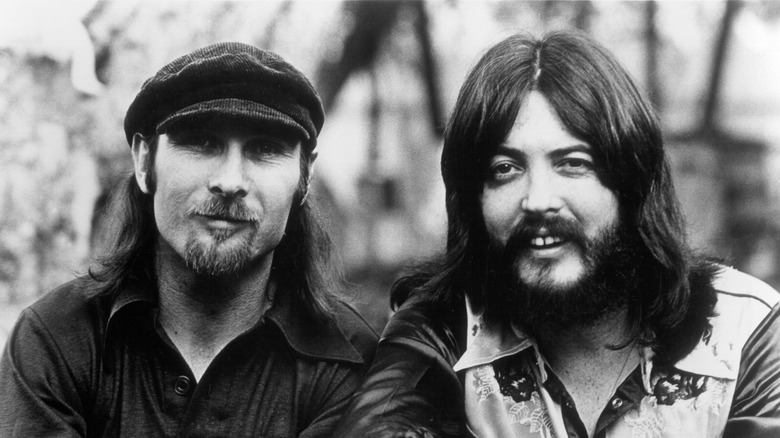
Seals & Crofts wasn't a one-hit wonder of the '70s. Jim Seals and Dash Crofts helped define the soft rock sound of the decade with a breezy style that incorporated elements of jazz, folk, rock, and pop as the band garnered multiple chart hits, was nominated for Grammys, and sold millions of records. One of the duo's biggest songs, "Summer Breeze," is an iconic tune that captures an easygoing love connection, wrapping up the hazy glow in a bittersweet sound and topping it off with an infinitely catchy melody — but it's not the group's best work.
We think the Seals & Crofts catalog holds even finer treasures. In our view, the duo has catchier and more sophisticated songs that don't always get the appreciation they deserve. Some of these were hit singles that became radio staples during the band's heyday. Others are deep cuts that make revisiting the albums a voyage of audio rediscovery. We think they deserve some time in the spotlight.
Hummingbird
The 1972 song "Hummingbird" is from the duo's album "Summer Breeze," which means it had a lot of competition from the beloved title track. The depth of the lyrics may be surprising for the soft rock genre, but it's a natural fit for the late '60s and early '70s New Age spirit. "Heavenly songbird, we were so wrong / We harmed you," the pair sings in the opening, doubling their voices instead of going for harmony. The effect is an electrifying, hymn-like delivery in the church of Mother Nature.
Eventually, the funky bits roll in, with a fluttering flute line and wah-wah guitars adding weight to the urgent "Hummingbird don't fly away, fly away" motif the lyrics return to repeatedly. Then there's a plea for awakening: "Haven't you noticed the rays? The spirit sun is stronger / And a new day is dawning on us all"). Soon after, this passage is contrasted by the ominous admission, "Alas, here comes the 'Gardener'; he's come to till the flowers," removing the very thing that draws the hummingbird nearer. That's deep stuff.
Jim Seals explained in a 1991 Los Angeles Times interview that the hummingbird is a metaphor for Baháʼu'lláh, leader of the Baha'i faith that both he and Dash Crofts followed. Seals considered the song's underlying message — that the world's greatest spiritual teachers end up being persecuted due to human misunderstanding — as a musical "mea culpa" of sorts.
Get Closer
The message in "Get Closer" is a simple one: If you want commitment, you need to commit. As straightforward as that idea may be, there are far too many instances where it gets forgotten, which is why Seals & Crofts' instructive tune is such a winner. Sometimes, it takes a musical gem like this to illustrate the more solvable problems in life in a manner everyone can understand.
That's not to say the song takes the situation lightly — it actually faces the tough stuff head-on in a way that progresses as the lyrics unfold. "You say we've been like strangers," Jim Seals and Dash Crofts sing in unison, "but I'm not like the others you can wrap 'round your fingers." This is boundary setting at its most direct. The pair also pulled in singer Carolyn Willis to sing the female counterpoint to the male perspective. Her line "And there's a feelin', deep down inside me / I can't explain it and you're wondering why" is delivered in a piercing, almost gospel wail that sends shivers up the spine. Anyone who's ever been in a romantic quandary knows exactly what these three are singing about.
The soaring, soulful song found a place in the Top 10 of the Billboard Hot 100, reaching the No. 6 spot in July 1976. Today, the choir chorus is still a sing-along favorite after all this time.
Diamond Girl
Listeners have noticed that the melodic motif in the chorus of "Diamond Girl" mirrors the legendary Miles Davis' wonderwork "So What," showing off Seals & Crofts' rich musical background. The rest of the song is a bouncy, rapturous shuffle that does what soft rock songs do best: Extol the virtues of love. "Diamond Girl" sparkled all the way to No. 6 in 1973, giving the pair a hit to follow up "Summer Breeze" with a similar yet superior work of art.
The poetry in this classic is simple, just comparisons of the girl in question to the most striking phenomena in nature. Passages like "Oh, my love / You're like a precious stone / Part of earth where / Heaven has rained on" are no mere high school verses — they sound more like a religious text or an ode from a Renaissance bard. Their elegance serves to offset the supremely simplistic chorus: "Diamond Girl / You sure do shine / Glad I found you / Glad you're mine." When paired together alongside the elegant instrumentation, the two vibes become hypnotic and wildly catchy.
We May Never Pass This Way (Again)
So what if "Summer Breeze" made an unexpected appearance in a movie? "We May Never Pass This Way (Again)" summarized the existential nature of life and love in under five minutes, a testament to the power of a proper Seals & Crofts song to deliver big ideas that you can sing in the car. The band even funks out a little in the post-chorus bridge, letting everyone know they have a looser side, too.
When you open a song with lines like "Life, so they say, is but a game / And they let it slip away / Love, like the autumn sun / Should be dyin', but it's only just begun," you're cluing everyone that there are philosophical pinings ahead. Seals & Crofts deliver them with such grace and tunesmanship that what could have turned into sermonizing comes across instead as a deep realization the pair couldn't wait to share. The song also goes on to explain dreams and peace, piling on as much meaningful content as possible.
Naturally, there's an element of love coursing through the lyrics, as seen in lines like "I may never pass this way again / That's why I want it with you." The combination of high-minded exploration and music that shifts back and forth between reverent and playful is a winning mix that easily earns the song its soft rock wings.
You're the Love
When disco asserted itself as the dominant sound in the mid- to late-'70s, Seals & Crofts jumped on board with a danceable piece of harmony-drenched fluff called "You're the Love." Sure, the words didn't match the pair's usual upmarket lyricism. But the music took the group's rich layers into new sonic territory and introduced a sense of flexibility that made diehard fans say, "I didn't know they could groove like that!"
You can't count "Well love, you came to my rescue / I knew the moment I met you / Lonely and I was cryin' / Hurtin', I felt like dyin'" among the band's most high-minded compositions. But in a song like this, the simplified lyrics let the musicality leap forward. You want a disco tune? This song piles on the moves with Barry White-style strings, Bee Gees-esque chorus harmonies, and breathy "ah" vocalizing. It's an unexpectedly organic shift for a band that designed its own sound and then stuck to it, even when Jim Seals and Dash Crofts aimed their guitars at the dance floor.
The song delivered another Top 20 hit for Seals & Crofts, dancing its way to No. 18 on the Billboard Hot 100 in the summer of '78. Indeed, the track showed the "Saturday Night Fever" era that this musical pair could keep up with the times. Almost 50 years later, it's a tuneful charmer that deserves more love.