

11 Hit Songs Released After The Artist Died
Fans are always crushed when one of their favorite musicians dies, whether it's the loss of an elderly legend or the sudden and unexpected death of an up-and-coming act. But death doesn't always have to be the end of a successful or promising legacy — plenty of musicians scored hit songs after they died. Sometimes those bangers had already been on the charts and saw a surge in sales and airplay due to the musician's death, but other times they were brand-new pieces of music that fans hadn't heard before or hadn't yet been released as singles.
In the latter cases, the hits were true posthumous releases. The momentum of each came after the singer's death, and it's these tracks that we want to celebrate here. From iconic rap songs to unexpected collaborations to the return to success of performers who were past their prime, here are 11 hit songs released after the artist died.
Mo Money Mo Problems — The Notorious BIG
Christopher Wallace, aka The Notorious B.I.G. or Biggie Smalls, was already a successful rapper when he died in 1997. He'd seen six of his songs (or songs he featured on) make the Top 40 of the Billboard Hot 100, including "One More Chance," which hit No. 2 in 1995. But this promising career was cut tragically short in the early hours of March 9, 1997. Biggie, a New York City native, was in Los Angeles promoting his sophomore album, "Life After Death." Considering this was the height of the East Coast–West Coast hip-hop rivalry, it was a dangerous place for him to be, and on the night of March 8, an unknown assailant fatally wounded him in a drive-by shooting. Biggie was later pronounced dead at the hospital. He was just 24 years old.
"Mo Money Mo Problems" was released several months after the rapper's death and hit No. 1 on the Billboard Hot 100 on August 30, 1997, holding the top spot for two weeks. It ended up being the 10th biggest-selling single of the year, moving 1.3 million units, and was nominated for a Grammy.
The hit was actually the second Biggie song to top the chart posthumously. His previous No. 1, "Hypnotize," was released on March 4, just days before his death, although it didn't debut on the charts until after the tragedy. Biggie remains the only artist to have two songs hit No. 1 posthumously.
Your Cheatin' Heart — Hank Williams
Hank Williams' music was influential in more than one genre, and he is one of several country musicians who are in the Rock & Roll Hall 'n' Fame. One of his most iconic tunes is "Your Cheatin' Heart," a song inspired by his first wife. According to second wife Billie Jean Jones (via "Sing Your Heart Out, Country Boy"), while the newly engaged pair were on a road trip, Hank vented to her about his ex-wife, Audrey: "He said that one day her 'Cheatin' Heart' would pay. Then he said, 'Hey, that'd make a good song!'" She grabbed a pen and paper, he dictated the lyrics to her, and the rest is history.
Williams reportedly thought it was the best love song he ever wrote. Unfortunately, he wasn't around to see its success: The country star died suddenly in the back of a chauffeured car on New Year's Day in 1953. He was 29 years old. Before the month was out, "Your Cheatin' Heart" was released. Billboard believed that the combination of the song's quality and the enormous interest in Williams after his premature death meant it would sell like hotcakes. Listeners agreed, and the song was a massive hit. Rolling Stone placed the tune at No. 237 on the 2021 update of the 500 Greatest Songs of All Time list.
(Sittin' On) The Dock of the Bay — Otis Redding
Otis Redding had a flourishing career for much of the 1960s. Yet despite his electric performances — like the one at the famous Monterey Pop Festival — and success on the R&B singles chart, he hadn't gained mainstream success on the Billboard Hot 100. Before his death, the highest he had ever placed on that chart was No. 21 with "I've Been Loving You Too Long" in 1965. Then music started changing dramatically at the end of the 1960s, and Redding began changing with it.
The story of the writing and recording of "(Sittin' On) The Dock of the Bay" is disputed: Almost everyone who was involved, or claimed to be, has conflicting memories of how it came together. What seems to be true is that while borrowing a friend's houseboat in Sausalito, California, Redding was inspired and came up with part of the tune and some of the lyrics. Then he fleshed it out with a cowriter and recorded it — and a couple dozen other songs — sometime in the month before he died.
Otis Redding tragically died on December 10, 1967, when his private plane crashed into a lake. The 26-year-old and five teenage members of his backing band were onboard alongside the pilot and a valet. Only one of the teens survived. "(Sittin' On) The Dock of the Bay" was released less than a month later and eventually reached No. 1 on the Billboard Hot 100, the first ever posthumously released single to do so.
Come & Go — Juice Wrld featuring Marshmello
Juice Wrld's posthumous hit "Come & Go" was a collaboration with DJ and producer Marshmello. While the rapper (whose real name was Jarad Higgins) might not have seemed like the obvious choice for a song mixed by an EDM superstar, the combination worked brilliantly. The result was so successful it tied with 2018's "Lucid Dreams" for the rapper's highest-charting song, peaking at No. 2 on the Billboard Hot 100 when it was released seven months after his death.
Because the rapper died so young, so suddenly, and in such a dramatic manner, there are several conspiracy theories surrounding Juice Wrld's death. However, the reality was simple and tragic: He died on December 8, 2019, after suffering a seizure during a search of his private plane by law enforcement. The autopsy would reveal this was the result of an accidental overdose, with sources telling TMZ that the rapper downed several pills to hide them from the authorities. He was 21 years old.
Tributes poured in after Juice Wrld died, including from Marshmello. On Twitter, the DJ made a heartfelt post about the rapper, saying in part, "Watching you take breaks to do wheelies on your dirt bike and then come back and finish a whole song in one take was normal and to be able to be on this album with you and show the world what we made together means so much to me."
Me and Bobby McGee — Janis Joplin
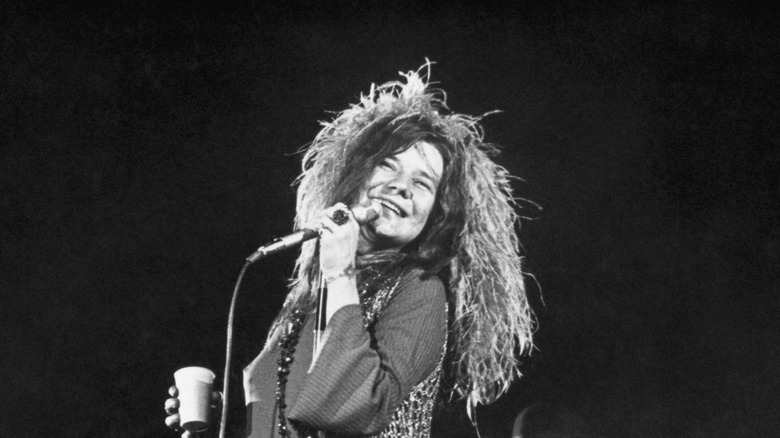
"Me and Bobby McGee" was written by Kris Kristofferson, and everyone from the Grateful Dead to Olivia Newton-John to Johnny Cash has covered it. But the most famous version of the song belongs to Janis Joplin. Her recording hit No. 1 on the Billboard Hot 100 in 1971, the year after she died of an overdose, making it only the second posthumous single to do so after Otis Redding's "(Sittin' On) The Dock of the Bay." It was by far her biggest hit ever.
"Me and Bobby McGee" was included as a track on "Pearl," the last album Janis Joplin recorded before she died. Famously a member of the 27 Club, Janis died of a heroin overdose on October 4, 1970, shortly after relapsing. Joplin and Kristofferson had worked together, lived together, and even dated, but he was unaware that his former lover had recorded his song until after she died. When he heard it for the first time, he walked around crying the rest of the day. In fact, he had to force himself to listen to it over and over until he could finally do so without sobbing. "I love it because of the passion and heart and soul that she put into everything she did," he said (via Far Out Magazine). "But, in that one, I can hear her saying, 'Wait until this son of a b**** hears this. He's gonna die.'"
Love Will Tear Us Apart — Ian Curtis (Joy Division)
Joy Division had a respectable hit with "Love Will Tear Us Apart," penned by lead singer Ian Curtis: The single peaked at No. 13 on the U.K. charts in July 1980. While it performed worse in the U.S., topping out at No. 42 on the Billboard Disco Top 100 that October, it has seen greater appreciation over the years. In Rolling Stone's 2021 update of the 500 Greatest Songs of All Time list, the song ranked No. 41.
The title is a tongue-in-cheek reference to Captain & Tennille's 1975 hit "Love Will Keep Us Together." But while that song is a joyous piece of pop, Curtis' lyrics were based on much darker topics. He experienced many setbacks and turbulent incidents in his life, right as Joy Division was starting to get big in the U.K. Curtis was a new father, but he was also having an affair and was diagnosed with epilepsy after experiencing seizures onstage. To make things even more stressful, he — along with the other members of the band — was trying to hold down his day job while touring the country on weekends, leading to more anxiety and exhaustion.
The difficulties that led him to pour his emotions into the song didn't go away. On May 18, 1980, Curtis died by suicide at age 23. "Love Will Tear Us Apart" was released one month later and became his epitaph, both figuratively and literally: His headstone bears the song's title.
Woman — John Lennon
John Lennon was one of the most famous musicians in the world when he was gunned down in front of his home in Manhattan by Mark David Chapman. But this was not the end of his legacy. Lennon's album "Double Fantasy" had just been released the previous month, and his death only made it more popular. The song "Woman" was released as a single on January 12, 1981, just over a month after his murder. It would be the first of many posthumous releases for Lennon, both from his solo work and even songs cobbled together out of unfinished tunes that were later released by the remaining Beatles.
This solo single was considered a return to his Beatles sound, and even Lennon recognized it, as he acknowledged in the Rolling Stone interview he gave shortly before his death. He also explained the inspiration for the song: "[W]hat dawned on me was everything I was taking for granted. Women really are the other half of the sky, as I whisper at the beginning of the song ... it just sort of hit me like a flood, and it came out like that." The video incorporated video of Lennon walking with Ono as well as headlines about his murder. The song hit No. 2 on the Billboard Hot 100.
You Got It — Roy Orbison
It was the late '80s, and Roy Orbison hadn't had a song crack the Top 40 since the 1960s. His time had seemingly come and gone. But things were about to change, because he made some good friends who all just happened to be incredibly talented musicians.
Orbison knew Jeff Lynne, a producer and member of Electric Light Orchestra. When the two decided to work on a new album, the producer knew just who to call. As Tom Petty remembers (via "Conversations With Tom Petty"): "Jeff lived not far from me, and one afternoon the phone rang, and it was him, and he said, 'Hey, Roy Orbison's over here, you've got to come over and help me write a song for him. I need some help.' So I jumped in the car ... I remember my first meeting with Roy ... we wrote 'You Got It.'" Throw in an appearance by ex-Beatle George Harrison, and they had themselves the perfect group to make a successful new album for Orbison.
Sadly, Orbison would only play "You Got It" publicly once. It was released as a single the month after he died of a heart attack on December 6, 1988, at the age of 52. Orbison's posthumous release hit No. 9 on the Billboard Hot 100 chart in 1989.
I Could Fall in Love — Selena
Selena Quintanilla-Pérez, who performed under the mononym Selena, was known as the "Queen of Tejano." She was incredibly successful in the Latin market, with her 1994 album "Amor Prohibido" going multi-platinum. But the singer, who was born and raised in Texas, wanted to break into the English market. She was finally poised to do just that when her life was cut tragically short.
The singer was killed on March 31, 1995. Selena's murderer, Yolanda Saldivar, was a personal friend and the former president of her fan club. But their relationship had imploded, as Selena and her management correctly suspected that Saldivar was embezzling money from the star. Realizing her scam was about to be exposed, Saldivar shot the 23-year-old, who died from her injuries shortly thereafter.
There was a huge outpouring of fan support for Selena's music after she died, and "I Could Fall in Love" became her first English-language hit. It received a ton of airplay, making it to No. 8 on Billboard's Radio Songs chart. Her album's title track, "Dreaming of You," was also released posthumously and peaked at No. 22 on the Billboard Hot 100 in November of 1995.
Falling Down — Lil Peep and XXXTentacion
Lil Peep (real name Gustav Åhr) and XXXTentacion (Jahseh Onfroy) had a hit with "Falling Down," and their single is particularly notable because it was a posthumous release for both rappers. The track was originally an unreleased Lil Peep song, and after his death from an accidental drug overdose on November 15, 2017, XXXTentacion heard a snippet of the tune that a fan had posted on YouTube. Inspired, he wrote his own verse. Then, on June 18, 2018, he was murdered.
In an interview with XXL, co-writer iLoveMakonnen (Makonnen Sheran) explained: "[X] ended up passing away, and his mom and his family were reaching out to Peep's management and everybody saying the song was something that [X] was very passionate about before he passed, and he would really like to be a part of this and [asked] if we could make this happen." They did, and the single was released in September 2018. It peaked at No. 13 on the Billboard Hot 100.
The two rappers had never met or otherwise communicated while they were alive, and not everyone was happy with the posthumous collaboration. "[Lil Peep] explicitly rejected Triple X for his abuse of women," GothBoiClique producer Fish Narc said in an Instagram Story (via Rolling Stone). "He spent time and money getting Triple X's songs removed from his Spotify playlist and wouldn't have co-signed that song."
Rock the Boat — Aaliyah
Okay, so Aaliyah's "Rock the Boat" was technically released as a single a few days before her death. But the hit music video was released posthumously, and the song peaked on the Billboard chart not long afterward. Funny enough, the record company wasn't sure about her recording "Rock the Boat," let alone releasing it as a single. Despite this waryness, the tune spent 25 weeks on the Billboard Hot 100 chart, peaking at No. 14 in November 2001. It was one of several songs of Aaliyah's to chart after her death, including "More Than a Woman" (No. 25) and "Miss You" (No. 3).
Sadly, the musician died right at the peak of her fame. Aaliyah's death was all the more tragic because, as well as her being so young — she was just 22 — it involved a mass casualty event. The singer was leaving the island where she had been filming the video for "Rock the Boat" when her small private plane crashed, killing all nine people on board.
"Those four days were very beautiful for everyone," director Hype Williams told MTV after her death. "We all worked together as a family. The last day, Saturday, was one of the best I've had in this business. Everyone felt part of something special, part of her song." At the time of his remarks, it wasn't known if the video would ever be released, as the footage had been turned over to her family. However, they did decide to let the world see the last creative project Aaliyah worked on, with the video soon in heavy rotation on BET and MTV.