

5 Moment-Defining Classic Rock Albums Hardly Anyone Talks About Anymore
We can all think back to a song that defines a particular moment in time or in our lives, personally. Perhaps these songs are massive hits that left a permanent mark on the zeitgeist, or maybe they made a subtler mark and don't really get talked about anymore. Same goes for albums across any decade, include classic rock and its golden era (1964 to 1982), a time littered with moment-defining works that reflect a societal phase, specific historical event, or artistic period.
Over time, there are lots of reasons why a certain album might fall out of public view. Maybe an album held some kind of relevance on release that it doesn't hold now. Maybe it gets overshadowed in conversation by more well-known, accessible, less ambiguous works, like Joni Mitchell's jazzy, 1976 "Hejira" swallowed up by 1969's folksy "Clouds" or 1971's "Blue." Other albums never reached the limelight but are lauded amongst other musicians (The Cure's Robert Smith, in the following case) for their verve and impact. Such was 1978's "Chairs Missing" by Wire, a truly ahead-of-its-time work that fused the most cutting-edge sounds of its day, particularly post punk and new wave, into something that still sounds fresh today.
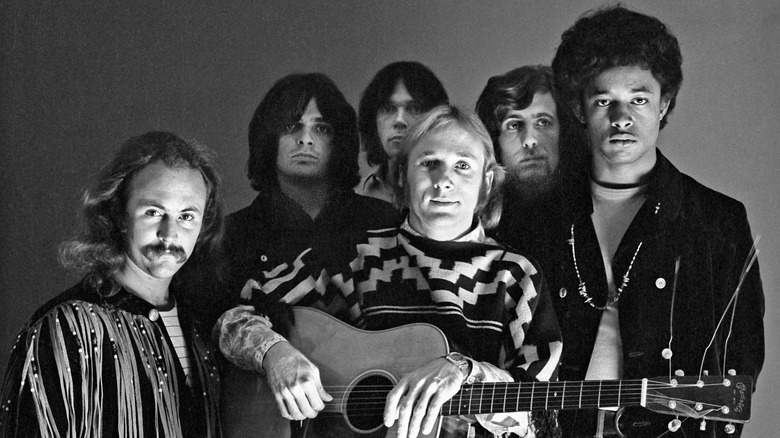
Besides these two examples, we've got a protest song from Crosby, Stills, Nash, and Young that most people know for its later version, not its original record. We've also got a weird, satirical concept album from The Who and an even weirder prog-defining album from The Mothers of Invention.
The Who Sell Out — The Who
The Summer of Love hit in 1967, a wild time of cultural upheaval, druggy experimentation, anti-war protests, sexual indulgence, and oodles of classic rock that reflected the times. Two years later we'd get Woodstock, the peak of '60s counterculture that presaged its decline. And what were English progsters "The Who" doing in 1967, two years after delivering their anthemic hit "My Generation" (off their debut, no less)? They were already way ahead of the cultural and musical curve with "The Who Sell Out," an album which didn't go anywhere, commercially, and which gets massively overshadowed by later albums like "Quadrophenia."
Come 1967, The Who were under pressure to release another record and decided to look to their pirate radio (non-BBC-owned) roots for inspiration, which had helped get their music out to begin with. Relatedly, they saw how music was being co-opted by a label-dominated, profit-driven industry, which worked hand-in-hand with the emptiness of modern consumerism in the middle of the Summer of Love. This is how The Who bypassed all psychedelic hippie stuff to release "The Who Sell Out," a mock pirate radio broadcast album complete with fake jingles and product placements so good that actual jingle writers and radio stations sued the band. The Who went a different direction than everyone else that year — Jimi Hendrix, Pink Floyd, and especially The Beatles' wacky, costume-filled "Sgt Pepper's Lonely Hearts Club Band" — and took musical inspiration from Brian Wilson's compositional work on The Beach Boys' 1966 "Pet Sounds."
As a result, The Who flipped off the establishment in a way that other bands only hoped to do. While other musicians marched lockstep and claimed to be anti-establishment, all together, The Who really were.
Hejira — Joni Mitchell
What does it mean when the lady who once wrote a song extolling the beauty of Woodstock later calls the whole thing "a large movement of conformity"? But even before singer-songwriter extraordinaire Joni Mitchell said those words in a 1985 interview with Old Grey Whistle Test, she'd steered away from solo acoustic guitar outings to a jazzy, hybrid folk-rock sound with an album no one really talks about anymore, 1976's "Hejira" (featuring the very personal opener, "Coyote"). The Vietnam War had ended the year prior in 1975, the classic rock-infused counterculture of the '60s had gone mainstream, big stadium rock was on the rise with groups like Led Zeppelin, and Mitchell was already ahead of the curve, just like The Who.
It's not that the dream of the '60s died with Mitchell, but rather "Hejira" earmarked its end for any straggling true believers. But Joni Mitchell, poetess supreme, was never a true believer. As Mitchell's official website quotes her, "I wasn't really a hippie at all. I was always looking at it for its upsides and its downsides, balancing it and thinking, here's the beauty of it and here's the exploitative quality of it and here's the silliness of it. I could never buy into it totally as an orthodoxy." How does this square with the lyrics of "Woodstock"? Well, "Woodstock" is actually a lament that ends in the words, "And we got to get ourselves back to the garden."
Nowadays, Mitchell's pre-"Hejira" albums tend to get all the focus, especially "Blue." But while "Blue" was certainly indicative of the times, it's too easy for people to remember its clear waters rather than talk about the more realistic, nuanced murk of a lost summer dream.
Freak Out! — The Mothers of Invention
Those whose vision of prog rock starts and ends with Pink Floyd's "The Dark Side of the Moon" are in for a shock when they step beyond that most accessible (and yes, stupendous) work. That album came at what is arguably the mid-to-early '70s peak of progressive rock's evolution: The Who's "Quadrophenia," King Crimson's "Red," Yes' "Closer to the Edge," Genesis' "Foxtrot," and more. This more outré and complex branch of rock grew out of mid-60's psychedelia in parallel with what would become arena rock. But Frank Zappa, head of the whackiest proto-prog band on the planet, "The Mothers of Invention," was vehemently anti-psychedelics. You'd never know it listening to 1966's "Freak Out!," though.
It's a bit hard to describe precisely how perfectly "Freak Out!" captures the mid-60s experimental energy that would blossom into full-blown prog. The album is basically a musical test tube bubbling with all sorts of creative notions: a smidgen of recognizable rock (folks with guitars, bass, and drums), a smattering of hallucinatory weirdness, a sprinkle of odd digressions and oddball humor, a big helping of "I don't care what anyone thinks," plus some kazoos. The whole album culminates in the most truly bizarre track you could ask for, "The Return of the Son of Monster Magnet," with its opening lines directed at "Suzy Creamcheese." Add some space lasers, hoots and barks, effects-drowned percussion, and a whole lot more strangeness, and you've got a glimpse of Zappa to come.
What does this all mean? It means that the mid-to-late-'60s were the perfect juncture for ultra-creative musicians to pass along their art to the public, with "Freak Out!" being a prime, early example. What a time to be alive.
Ohio — Crosby, Stills, Nash, and Young
Albums throughout the '60s were littered with anti-war protest songs, many of which folks would recognize on cue, like 1967's "Get Together" by The Youngbloods or 1968's "Revolution 1" by the Beatles (actually written in rebuke of violent protests). Entire protest albums, though, are a rarer breed — unless you're Crosby, Stills, Nash, and Young speaking about violence not on foreign soil, but American streets. So it was that the quartet released "Ohio" in 1970 in response to the Kent State Massacre on May 4, 1970, when the Ohio National Guard fired into a crowd of protestors at Kent State University and killed four students. Few songs could be as timely or "of the moment."
Classic rock fans might recognize "Ohio," as it has nearly 122 million listens on Spotify — from the 1974 album "So Far," that is. Live versions of the song came years earlier on 1971's "4 Way Street," and 1970's "Fillmore East 1970," both of which hover at the far fewer million-plus listens. But, there was an even earlier release of the song on its own, two-song album (a single, essentially) in 1970, along with "Find The Cost Of Freedom." This happened because Neil Young, the songwriter, wrote and recorded the track immediately after hearing the news about the shootings and took about an hour to do so, as Graham Nash said in a 1990 interview on YouTube. The track got rushed through the record-pressing process and hit the public a mere 10 days later, when the news was still fresh.
Nowadays, this original, two-song release of "Ohio" is an obscure musical find. But the song itself lives on and remains sadly relevant.
Chairs Missing — Wire
So let's pretend we can take punk, post-punk, punk pop, new wave, splice it with the remnants of early '70s psychedelia, lacquer it with weird sound effects and dark synth sounds, drape it over the skeleton of a band, and fashion it into something so fresh that it sounds like a 21st-century home studio digital project. This exists, you ask? Indeed it does, and it's called 1978's "Chairs Missing" by Wire, an album that you've likely never heard of unless you're a music history aficionado or were a fan back when it was released.
"Chairs Missing" is a lightning-in-a-bottle album that sat at the crossroads of rock come the late '70s. It bundled up the past, present, and future into one music-defining album that could only come from its time, but sounds ahead of its time while also sounding timeless (let that sink in). The album's more dissonant, creepier, noisy electro-pop elements even echo later non-rock genres, especially '90s trip-hop. Its position as a 1978 release isn't accidental, either. Released one year after punk cracked the mainstream via Sex Pistols, it's as though Wire frontman and songwriter Colin Newman had already sized up the zeitgeist, plucked its best parts, and assembled '80s and '90s sound and sound engineering in one go. Singer Robert Smith of The Cure once said that he'd give up on music altogether if Wire came back.
But as Rock and Roll Globe quotes Newman, "Wire is really not actually a punk group." They're not a rock band, either, he said. So what are they? Music, we could say. Newman described the album coming from a group of guys in a good head space, having fun making music, and that's that. That's also history.