

Musicians Who Predicted These Then-Young Stars Would Skyrocket To Fame
On the Conversations with Tyler podcast, legendary producer Rick Rubin defines creativity as "the act of noticing," adding, "[t]he creator isn't making the thing. The creator is recognizing the thing, noticing the thing." Both the art and business of music rely on that ability. It helps you spot talent, hear hit potential, and identify star power. This act of prediction is the lifeline of an industry always seeking the new, the novel, and the next big thing. Everyone in the game, including the musician, is in talent acquisition and artist relations (A&R) to some extent: keeping ears to the ground, reading the tea leaves, and charting stars on the rise.
Across musical genres and time periods, certain rock, pop, R&B, and hip-hop artists have proven especially adept at this critical astronomy. They've recognized game, predicting an artist's rise to fame long before the rest of the world figured it out. Stevie Wonder heard it the first time he met the once and future King of Pop, and Chaka Khan knew a young Whitney Houston was special the moment she grabbed the mic. Some musicians even bet on these up-and-comers, tipping the scales in their favor, or offering mentorship.
These musicians believed their eyes and ears, broke out the crystal ball, and predicted coming waves of fame. Perhaps seeing something of themselves in their young proteges, each one took part in that act of noticing. They recognized the rocket ship before liftoff, knowing exactly how high it would soar.
Stevie Wonder meets a curious pop prince in the studio
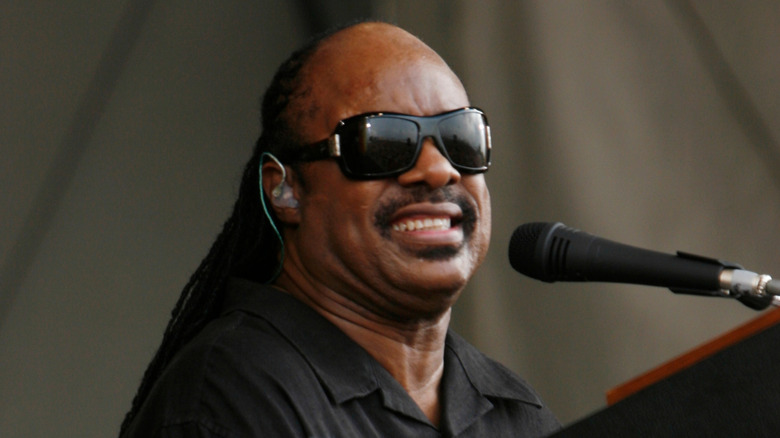
As a musical prodigy, Stevie Wonder was uniquely able to identify talent on the rise, though it must've been easy to tell with the singing and dancing kid from the Jackson 5. The iconic R&B singer, pianist, and songwriter was just 13 himself when he scored a No. 1 on the Billboard Hot 100 with "Fingertips, Pt. 2" in 1963. As part of the Motown Records factory, Wonder grew up in the studio and on his records, spinning early recognition into continued relevance and eventual creative control. Wonder knew from the jump that this kid was special, and no doubt, his career arc was an inspiration to young Michael Jackson; the older musician's career in many ways set the template for the younger.
Wonder was in his late teens when the Jackson 5 started coming around to the studios in 1969. The buzz was palpable surrounding the group, especially their supremely gifted lead singer, Michael. What first struck Wonder was the kid's voracious hunger for knowledge, telling Time, "He would always come into the studio curious about how I worked and what I did." He also knew immediately that this curious wunderkind was going places, adding: "I definitely felt that he would be someone. You heard the voice, and all he could do was grow." The growth was quick and the impact immediate: the Jackson 5 charged out of the gate, scoring four consecutive hits in 1970 alone, and Michael Jackson put on the pop crown.
Chaka Khan knows Whitney isn't every woman

It took just a few notes and bars for Chaka Khan to understand that Whitney Houston was going to be a brilliant and bright star. Breaking through singing the Stevie Wonder-written "Tell Me Something Good" with the soul funk band Rufus, Khan's solo career became nothing less than jaw-dropping: 10 Grammys, chart dominance (including eight No. 1s on the Hot R&B/Hip Hop charts) and, with "I'm Every Woman," a timeless anthem of women's empowerment. As someone who blazed trails, Khan immediately clocked the type of talent that would carry the torch.
Singing runs in Whitney Houston's family. Dione Warwick is a first cousin, and her mother, Cissy Houston, made a name for herself as a gospel, R&B, and soul singer. Cissy, working as a backup singer, talked up her immensely talented daughter to Chaka Khan. The 13-year-old was invited to perform for her, and Khan was immediately floored. "She was brilliant," Khan told the Table Manners podcast, "And, you know, I thought to myself, I was thinking, 'God, she's going to be so great'" (via Music Radar).
Houston's career — cut off far too soon with her death in 2012 — burned bright as predicted. She scored an astonishing 11 No. 1s on the Billboard Hot 100 and became one of the most celebrated voices in pop and R&B. And a highlight of that legacy is her version of the song that made Chaka Khan a household name: "I'm Every Woman" off "The Bodyguard" soundtrack.
Usher was the original Belieber
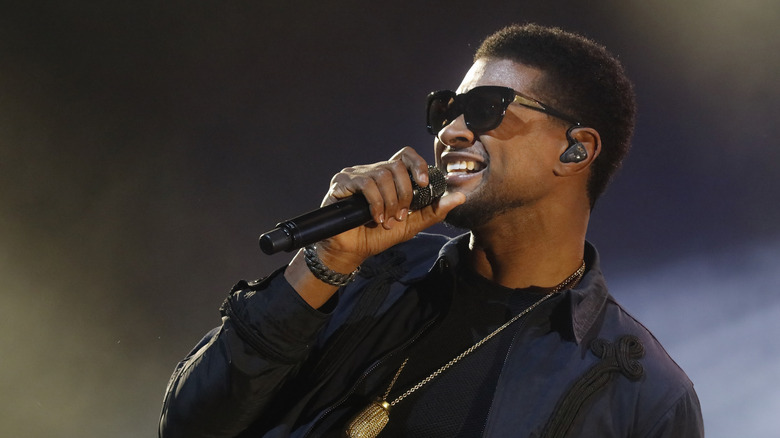
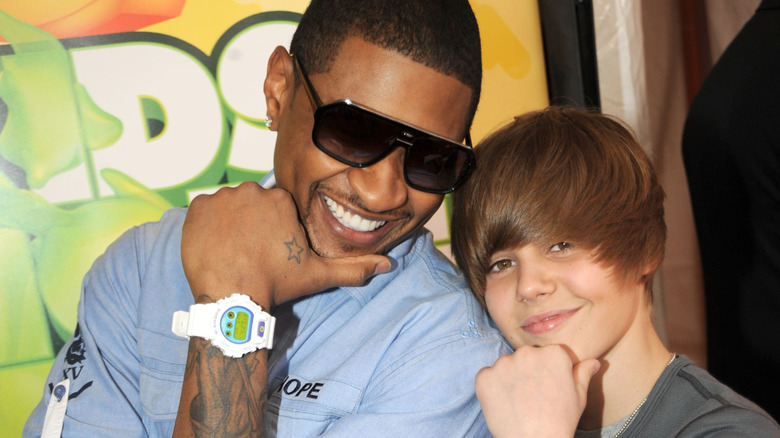
To succeed in music and business — and especially in the business of music — it helps to have a good mentor. They help you find footing in a chaotic industry, mold and cultivate your talent, and show you what it takes to become a superstar. We'll never know for sure, but it's clear that Justin Bieber's career would look different without the mentorship and collaboration of R&B songwriter, singer, producer, dancer, and pop mogul Usher. And here, too, the protégé gained the insights of a former child star.
Usher had big aspirations growing up, and the adults around him, starting with his mother, recognized his talent. He scored a record deal by age 13 or 14, depending on the source. His 1997 debut album "My Way" peaked at No. 4 in the Billboard 200, marking a rise to pop's stratosphere, where he remains both as a performer and writer and as a producer and cultivator of talent. Thanks to viral YouTube videos, a buzz developed around Bieber when he was around 13, and after an audition, in 2008, Usher signed the young Canadian singer. "It was truly his talent — his ability to, on the spot, produce that magic," he told Parade (via AOL), "I didn't know what he would be, but I knew I wanted to be involved."
Usher wasn't the only one interested in Justin Bieber — he beat out Justin Timberlake in the bidding war — but there's no denying that it was a good fit. The results spoke for themselves; Usher co-produced Bieber's debut EP "My World," co-wrote early hits like "One Less Lonely Girl" and "First Dance." Clearly, game recognized game.
Bowie helps Devo devolve
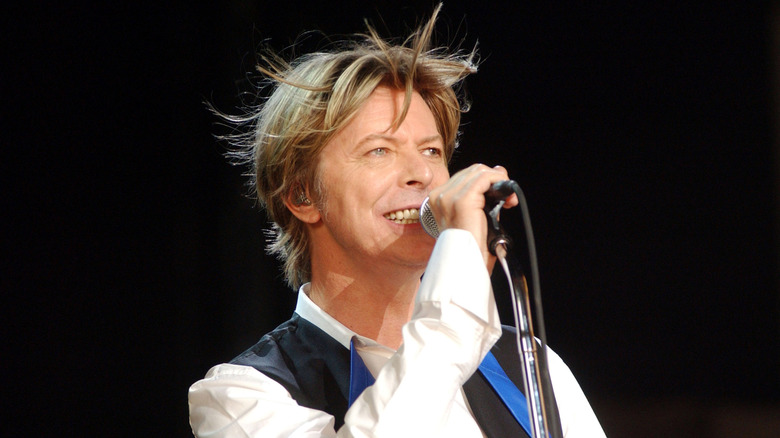
The night David Bowie introduced them as "the band of the future," Devo didn't know where they were going to crash. After seeing a set at Max's Kansas City in 1977, the legendary rocker offered to produce them and get them signed. "And we're like: 'Sounds great to us,'" singer and guitarist Mark Mothersbaugh recalled at a 2017 "Song Stories" talk at the Soho Sonos Store, "We're sleeping in an Econoline van out in front on Bowery tonight, on top of our equipment" (via Bedford and Bowery). For what it's worth, Mothersbaugh made out alright that night. Reportedly, Bowie took the band out — among highlights of a wild night, the Akron, Ohio native had his first taste of sushi — and put him up in his hotel room. That beats bunking in the van by a long shot.
More importantly, Bowie wasn't just blowing glitter that night. He became instrumental in the making of Devo's debut album "Q: Are We Not Men? A: We Are DEVO!," which was recorded in Cologne, Germany. His collaborator Brian Eno was the producer; he'd stop by the studio and he even recorded some backing vocals. Bowie's singing didn't make the album because Mothersbaugh was "totally paranoid about people interfering with our stuff," he told the audience at "Song Store" (via Bedford and Bowery) — but Bowie's thumbprints are all over the vinyl. And within three years, the release of the "Freedom of Choice" album made Devo that band of the future, with songs that sound even cooler today than they did in 1980.