

'80s Rock Icons Who Walked Away From Their Careers
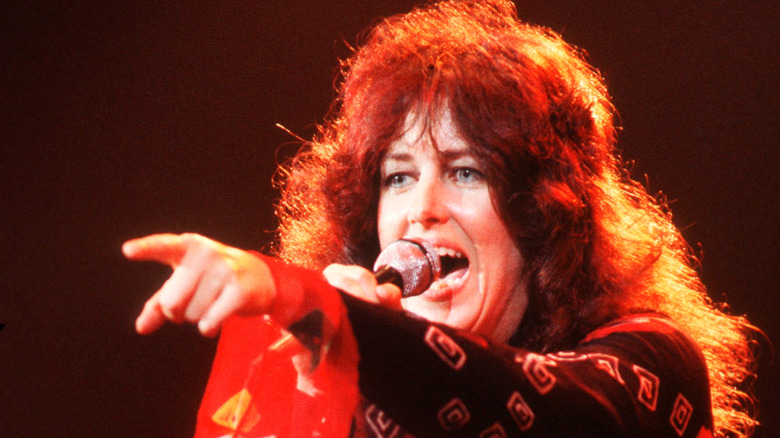
Believe it or not, there is more than life to music. A controversial take, we know, and yet some of the coolest musicians of all time have come to agree. Even some rockstars, with all the fame and money that come with the job, have eventually found their way out of the music world and into the real one. As one of rock's biggest, loudest, and most experimental decades and the start of the music video era, the '80s saw more than its share of musicians hit big before disappearing. And perhaps surprisingly, many made the choice willingly.
Here are five examples of '80s rockstars who left music on their own terms. Some found new passions ranging from farming to race car driving, others merely tired of the lifestyle, and others still continue to keep their true motivations secreted away. Whatever the case, this is what these '80s artists are up to after quitting music for good.
Andrew Ridgeley
To the extent that Andrew Ridgeley is a household name, it's as one of the most famous second fiddles in pop music history (and in a meta sense, is possibly the second most famous second, behind only Art Garfunkel). Ridgeley was, of course, the guy in Wham! who wasn't superstar George Michael. This fame came with a lifetime of comparisons, but by Ridgeley's own design, it also afforded him the chance to retire on top and explore a comfortable life beyond music.
Through the years, Ridgeley has always been transparent about his limited interest in the music industry. "It was an intrusion that I wasn't prepared to have, so I was quite content to step away," he said of the fame that came with Wham! while speaking with Classic Pop. Ridgeley has also been open about his unwavering desire to see Michael go on without him and revealed that the group's breakup was always the plan. "Very early on, we understood that Wham! could only be temporary," he explained. "For George to develop as a songwriter, he had to do it on his own ... Wham! had parameters and constraints. That's why it could never be permanent."
There's a lot of grace and wisdom in Ridgeley's decision to end Wham! at its peak. The duo can certainly never be accused of overstaying its welcome. Ridgeley has had a happy life since, including a long marriage to Keren Woodward of Bananarama and even a brief foray into Formula 3 motor racing.
Billy Squier
Billy Squier is one of those artists that are so definitively of their time period. Squier is the early '80s, and to some extent, the early '80s are Squier. The rocker was a huge success in the early half of the decade, and the combination of his working man's-Robert Plant-singing and drum-forward arrangements helped lay the foundation for the arena rock and power pop that would come to define the era. Unfortunately, his rising star began a swift descent to Earth following the disastrous release of his "Rock Me Tonite" music video, often regarded as one of the worst ever, both cursing and blessing Squier with an early retirement.
How much of Squier's fall from grace was the result of the "Rock Me Tonite" video has been the subject of debate. But regardless of the reason why, he found sharply diminishing returns from his music career in the years after its release. In 1994, Squier decided to retire as a full-time musician and, as he revealed in the book "I Want My MTV: The Uncensored Story of the Music Video Revolution," is pretty happy with his choice. "The wounds have healed and the scars aren't that deep," he said, "because my life has evolved in a good way. I left the music business when I was 43. I don't have to work. Look who's smiling now! That video is a bad part of a good life."
Paul Westerberg
Between 1984 and 1987, the legendary Minnesota-based alternative rock band The Replacements released three of the genre's greatest albums — "Let It Be," "Tim," and "Pleased to Meet Me" — all in a row. The group's work bridged the gap between punk rock and alternative and became an enduring influence on both genres, largely thanks to the songwriting of frontman Paul Westerberg. Part of Westerberg's genius was in his unpredictability (something that contributed to the intense notoriety of the act's live shows), and it was that same unpredictability that led to him exiting the band for ... well, you never know with Westerberg.
Despite the band being his vehicle more than anyone's, Westerberg was still critical of its music in interviews. At times, he even reportedly showed contempt that he had to perform the group's material live (again, his own material). For whatever reason, Westerberg just couldn't walk a path anyone expected, and it led to him dissolving The Replacements entirely, despite its critical adoration and devoted cult following.
When asked by The Washington Post about Westerberg, Replacements bassist Tommy Stinson answered with a level of diplomacy brought on by years of practice. "He's just on his own trajectory to be Paul and the way he feels like he wants to be," he explained. "You've got to tip your hat to him — it's like he's doing what he wants, whatever that is. When he wants to do something else, you'll hear about it, I'm sure." The last time Westerberg released an album was in 2016, and only he knows if there'll ever be another.
Bill Berry
In contrast to a mercurial figure like Paul Westerberg, whose motivations can seemingly never be pinned down, Bill Berry is one rockstar whose philosophy and goals have always been open and apparent. Berry was the drummer for R.E.M. through the band's first 10 albums — a period that includes essentially the entirety of the group's commercial success. He is a rare rock star who not only gave up the spotlight willingly but also did so amicably with all of his bandmates and even continued supporting them throughout their career.
Put simply, Berry just didn't enjoy being a working rockstar. In multiple interviews, he has insisted that, though he did and still does love music, he didn't like the business side, the fame, or the constant travel. When he'd had enough of the lifestyle (which it's worth pointing out came right after he suffered a ruptured cerebral aneurysm onstage that required brain surgery), Berry simply arranged an amicable exit with the band and settled down to a quiet life on a farm in Georgia.
In the years since, Berry has returned to perform with R.E.M. a handful of times and released some of his own material, but he nevertheless seems content to live a quiet, bucolic life. "Vacation for me is right here [on the farm]," he told the "In Weird Cities" podcast. "I spent enough time in airports and in vans and on buses. I kind of like sitting still for a while. Still haven't grown tired of that."
Grace Slick
Singer Grace Slick has always been one of the queens of reinvention. Not many people can say they were the frontperson to two (really two and a half) hit bands in two different decades — nonconsecutive decades, to boot — and fewer still can say that they then gave it all up for an entirely new iteration, one completely apart from the music that made them. Thanks to her tenures as the face of Jefferson Airplane in the '60s and Starship (née Jefferson Starship) in the '80s and her decision to retire young and pursue painting, Grace Slick can.
Starship was one of those bands that screamed '80s, from its technicolored album covers to its synth-laden, arena-ready, middle-of-the-road rock. Fittingly, as the decade that birthed it came to a close, so did Starship — at least the successful, Slick-led version. Between '89 and '90, she left Starship and, with only a couple of minor exceptions, has never looked back.
Since she retired from the music business, Slick has been content to produce visual art instead. She spends her days in Malibu, painting and living what seems to be an idyllic life. Speaking with Classic Rock, Slick candidly revealed how comfortable her musical past has made her. "Royalty checks are great," she said. "I always knew once [Jefferson] Airplane became famous that it would be around until I drop dead. Anyway, I deserve it. I wrote a few good songs. And I've never bounced a check in my life." For Slick, at least, walking away seems to have been a perfect choice.