

5 Songs From 1983 That Define Rock History
Five of the most important songs in the history of rock 'n' roll graced record stores, radio, and MTV in 1983, making it one of the most pivotal years in rock history. As the mid-decade approached, the sounds of the 1970s had given way to or inspired the musical forms that would come to define the 1980s and beyond. That year demonstrated a splintering of classic and straightforward rock into various new and emergent forms and subgenres. Hard rock, new wave, synthesizer-based rock, and soft rock would all find receptive audiences and inspire other musicians as they pushed pop music forward.
Some of the biggest artists of the 1980s hit creative and commercial peaks alike in 1983. Their career-highlight songs would go on to be inextricably linked to that year as well as becoming milestone moments in pop culture. Not only were they some of the biggest hits of the year (if not all time) that were rock-coded, but they also acted as test balloons of new and ultimately crucial rock sub-styles. Here are five quintessential songs from 1983 that help define the history of rock.
Every Breath You Take - The Police
"Every Breath You Take" by the Police created a ripple effect on rock music in the 1980s. It helped take thoughtful, moody alternative rock from the U.K. into the mainstream, opening the door for more American exposure for bands like Duran Duran and the Cure. The Police's music, and "Every Breath You Take" in particular, was a worldly, mature kind of rock, and it set up frontman Sting to embark on his solo career as a craftsman of sophisticated, adult-oriented pop rock.
Even without considering its artistic merits, "Every Breath You Take" is one of the most important rock songs to emerge in 1983 simply because it's one of the most wildly successful singles in history. A classic rock song from the '80s that's worth a head-turning amount of money, "Every Breath You Take" spent eight weeks at No. 1 in the summer of 1983 — enough for Billboard to declare it the top single of the entire year. By 2019, "Every Breath You Take" had been spun on the radio about 15 million times, making it the most-played song ever.
Photograph - Def Leppard
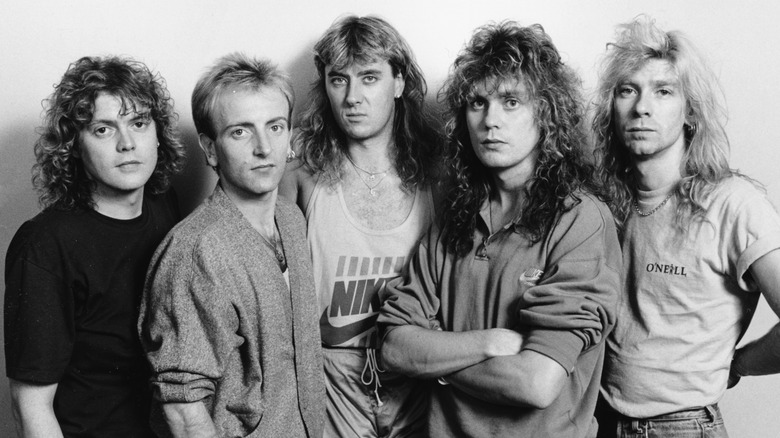
While Def Leppard wasn't really ever a hair metal band, it certainly inspired numerous famous '80s hair bands with its early hits, particularly the 1983 single "Photograph." Check out that opening messy lick, the thundering drums, and Joe Elliott's reaching vocals. This is what '80s hard rock and hair metal would sound like. Hailing from the factory city of Sheffield, England, and finding a following as a shaggy, loud, and hard-rocking outfit since forming in 1977, Def Leppard went on to become one of the most important rock bands of the 1980s. It took parts of the arena rock of the '70s — big riffs, soaring vocals, anthemic melodies with singalong lyrics — and added in the pop sensibility, tight harmonies, and intricately produced and processed sheen associated with the '80s.
The loud and heavy guitar-drenched track bore all the trappings of metal, but it was also an extremely catchy pop song. It's a formula that later guitar-based but radio-friendly bands with towering hairdos would use on their own hits. "Photograph" was not only a No. 12 hit in the spring of 1983, it was also the first of Def Leppard's 15 trips into the Top 40.
Stand Back - Stevie Nicks
Stevie Nicks' "Stand Back" was a declarative statement of a new era of classic rock. The first era, dominated by blues-influenced British bands, psychedelic acts, and guitar-based hard rock groups, endured from the late 1960s through the 1970s. With her propulsive and sensual "Stand Back," which peaked at No. 5 on the Hot 100 in August 1983, Nicks helped bring on the second wave of classic rock, presaging how many other established rock figures — Aerosmith, Elton John, and the Beach Boys, to name a few — would approached the years to come.
It wasn't her first hit away from Fleetwood Mac, but it was more rock-forward than her previous, smoother solo hits and collaborations with Don Henley and Tom Petty and the Heartbreakers. What made "Stand Back" such a milestone in '80s rock is its use of synthesizers. Artificial sounds made by keyboards and other machines are a definitive '80s element, and Nicks proved that one could still make a song that rocked hard even if it was built on shimmering synthesizers. There's of course plenty of guitar in the mix, but "Stand Back" championed rock keyboards in a pioneering way.
Sweet Dreams (Are Made of This) - Eurythmics
By 1983, the new wave era had been happening for about half of a decade. It evolved and transformed rapidly, moving from a simple and unpretentious crunchy guitar style into one that incorporated synthesizers that sounded as futuristic as the phrase "new wave" implied. New wave of the mid-1980s remained spare and even a little cold, and it's the U.K. duo Eurythmics that perfected the mixture. Its 1983 hit "Sweet Dreams (Are Made of This)" is thus the ultimate song of new-wave-with-synthesizers period and fundamental to '80s rock history.
And yet in their attempt to make what could be considered a creepy and robotic song that reflected an unease with modern life, musicians Dave Stewart and Annie Lennox crafted "Sweet Dreams (Are Made of This)" into a piece as human, soulful, and resonant as any classic rock standard. Eurythmics' first commercially successful single in the U.S., it topped the Hot 100 for a week in September 1983. Eurythmics also demonstrated the importance of MTV to an act's success, as its strange and abstract video for "Sweet Dreams (Are Made of This)" was a hit at the fledgling network that married images to rock and pop music.
Beat It - Michael Jackson
The lines that separated musical genres and individual rock styles became delightfully blurred in the 1980s, and Michael Jackson was partially responsible for a big shift in that direction with "Beat It." Before recording "Thriller," the so-called King of Pop aimed to make an LP where every track could feasibly be a hit single. To do that, the songs would have to appeal to as many people as possible, meaning fans of different genres. There's plenty of signature Jackson pop and R&B on the LP, like "The Girl Is Mine" and "Billie Jean," respectively, but then there's also "Beat It." The song spent three weeks at No. 1 in the spring of 1983, the second track from "Thriller" to top the Hot 100. It's Jackson's stab at populist hard rock, and it helped "Thriller" to sales of 34 million copies, the most of any studio album ever.
To create such a pristine, stripped-down, and rapid-fire rock track from scratch, Jackson sought out collaborators who knew that world better than he did. Steve Lukather of Toto played most of the guitar parts on "Beat It," while Eddie Van Halen of Van Halen contributed the blistering guitar solo. In that way, "Beat It" hitting as big as it did in 1983 prepared the public for a major rock event of 1984: Van Halen's "1984" album, that band's most popular LP of the decade.