

The 5 Best Classic Rock Album Covers Of The '70s

Old-school vinyl records may be making a comeback, but it was the most popular way for music fans in the 1970s to hear their favorite rock stars. And it wasn't just the music, as the cover of each album became part of the overall experience — to the point that the designs of album covers became increasingly creative, ultimately emerging as an art form.
That was certainly the case with some of the biggest acts of that decade, with some album artwork becoming as iconic as the albums themselves (say, The Rolling Stones' "Sticky Fingers," or Led Zeppelin's legendary fourth album). Truth be told, there are so many amazing album covers that emerged from the 1970s that determining which are best is no mean feat. To address this, we focused on highlighting those that were instantly identifiable, have become inextricably linked with the music contained within, and continue to have a cultural impact. With that in mind, read on for a rundown of the five best classic rock album covers of the '70s.
The Rolling Stones - Some Girls
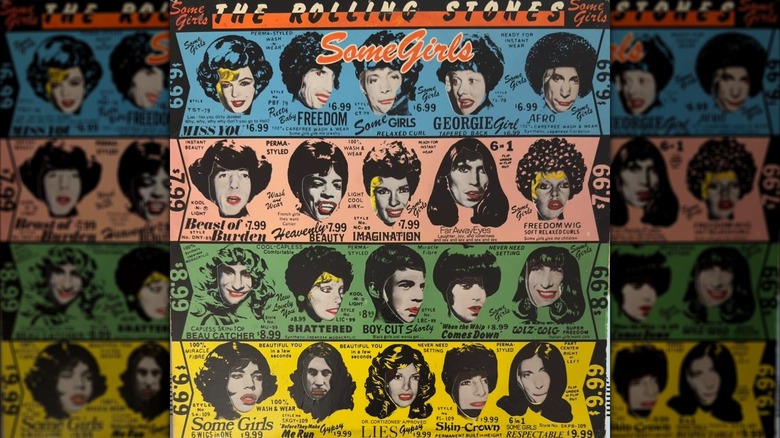
When delving into the untold truth of The Rolling Stones, the band's 1978 "Some Girls" album not only represented a return to form, but the album's cover was as visually striking as it gets. Boasting garish colors and a punk sensibility that hinted at the raw rock sound contained within the vinyl's grooves, the "Some Girls" cover sparked controversy and legal threats.
Designed by graphic artist Peter Corriston, the design utilized an old magazine ad for wigs, from a company called Valmor, with the model's faces removed. The inner sleeve contained vintage photos of various celebrities, ranging from Judy Garland to Lucille Ball, in addition to the visages of the band members. However, the album had to be quickly redesigned when some of those celebs objected to their images being used, and threatened to sue — as did Valmor, which was reportedly paid a settlement. "On the original album there were old-fashioned film stars, but because we were stupid and never got permission from them, we got stopped a lot from using them," Stones frontman Mick Jagger recalled in an interview with Yahoo! Entertainment.
That led to the album pulled from the shelves, with other versions issued. One of these featured original drawings of women, from illustrator Hubert Kretzschmar, while yet another replaced the old-timey stars with 1970-era celebrities. Yet another removed all the faces entirely, with a banner across the album that read, "Pardon Our Appearance – Cover Under Reconstruction."
Pink Floyd - Dark Side of the Moon
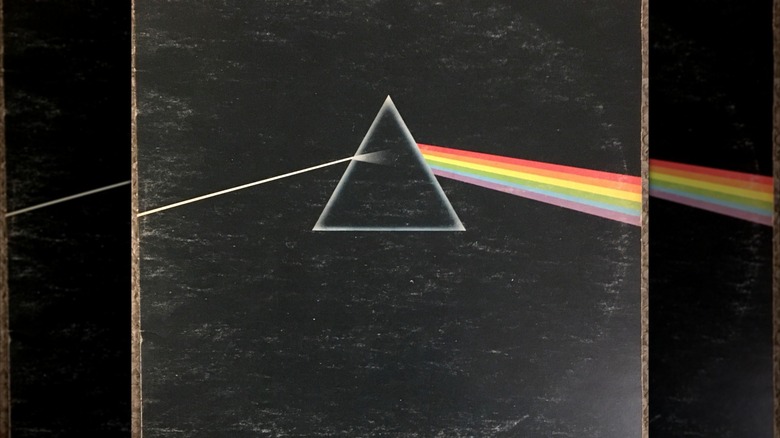
Released in 1973, Pink Floyd's "Dark Side of the Moon" quickly became a rock classic. The album made history for spending more time in the Billboard Top 200 than any other in history — nearly 1,000 weeks. Meanwhile, the album's cover has become indelibly integrated within popular culture, a triangular prism set within a black background, with a single beam of light entering one side, and a multi-colored rainbow-like beam exiting another.
The cover was designed by Hipgnosis, a London-based design agency founded by graphic artists Storm Thorgerson and Aubrey "Po" Powell. Hipgnosis ultimately created hundreds of iconic album covers, ranging from Led Zeppelin's "Houses of the Holy" to Paul McCartney and Wings' "Band on the Run," yet "Dark Side of the Moon" remains the agency's towering achievement.
The concept came after they met with the band, and were warned to avoid anything too surrealistic. Searching for ideas, they thumbed through a French physics textbook and stumbled upon a photo of light refracted through a small glass object. "Storm looked at me and said, 'I've got it: a prism. It's all about Pink Floyd and their light show,'" Powell told Rolling Stone. When they presented the concept to the band, all the members instantly loved it. "It's very interesting, because it became one of the most iconic album covers of my generation," Powell mused. "And of course I'm very proud of the status it gained."
David Bowie - Alladin Sane

Prior to breaking through to mega-stardom with his "Ziggy Stardust and the Spiders from Mars" album, David Bowie held the ignominious status as one of the music icons whose debut album flopped. And as striking and iconic as the "Ziggy" album cover is, the cover of Bowie's 1973 follow-up, "Aladdin Sane," is even more so.
Ultimately, the impetus behind the design came from Bowie's then-manager, Tony Defries, who instructed photographer Brian Duffy to pull out all the stops and spare no expense. "The key was to make something that was different and astonishing and important," Defries told Mojo. In that vein, Duffy came up with the idea of painting a colorful lightning bolt on Bowie's face, inspired by the "Taking Care of Business" logo that Elvis Presley had recently started using.
When doctoring the image, Duffy utilized state-of-the-art techniques — including special photographic plates manufactured in Switzerland — to create the stylized look of the cover, which includes a drip of melted wax in the hollow of Bowie's clavicle. That image, with the lightning flash adorning Bowie's face, is arguably the single photo that's become most associated with the late singer. "Defries had a master plan to make David a world superstar," noted the late photographer's son, Chris Duffy. "But it's funny: Bowie only ever had the flash on his face once, that one day."
Fleetwood Mac - Rumours
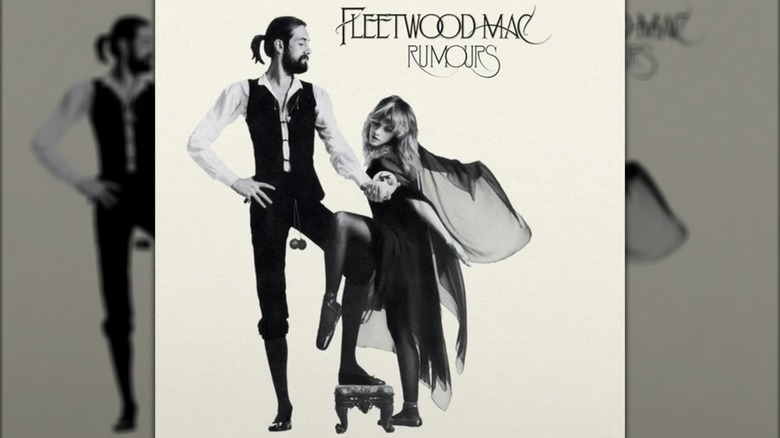
As rock fans know, the story behind Fleetwood Mac's "Rumours" album is pretty wild, and that's also the case with the album's now-iconic cover. Not only is the photo — a balletic image of drummer Mick Fleetwood and singer Stevie Nicks, in a dance-like pose with her leg resting upon his while clutching a crystal ball — completely arresting, it was also bursting with symbolic imagery, even if fans had no idea what it was all supposed to mean. Meanwhile, it didn't hurt that the album itself was a blockbuster, selling more than 40 million copies.
The most eye-catching aspect of the photo is the set of twin orbs dangling between Fleetwood's legs — which were actually wooden balls attached to a chain, which he'd taken from a toilet, and habitually wore on his belt as a sort of good-luck charm. Meanwhile, the same crystal ball had appeared on the group's previous album, the self-titled "Fleetwood Mac."
The striking photo was taken by self-taught photographer Herbert W. Worthington III, with Nicks said to be costumed as the Welsh witch upon whom she based her song, "Rhiannon." That image of Fleetwood and Nicks has become deeply ingrained within the pop-culture consciousness; five decades after the album's release, the "Rumours" album cover remains instantly recognizable, and conjures up the numerous hits that the album spawned.
The Clash - London Calling
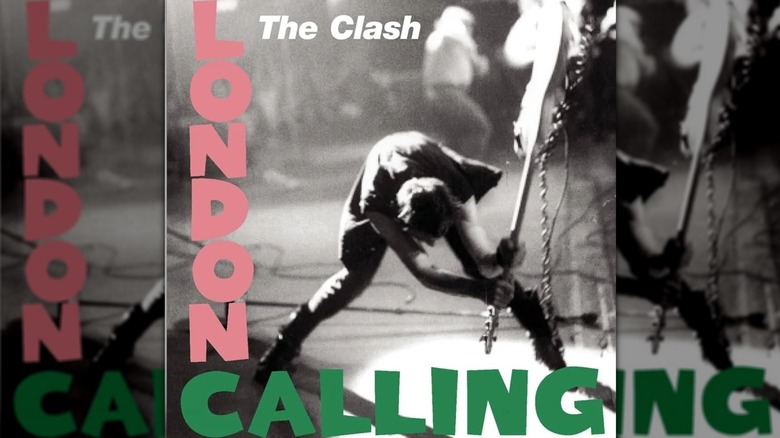
Of all The Clash's releases, the 1979 double album "London Calling" is widely regarded as the band's best. Beyond that, "London Calling" is also blessed with an album cover that is visceral, dangerous, and downright iconic.
The cover design is modeled directly on Elvis Presley's self-titled debut album, which boasts pink lettering on the lefthand side, and green along the bottom, atop a black-and-white photo of the King in mid-holler. "London Calling," however, utilizes a photo taken that photographer Pennie Smith had taken during a Clash show, in which bassist Joe Simonon is hunched over, smashing his bass on the stage. That photo was utilized in the cover by its designer, Ray Lowry — who had to convince Smith to let him use it (she wasn't happy with the quality, feeling the clarity wasn't sharp enough). Yet that image has since become legendary; in 2002, Q magazine declared Smith's pic to be the all-time greatest photo in rock history, while Simonon's busted bass was proudly displayed at an exhibit at the Museum of London, alongside Lowry's original concept sketch for the album cover.
The "London Calling" cover has become so iconic that it was even referenced by acclaimed street artist Banksy, who created his own version in which Simonon is about to smash an office chair to smithereens. As captured by Smith and designed by Lowry, that single image has come to define punk rock.