

These 5 Female Guitarists Of The '70s Are Criminally Underrated
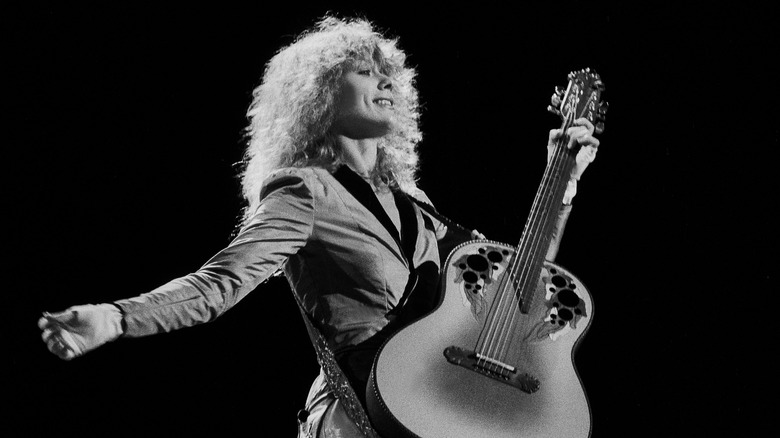
During the 1970s, rock was rife with underrated guitarists who delivered solid musical work and gained legions of fans yet never received the accolades of such rock gods as Jimmy Page and Keith Richards. Yet when it comes to rock guitarists who never got enough credit, that's been especially true for female guitarists. Not only were there relatively few women playing guitar during that era, the few that did emerge were largely underrated and typically overshadowed by their male counterparts.
So what makes a guitarist underrated? Is it a lack of mainstream recognition, despite creating exemplary music? Is it achieving success based more on catchy hit songs than by the extraordinary guitar playing contained within them? Or is it a question of genre, with the flashy electric guitar solos that burned up rock radio garnering all the attention, while softer, acoustic songs may feature a degree guitar wizardry that the average listener may not even notice — but would certainly be apparent to other guitarists?
When taking that into consideration, we factor in all of the above when singling out a handful of ultra-talented women who left their own indelible marks on 1970s rock. Keep reading, and it will be apparent that these five female guitarists of the '70s are criminally underrated.
Bonnie Raitt
After decades on rock's B-list, Bonnie Raitt hit the big time in 1989 when her 10th studio album, "Nick of Time," broke out. Selling more than 5 million copies (more than her previous nine albums combined), and hitting No. 1, "Nick of Time" swept the Grammys, with Raitt taking home four awards — including album of the year. Ironically, the album placed her squarely in the adult contemporary category by shifting the focus on what had always been her main claim to fame: her sizzling slide guitar.
When delving into Raitt's life and career, it's clear that she had distinguished herself as one of rock's premiere slide players, yet spent the 1970s and '80s as more of a cult figure than the superstar she was destined to become. Self-taught, part of her distinctive tone comes from wearing her glass slide on her middle finger, rather than her ring finger. "The rest of it is just imitating something that you love until you feel like you've got it; just playing with all your heart and soul every time you pick up the guitar," Raitt told Guitar World. "I was trying to make it as close to the human voice as I could."
Celebrated blues guitarist Joe Bonamassa offered Raitt high praise, ranking her slide work on 1989 single "Thing Called Love" as one of the top-10 best blues-rock solos ever. "It's very restrained, but super effective," Bonamassa wrote of her solo in that song. "To me, Bonnie Raitt is one of the most underrated guitar players of all time."
Joni Mitchell
Joni Mitchell — guitar hero? That's not usually a superlative typically associated with the Canadian singer-songwriter known for such folk-rock classics as "Blue" and "Free Man in Paris," and it's understandable why some might find the notion absurd. However, scratch the surface and it becomes evident that Mitchell is also one of rock's most inventive and talented guitarists. While her sound may be mellow, guitarists who understand what she's doing realize that her mastery of multiple open tunings — more than 50 — and sheer virtuosity on her instrument are far more complicated and complex than the average pop song.
"When I play the guitar, I hear it as an orchestra: the top three strings being horn section, the bottom three being cello, viola, and bass — the bass being indicated but not rooted," she told Acoustic Guitar, explaining her unique approach to guitar. Yet that technique — which has flummoxed many musicians who've tried to accompany her — came about out of necessity, when Mitchell's tragic childhood included a bout of childhood polio that left her hands weakened. To compensate, she began experimenting with different tunings that would be easier to handle. "My style was quite different," she told Guitar Player. "People were always telling me I was playing things wrong."
Among the many guitarists she's influenced is Sonic Youth's Lee Ranaldo of Sonic Youth. "Something about those rich modal tunings she was using left a big impression on me," he pointed out in an interview with Uncut. "What Joni was doing was very mysterious."
Nancy Wilson
It's clear there have been some rock guitarists who never got enough credit, and when focusing specifically on the 1970s there's certainly one underrated guitarist who can be added to that list: Nancy Wilson of Heart. Serving primarily as the band's rhythm guitarist, Wilson has also demonstrated versatility, known to rip out her own sizzling solos, while viewed as Heart's underrated secret weapon in shaping the band's signature sound.
Yet there's one song that has long proven to be her most jaw-dropping: "Crazy on You," specifically the fingerpicked acoustic guitar flourish that opens the song. The acoustic section that kicks off the track, she told American Songwriter, actually has its own title, "Silver Wheels." "I thought it should have fanfare, sort of like an introduction, almost like a thematic introduction," she explained. Speaking with Guitar Player in 1979, Wilson admitted that her intensely percussive style of strumming is not for the timid. "I'm mainly a rhythm player, and, on acoustic, I play really hard," she said. "My hands are the true story of my personality. One hand looks kind of glamorous, and the other is a real worker hand with broken nails."
When Classic Rock asked her to single out the guitarist whom she felt to be rock's most underrated. Wilson offered an unexpected response. "Paul McCartney, because he plays amazing lead and incredible acoustic," she declared. "He might just be the most-underrated all-around guitar player."
June Millington
Those who aren't familiar with guitarist June Millington are probably just as unfamiliar with the group she co-founded with her sister: Fanny, the history-making all-female band you've never heard of. The trailblazing group was signed to a major label in the early 1970s, poised to be the next big thing. One of their biggest fans, in fact, was no less an icon than David Bowie. "They were one of the finest [expletive] rock bands of their time," Bowie told Rolling Stone in 1999 of the women who are are now a mostly forgotten footnote in the annals of rock history. "June Millington's guitar work is superb, uniformly functional from both the standpoint of lead and rhythm," wrote critic Mike Saunders in his 1972 Rolling Stone review of Fanny's third album, "Fanny Hill."
As the band's sole guitarist, Millington is both underrated and seldom remembered. However, during Fanny's heyday, she was renowned for her ability to effortlessly switch between rhythm and lead, in much the same manner as Jimi Hendrix (whom she's identified as a key influence). Yet when the moment arrived for a guitar solo, Millington could shred with the best of them, her guitar sound raw, distorted, and very loud.
In her golden years, Millington continues to rock — although she's become inclined to eschew fancy pedals in favor of a purer sound. "I don't use too many pedals to get vintage sounds because I've got the [expletive] vintage gear," she told Premier Guitar. "Forget all the rest of it — work with your guitar and your amp!"
Rory Block
For five decades and counting, Rory Block has been refining her own distinctive style of acoustic blues, using a metal slide and carrying on the legacy of such Delta blues legends as Robert Johnson and Charley Patton. Despite earning acclaim and awards from the blues world, Block never broke through into the mainstream, making her among the most underrated female guitarists of the past half-century.
Block is no dilletante; at age 14, she began journeying throughout the U.S. to connect with as many surviving bluesmen as she could, learning tips and tricks from Skip James, Rev. Gary Davis, and Son House. Despite coming of age in the late 1960s, as psychedelia infused rock music, that was never her scene. "The moment I heard country blues, I was drawn to it," Block told Guitar World. "It spoke to what was in my heart." And while she may not be a household name, Block has released more than 30 albums, including a 2024 collection of acoustic-blues covers of Bob Dylan songs.
One reason Block has remained so underrated has been that, unlike other guitarists who came up during the 1970s, she had less interest in evolving the blues than in preserving it. "All I wanted to do was to play what they played the way that they played it," she told Jazz Weekly. "I was very reverential about it. I was deeply respectful, and wanted to honor the music by reproducing it as closely to as I was able."