

5 Rock Songs With Chillingly Good Orchestral Covers
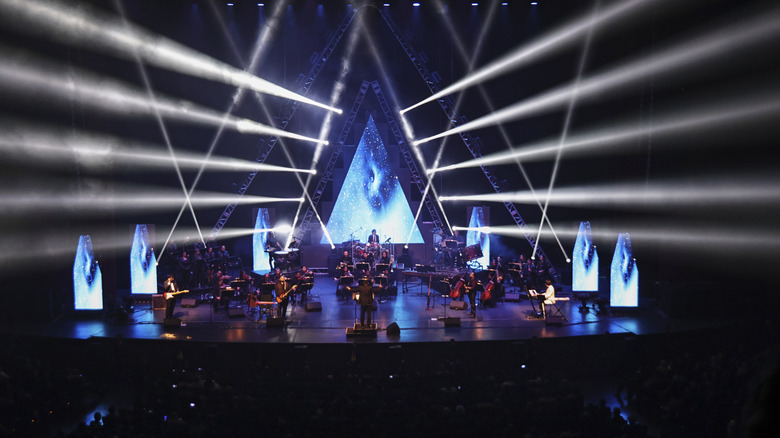
It's always exciting when rock artists branch out into the symphonic realm by sanctioning orchestral reinventions of their biggest hits. It's even more thrilling when the band themselves play along, backed by a multipiece army of formally trained classical musicians who know how to deliver the drama. The additional dimensions this sort of collaboration creates often transform the original tune into something refined and exhilarating.
Our favorite versions of orchestral rock reinventions tap into the mood of the original song and elevate it with complex arrangements. Works like "Nothing Else Matters" by Metallica and "Time" and "Breathe (Reprise)" by Pink Floyd swell with lush passages that enhance melodies and deepen the texture. Other tunes like "Creep" by Radiohead take on a new personality, one where more refined musicianship exposed the power of a simple melody. The undeniable thrill of hearing orchestral alternatives to the originals makes hearing these five familiar bangers a brand-new experience.
Nothing Else Matters — Metallica
Metallica may have had its fair share of scandals, but hearing how majestic the band sounds with orchestral backing is a reminder of what this ageless rock unit is capable of. It feels like a cheat to include this one, since Metallica is actually playing on their own orchestral cover, but the symphonic version of "Nothing Else Matters" featuring the San Francisco Symphony is too fantastic to omit. It's already one of the band's best and most melodic songs, a heavy metal power ballad that shows off the performance strength and songwriting skills of one of the rock world's most notable ensembles.
Piling a sonic velvet curtain of classical strings and woodwinds over the drums and guitars creates an aural atmosphere that proves metal's musical worth while delivering a performance as stirring as a cinema soundtrack. James Hetfield imbues his booming vocals with the same yearning as in the band's non-symphonic version, helping them carry beyond the seemingly endless layers of instrumental interplay. The draw out the elegance from amongst the sharper edges of sound without betraying the weighty presentation that makes the original version so brutally expressive.
Call it the spicy-sweet combo of the rock music world, a fusion of two diametrically opposed musical forms that work splendidly in concert (literally) with one another. There's no pigeonholing Metallica once you hear how authentically the band's music unfolds with a little classical-style shading to emphasize its deeper layers.
Time/Breathe (Reprise) — Pink Floyd
Reimagined as a complex symphonic work that retains its eerie psychedelia twosome, "Time" and "Breathe (Reprise) by Pink Floyd was interpreted by Ireland's Trinity Orchestra, an all-student university ensemble enlisting a young college student, Hozier, to handle co-lead vocals with fellow alum Oli Smith. The recording was captured in 2012, when the future folk music icon had shorter hair but the same powerhouse pipes that tower over the crescendos of this classic piece.
Hearing what sounds like a Gregorian ticking clock performed on hammered chimes at the songs opening, it's easy to imagine the orchestra pit being positioned in the bell tower of a grand cathedral. The brass and woodwinds form an impenetrable wall of sound, embraced by soaring strings and a blazing guitar solo that pays homage to David Gilmour's original fretwork. Naturally, Hozier's sonic wail is a stunning addition, and Smith lends choral tones that don't seem out of place. It all swirls together to remind listeners of the prog rock magic the band could conjure at its peak, in an interpretation that expands the musicianship to make simple guitar and synth arrangements of the original seem quaint by comparison.
Trinity Orchestra recreated the whole "Dark Side of the Moon" album, turning a timeless rock album into a monstrous orchestral suite. Having this standout pairing is a testament to how orchestration can take even the most thoughtfully composed rock tunes into new realms of creativity.
Creep — Radiohead
Brooklyn Duo, a husband-and-wife act consisting of pianist Marnie Laird and cellist Patrick Laird, enlist the help of Escher Quartet for their chamber orchestra iteration of Radiohead's most iconic rip-off of a song, the alt-rock favorite "Creep," and prove that even a small orchestral team can inspire chills when reimagining a rock song. This lovely version takes the chiming, crunchy weirdness of the original and draws out the cinematic melodrama, resulting in a haunting reworking that amplifies the chills of the soaring final bridge while deepening the awkward sadness along the way.
It may have seemed that crackling art-rock simplicity was the perfect format for delivering the proper level of angst, but the inclusion of soul-stirring instrumentation to augment the simple four-chord structure refines the raw emotion, multiplying it out to infinity. And there are no vocals required for this cover; the strings do a stellar job of conveying an evocative take on the melody. The harmonics add a fragility that's just as powerful as Thom Yorke's vocal performance but in an instrumental language.
The intimate execution of this piano and strings allows the interplay among the instruments to shine through more readily than a larger orchestral ensemble would. It's an object lesson in how less can be more when breathing new life into a well-known rock song.
Chop Suey — System of a Down
"Chop Suey" by thrash metal masters System of a Down is one of the most infectious, rapid-fire tunes that ever vibrated the airwaves. It would be the last work you'd ever imagine would work with the application of symphonic decoration. But the orchestration crafted by the Rock Orchestra creates a soundscape that pulses with making the original feel almost tame in its emotional firepower.
The earsplitting power chords become a screeching seesaw of strings that manage to capture the eerie squeal, while horns fire off brassy blasts like heavy metal lightning of a different sort. Without the machine gun lyrics of the verses punctuating the instruments, the song is given more room to breathe and demonstrate its pulse-pounding allure that doesn't require lyrics to captivate (they're largely unintelligible in the original anyway).
It's a fascinating turn that even with the modified instrumentation, there's no loss of searing heat. You may not hear System of a Down thrashing and shrieking, but you can feel every ounce of the band's DNA in this fiery orchestral clone. The band may not have released a new album since 2005, but thanks to clever musicians with ambitious ideas, we have exciting symphonic takes on their songs to carry us through.
Thunderstruck — AC/DC
Who doesn't love a wicked instrumental twist on a hard-rocking classic that depends largely on thunderous vocal delivery for its voltage? As performed by London Symphonic Rock Orchestra, AC/DC's "Thunderstruck" gives its players a chance to pull back the metal curtain and expose the sinew and bone lurking beneath the muscular — and still thoroughly discernible — structure of the song.
How do you replicate the outrageous energy of AC/DC without the players in the band factored in? Creatively, of course. Anxious violin scratching replaces Angus Young's power arpeggios, and a squawking saxophone stands in for Bryan Johnson's cannon vocals. With a string section drone punctuated by saucy, brass lightning strikes and booming drums forming a foundation, it all comes together with the spirit of an Irish folk jig performed at a wood sprite's Halloween masquerade. There's more spirited joy in this version than in the original, but with just as much pulse-pounding firepower on display.
"Thunderstruck" takes on an anthemic quality, broadening in scope and scale while feeling somehow more open and agile than when AC/DC. If you watch the video, you'll see how much fun the players have performing it, too.