

Classic Rock Artists Who Scored Their First No. 1 Hit After Turning 40
Some of the biggest names in rock waited decades to land one of the most widely recognized achievements in the music business: a No. 1 hit. Still, they got that chart-topper, even after sailing past their 40th birthday. The pop chart is generally associated with youth — music made for young people by young people. But every now and then, an older, influential, and venerated act breaks through with a song so hip, fresh, and undeniable that it goes all the way to No. 1 on Billboard's Hot 100. What's even more impressive about these late-career and long-overdue triumphs is that those songs mark the first time that those classic rock artists have ever reached that milestone.
Bands can sell millions of records and never have a No. 1 hit, or an artist can become a certified rock legend and still have zero No. 1 hits to show for it. A handful of the greatest rock acts ever did manage to get to No. 1, but not with a song released in their '60s or '70s heyday. Here are the classic rock artists who finally made it to No. 1 in the '80s or '90s — and well after they turned 40.
Carlos Santana
With his self-titled band and its evolving lineup, Carlos Santana introduced Latin rock and jazz fusion to the already experimental and psychedelic scene of the late 1960s and early 1970s. Santana the band's huge, captivating singles like "Evil Ways," "Black Magic Woman," and "Oye Como Va" became massive pop hits before becoming part of the permanent firmament of the classic rock radio canon. Santana records continued to perform well with consumers throughout the 1970s and into the 1980s, with the band's commercial success seeming to fade after one last hit, 1982's "Hold On."
The singer stopped professionally recording in the early 1990s, and he was without a label when his old friend and former Columbia Records executive Clive Davis helped him develop "Supernatural," a 1999 collection of pop songs featuring hip young singers and Santana's unmistakable guitar licks. The first single, featuring Rob Thomas of Matchbox 20, took off. As "Smooth" increasingly dominated the airwaves in the summer of 1999, Santana marked his 52nd birthday. "Smooth" would glide up to the No. 1 position on October 23, 1999, initiating a 12-week hold on the spot.
Bob Seger
He was one of the most consistent hit-making rockers for two decades, yet Bob Seger never quite managed to get a song to the top of the charts. It would take associating himself with a different pop cultural juggernaut to get him to No. 1. Seger reached the Top 20 for the first time back in 1968 with "Ramblin' Gamblin' Man," attributed to the Bob Seger System. Throughout the '70s and early '80s, Seger rolled out numerous hits as the named frontman of the Silver Bullet Band, including classic rock standards like "Old Time Rock & Roll," "Hollywood Nights," "Like a Rock," and "Night Moves."
In 1987, Seger took a break from the Silver Bullet Band and recorded "Shakedown" for the soundtrack to the highly anticipated action comedy sequel "Beverly Hills Cop II." The Eddie Murphy film made about $300 million at the box office, exposing crowds to Seger's jaunty, cocky theme. The week of August 1, 1987, "Shakedown" became the No. 1 song in the country. At the time, Seger was 42 years old.
Meat Loaf
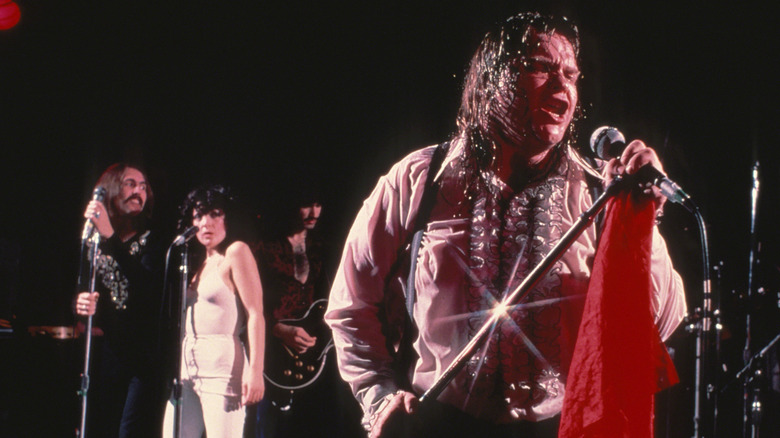
Meat Loaf sold a lot of records with his debut album, and then virtually disappeared from mainstream music for about 15 years. In 1977, the powerful singer emerged with "Bat Out of Hell," a collection of bold and boisterous rock opera anthems from theatrical composer Jim Steinman. The LP would ultimately sell 14 million copies, and audiences preferred to consume it in its entirety, as the singles from "Bat Out of Hell" — including "Two Out of Three Ain't Bad" — couldn't place any higher than No. 11 on the Hot 100.
Meat Loaf destroyed his voice touring behind "Bat Out of Hell," and so he couldn't record new material with Steinman. The music partners had a dispute, and they wouldn't collaborate for years; Meat Loaf's '80s work subsequently tanked. But then, they made up and devised a sequel album, "Bat Out of Hell II: Back Into Hell." It did what the original LP never did: occupy the No. 1 slot on the album chart and generate a No. 1 single. In September 1993, Meat Loaf celebrated his 46th birthday, and several weeks later, on November 6, 1993, the album's lead single, "I'd Do Anything for Love (But I Won't Do That)," began a five-week spell at the top of the pop chart.
Aerosmith
A string of bluesy, hard-rocking songs in the 1970s elevated Aerosmith to a position as one of the premier American rock bands. And yet in that initial, classic era, Aerosmith never took a song to No. 1. They got close, however — the ballad "Dream On" peaked at No. 6, and the heavier "Walk This Way" stalled at No. 10. After faltering commercially for a few years, Aerosmith triumphantly returned to the forefront of rock and pop in the late 1980s. Albums like "Permanent Vacation," "Pump," and "Get a Grip" kept Aerosmith on the charts into the '90s as the group racked up more Top 20 hits, like "Angel," "Love in an Elevator," "Cryin'" and "Crazy."
The Aerosmith comeback wasn't truly complete until 1998, when the band finally took a single as far as it could go. They recorded the unabashedly romantic and soft ballad "I Don't Want to Miss a Thing" for inclusion in the summer movie blockbuster "Armageddon." On September 5, 1998, "I Don't Want to Miss a Thing" began a four-week run at No. 1. At that point, Aerosmith singer Steven Tyler was 50 years old, drummer Joey Kramer had recently turned 48, guitarist Joe Perry was five days shy of his 48th birthday, bassist Tom Hamilton was nearly 47, and second guitarist Brad Whitford was 46.