

5 Hits That Prove 1972 Was The Decade's Best Year For Americana Music
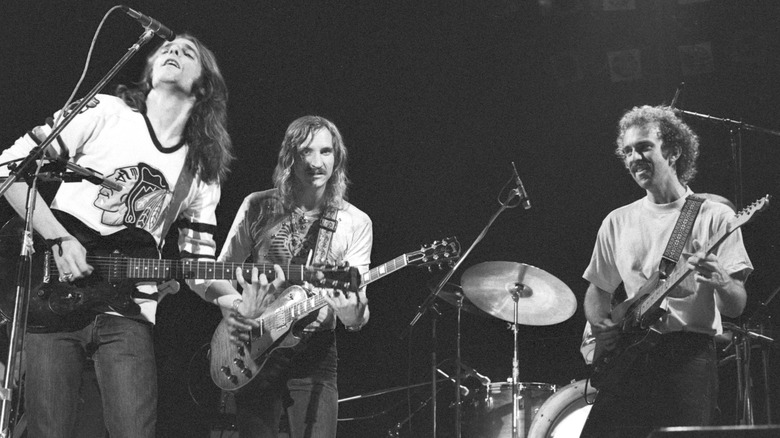
Americana music achieved many heights and produced a number of great albums and songs across its first real peak in the '60s and '70s, but the hits of 1972 set that year apart. This year produced a number of now-classic Americana songs, whether they were sung in a more upbeat style by classic rock 'n' roll bands like the Eagles, or more softly by singer-songwriters such as Jim Croce.
In this list, we'll use five standout songs from 1972 to make it clear that this year was no joke when it came to Americana. We chose songs that embody the spirit of Americana both in form and content, from artists who combined elements of country, rock, folk, and American roots music with lyrics about classic Americana themes such as love and the open road. These five defining songs of '70s Americana were all somehow released during 1972, which no other year of the decade can compete with.
A Horse With No Name — America
The band America — Dewey Bunnell, Gerry Beckley, and Dan Peek — was appropriately best known for its folk-rock and Americana tracks in the early '70s, namely "Ventura Highway" and "A Horse With No Name." The latter is a clear highlight of Americana, a timeless hit that made waves when it was first released in '72, topping the Billboard Hot 100 in the U.S. for a stellar three weeks. "A Horse With No Name" is arguably one of the most iconic Americana tracks of the '70s, or ever, remaining relevant today with over a billion streams on Spotify alone.
It's not hard to understand why. The imagery itself is definitively Americana, capturing the wandering spirit and Western idolatry that much of the genre modeled itself after: "I've been through the desert on a horse with no name / It felt good to be out of the rain / In the desert, you can remember your name / 'Cause there ain't no one for to give you no pain." The simple guitar chords drive the song enchantingly, and the swaying vocals make this musical desert come alive, the sound perfectly matching the subject matter.
Operator (That's Not the Way It Feels) — Jim Croce
This catchy tune is best known for its trademark guitar playing and sentimental story, and it's truly a masterpiece from Jim Croce, the early '70s singer-songwriter who produced an impressive number of hits despite his career ending far too soon. "Operator (That's Not the Way It Feels)" didn't hit No. 1, but it reached a respectable No. 17 on the Billboard Hot 100 in 1972, as Americana just couldn't keep off the charts during this storied year.
Jim Croce's undeniable charm carries the track across its lovesick story, where the narrator attempts to call his once lover while letting the story loose to the telephone operator. Its bright, infectious lead guitar is played incredibly, and the builds of harmony into the later choruses are fitting and satisfying. "Operator (That's Not the Way It Feels)" has an especially Americana air in its lyrics, ending in a philosophically hopeful but still melancholic conclusion: "I only wish my words could just convince myself / That it just wasn't real / But that's not the way it feels."
Vincent — Don McLean
Don McLean is best known for his hit "American Pie," which has a long-debated meaning, but the singer-songwriter also achieved a storied hit with "Vincent," a historically inspired track (based on painter Vincent van Gogh) that captures the true spirit of Americana music. The mellow track vaulted all the way to No. 12 on the U.S. charts in the spring of 1972, with its haunting but heartwarming sound charming the hearts of fans. McLean's vocals are tender and touching, with only the acoustic instrumental complimenting them until strings flourish near the end of the song.
The song's mix of beauty and tragedy is an apt reflection of its subject, and "Vincent" paints the troubled artist in an especially romantic light as McLean mythologizes a hero of his: "Now I understand / What you tried to say to me / And how you suffered for your sanity / And how you tried to set them free / They would not listen, they did not know how / Perhaps they'll listen now." For singer-songwriter Americana, "Vincent" is a clear standout track, and another storied song from 1972.
Take It Easy — The Eagles
This pretty and groovy song is classic Americana, as the Eagles crafted a road-trip staple with this 1972 hit. Released on the band's self-titled album a couple of years before its era of near-dominance at the top of the charts, "Take It Easy" didn't achieve this peak of success, though it climbed up to No. 12 in the U.S. over the summer of '72. Still, it has since become the legendary band's most iconic song aside from "Hotel California."
"Take It Easy" is catchy from start to finish, with a resoundingly perfect vocal melody that swings over the upbeat instrumental for the duration of the track, through verses and choruses alike. It's a song about being in love and on the road, two defining themes of Americana music in the '70s, with lyrics — "Well, I'm a standing on a corner in Winslow, Arizona / And such a fine sight to see / It's a girl, my Lord, in a flatbed Ford / Slowin' down to take a look at me" — that have even led to the creation of monuments on the iconic Route 66. There are few songs as replayable as "Take It Easy," and it's hard to argue for any other year of the '70s just for the inclusion of this song alone.
Made in Japan — Buck Owens
Buck Owens was one of the stars of country music during the 1960s, but this venture into a more classic, but still fresh, sound was one of his last major hits in the U.S. "Made in Japan" reached No. 1 on the U.S. country charts, likely thanks to the heartfelt performance at its center. The song's blend of classic Americana, headlined by sticky bluegrass guitars and crooning country vocals, with other instrumentation inspired by the country Owens sings of is executed organically and fruitfully, with the styles blending into a gorgeous arrangement.
Owens sings of a lost lover in Japan, chronicling the beauty of their time together with sentimental lyrics — "That beauty of her face was beyond my wildest dreams / Like cherry blossoms blooming in the mountains in the early spring" — that ring true to that classic, lovestruck Americana narration. "Made in Japan" is full of genuine love, which pairs well with the genre's central theme of journeying, both emotionally and physically.