

The 5 Best Monkees Songs That Aren't I'm A Believer
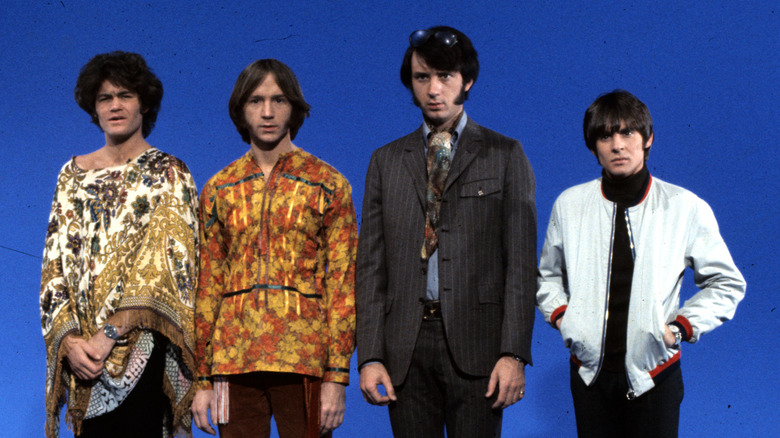
Looking back at the Monkees, one song immediately springs to mind: "I'm a Believer," which soared to the top of the charts, spending seven weeks at No. 1 while becoming 1967's top-selling single. And while it may be true that Neil Diamond wrote the 1966 tune for the Monkees (and it's still one of the group's catchiest tunes), it was by no means the group's sole smash. The band also hit No. 1 on the Billboard Hot 100 with singles "Daydream Believer" and "Last Train to Clarksville," while several others landed in the Top 20.
Despite the Monkees being derided as the "Prefab Four" for its members being cast like actors in a sitcom (which, for the record, they actually were), it's also impossible to ignore just how popular the band was. Consisting of Micky Dolenz, Peter Tork, Davy Jones, and Michael Nesmith, the Monkees scored four No. 1 albums in 1967, the only act in the history of Billboard's charts to ever achieve that feat within the same calendar year. Compiling a list of the band's best songs can be incredibly subjective, given the sheer volume of hits the Monkees churned out.
"I think the Monkees songbook is maybe the third-best songbook," Tork once told Salon, ranking the band's output below only Lennon-McCartney and Jagger-Richards. That's why we're taking various factors into consideration, including chart position, longevity — and, for good measure, that certain "je ne sais quoi" that makes a listener immediately connect to a track. With that in mind, keep reading for a rundown of the five best Monkees songs that aren't "I'm A Believer."
Last Train to Clarksville
The Monkees' debut single, "Last Train to Clarksville," arrived in August 1966 and was included on the group's self-titled first album when it was released in October the same year. Truth be told, the whole thing was masterful marketing cooked up by NBC to promote the addition of the "Monkees" sitcom to the network's fall lineup. That synergistic strategy worked better than any TV executive could have hoped: The single hit No. 1 on the Hot 100, while the show debuted to huge ratings, even winning an Emmy for the year's best comedy series.
"Last Train to Clarksville," with its jangly, Beatle-esque guitar intro — reminiscent of the riff at the start of "Paperback Writer" — remains a familiar toe-tapper, an upbeat classic that is guaranteed to put a smile on any face. Yet there was an edge within the lyrics, particularly the last line: "I don't know if I'm ever coming home." It obliquely references all the young men being drafted and sent to fight in the Vietnam War.
Among the strange things about the Monkees most fans don't know is that even though the members were all talented musicians, they didn't write their songs or play on them — at least not at first. "Last Train to Clarksville" was written by Tommy Boyce and Bobby Hart and recorded by the legendary group of LA studio musicians known as the Wrecking Crew. Interviewed for the "Wrecking Crew" documentary, Mickey Dolenz revealed many tracks on the debut album had been recorded before he was even hired. "The Monkees was not a band," he insisted.
Pleasant Valley Sunday
Released as a single in 1967, "Pleasant Valley Sunday" was another Monkees song written by pros, in this case the powerhouse songwriting team of Gerry Goffin and Carole King. Despite its catchy, cheery melody, the song is an indictment of the hollowness of suburban conformity, with scathing lyrics such as, "Charcoal burning everywhere / Rows of houses that are all the same ... Here in status symbol land." As King wrote in her memoir, "A Natural Woman," she and her future ex-husband had relocated from Manhattan to the 'burbs. "But Gerry did not enjoy living in the suburbs, an opinion he vigorously documented in a song called 'Pleasant Valley Sunday,'" she wrote.
Peaking at No. 3, the song became one of the Monkees' biggest hits — and, unlike some of the others, it featured the musicianship of the actual band members. Boasting a complex arrangement from producer Chip Douglas, Micky Dolenz handled lead vocals, and he still considers "Pleasant Valley Sunday" to be the finest uptempo track the Monkees ever released. As he declared in a 2023 interview with Forbes, the song remains a performance favorite: "Still a great song to do live, a real rocker."
(I'm Not Your) Stepping Stone
Tommy Boyce and Bobby Hart, who wrote "Last Train to Clarksville," were also behind another memorable Monkees classic, "(I'm Not Your) Stepping Stone." The song has come to be revered as a fan favorite, yet it was never released as a single (it was the B-side to "I'm A Believer"). Far less of a pop song than the A-side, the hard-hitting "Stepping Stone" is more akin to garage rock — evident when the Sex Pistols covered it for the soundtrack of their film, "The Great Rock 'n' Roll Swindle." Despite its hard edge, the Micky Dolenz-sung track still managed to crack the Top 20 on the Hot 100, a clear indication of just how popular the band was during that point in the 1960s. Interestingly, the Monkees were not the first group to record that particular song. The initial version released was by the Liverpool Five, followed by another from Paul Revere and the Raiders.
"The songs that we got [in the' 60s] were really songs of some vigor and substance," Peter Tork told Entertainment Weekly. "'(I'm Not Your) Stepping Stone' is not peaches and cream. It comes down hard on the subject, poor girl. And the weight of the song is indicated by the fact that the Sex Pistols covered it. Anybody trying to write '60s songs' now thinks that you have to write '59th St. Bridge.' [Sings] 'Feeling groovy!' Which is an okay song, but has not got a lot of guts. 'Stepping Stone' has guts."
Daydream Believer
A Hot 100 No. 1 hit in late 1976, "Daydream Believer" is the antithesis of "(I'm Not Your) Stepping Stone." Featuring Davy Jones on lead vocals and written by John Stewart — a one-time member of folk group the Kingston Trio — the song is pure, shimmering pop. The lyrics are on the verge of being over the top, replete with a singing bluebird, "a knight on his steed," "a homecoming queen," and the entreaty in the chorus to "cheer up, sleepy Jean."
The song's legacy is evident in its ranking with Rolling Stone readers, who voted it the Monkees' top track, the magazine deeming the song to be the highlight of Jones' singing career. As true fans know, the tune begins with some studio dialogue — which became problematic when the song was released as a single. "We probably shouldn't have left it on 'Daydream Believer,'" producer Chip Douglas explained when interviewed for Tiger Beat's Monkee Spectacular back in 1968. "The disc jockeys don't like the talking at the beginning, because it's hard to queue up. ... I wasn't thinking about singles. Then, they decided to put 'Daydream Believer' out as a single. I completely forgot about the talking intro on that, but it's just as well anyway."
Me & Magdalena
"Me & Magdalena" was a late entry in the Monkees' canon, recorded for the group's 2016 album "Good Times!" It was the band's first studio album of new material in a decade, and it was bittersweet, given that it was the first without Davy Jones, who died in 2012. What made the album so special was that it featured the band returning to their original practice of recording the work of other songwriters. This time, however, the songs were specifically written for the Monkees by the likes of Noel Gallagher of Oasis, Weezer frontman Rivers Cuomo, and Death Cab for Cutie's Ben Gibbard — the latter contributing "Me & Magdalena."
This brooding, melancholy ballad is sung by Mike Nesmith, who asks the titular Magdalena, "What do you see in the depths of your night?" As they drive along the California coastline through Monterey, he reassures her: "But know everything lost will be recovered / When you drift into the arms of the undiscovered."
In an email to NPR, Gibbard shared his excitement at writing a song for the band that had been his first favorite. "Before the Beatles, before the Velvet Underground and before punk and/or indie rock, the Monkees were the first band I truly loved," he wrote. "They made being in a band seem so fun ... I can say with absolutely zero hyperbole that contributing 'Me & Magdalena' to this album has been the greatest honor of my career."