

5 Disco Songs From The '70s That Still Put Us In A Dancing Mood Today
Was disco a fad, a cultural trend, an era-defining musical genre — or all of the above? Whatever the case, there's no denying that there are some disco songs that, as soon as those opening notes kick in, make listeners want to get up and shake their groove things (to borrow from the 1978 Peaches & Herb classic).
We know them when we hear them, those songs that send people leaping to their feet and heading to the dance floor, combining propulsive rhythm with a feel-good vibe that generates an instant party. Here, we've selected a handful of hits that have continued to stand the test of time, five decades after they were first released.
From an iconic track that anchored the "Saturday Night Fever" soundtrack, to a dance tune that's become a gay anthem, these five disco songs from the '70s still have the power to conjure up a good time, in pretty much any setting.
Disco Inferno — The Trammps
Released as a single in late 1976, the title track of the Trammps' "Disco Inferno" was initially not the hit it would become, stalling at No. 53 on the Billboard Hot 100. Everything changed, however, when it was included in the "Saturday Night Fever" soundtrack the following year. That soundtrack proved to be a monster, selling 25 million copies by 1980. That led "Disco Inferno" to explode, this time making it to No. 11 when it was released as a single a second time.
Thanks to the Trammps' roots in Philadelphia soul, the song incorporates strings and horns, combining for a lushness within the danceable groove. "It's been given that name [disco] but all the way along the line, we've basically been playing the same kind of music," Trammps vocalist Harold "Doc" Wade said in a 1977 interview (via Rhino Records). "It's just that with the trend towards things being disco this, disco that, we got labelled that way — our music fell right into the bag."
With its rock-solid, uptempo beat (129 beats per minute) and pulsating bass line, "Disco Inferno" still holds the power to get people moving — including Vermont's senator Bernie Sanders. In 2015, when he appeared on "The Ellen DeGeneres Show," "Disco Inferno" was played during his intro as he danced his way onto the set while the "Burn, baby, burn," chorus played.
I Feel Love — Donna Summer
It would be bordering on criminal if the singer nicknamed the "Queen of Disco" didn't appear in this roster, but choosing just one of Donna Summer's songs can be a bit of a challenge. Among such hits as the sultry "Love to Love You Baby," the high-octane "Hot Stuff," and the dramatic "Last Dance," the one that continually rises to the top is "I Feel Love," her groove-heavy, synth-driven single that was a staple in discos during 1977.
Led by Summer's dreamlike vocals, the hypnotic and undulating sound (with the exception of the drums) was produced entirely by Moog synthesizers. In that respect, "I Feel Love" not only dominated its era but predicted the future. As Rolling Stone recounted, David Bowie recalled the moment when producer Brian Eno excitedly played the record for him. "He said, 'This is it, look no further. This single is going to change the sound of club music for the next 15 years.' Which was more or less right," Bowie said.
Of course, credit for the song's enduring popularity on the dance floor goes to producers Giorgio Moroder and Pete Bellotte, and their trailblazing use of the synthesizer. As for what makes the song so danceable, Moroder revealed the secret sauce when interviewed by the Library of Congress. "One thing about the original: While we were mixing it, my engineer added a delay and it gave it a whole new feel and that's ... really what made the sound; it's what made that driving bass line," he explained.
Stayin' Alive — The Bee Gees
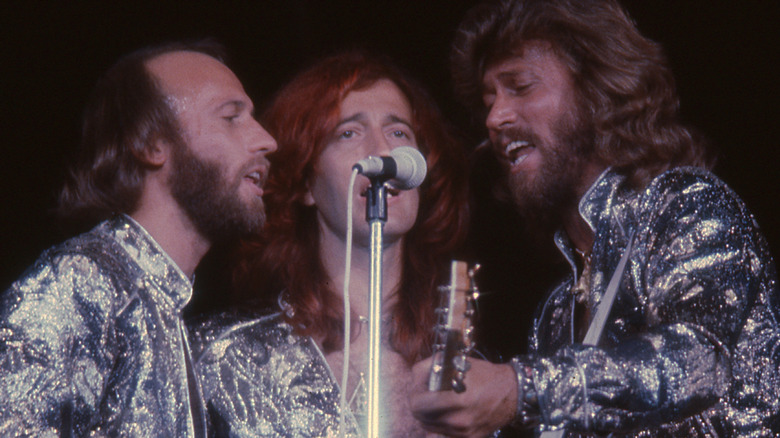
If there's a single song that could be seen as responsible for bringing disco into the mainstream, it's the Bee Gees' "Stayin' Alive," the centerpiece of the 1977 soundtrack for disco-themed Hollywood blockbuster "Saturday Night Fever." The song became iconic thanks to a now-famous scene in which star John Travolta struts down the street in perfect rhythm to the beat.
In retrospect, the Gibb brothers were unlikely poster boys for disco, given that their hits prior to that were more in the pop-rock vein. Yet the success of 1975's "Jive Talkin'" and 1976's "You Should Be Dancing" propelled them toward dance music. "We got sucked into that. We were just making records we loved," Barry Gibb told The New York Times. "In fact, we didn't even call them 'disco.' ... But you get classified."
One reason why "Stayin' Alive" is so danceable is a mathematical one: The song boasts 103 beats per minute, precisely mimicking the bpm of the human heartbeat. (Fun fact: Doctors recommend "Stayin' Alive" as the perfect song to guide someone through performing CPR.) Meanwhile, it remains the song that will always be most associated with the Bee Gees, and it's one of the songs that defined '70s disco. It speaks volumes that Dave Grohl and Foo Fighters covered "Stayin' Alive" as alter egos the Dee Gees for their 2021 disco album "Hail Satin."
Le Freak — Chic
Chic was the brainchild of guitarist and activist Nile Rodgers and bass player Bernard Edwards, and the band's music was made for dancing. The group experienced out-of-the-box success with its first album, but it was with the second, 1978's "C'est Chic," that Chic hit solid gold with what would become the band's signature song, "Le Freak."
The song's funky groove, punctuated by Rodgers' percussive guitar licks, made "Le Freak" an instant dance-floor classic that has never gone out of style. That was evident when Dutch producer Oliver Heldens remixed a new version in 2018. "Dance music is as strong and unifying as ever," Rodgers told Paper magazine. "Oliver has captured that spirit with this new remix. You will definitely want to move."
"Le Freak" was written after Rodgers and Edwards were invited by Grace Jones to see her perform at Studio 54. She had instructed them to knock on the back door, but when they did, they were denied entrance by a bouncer who told them to "f*** off." They then began spontaneously singing that phrase. "And we developed it," Rodgers told the Library of Congress. "We wrote a bridge! We came up with every possible scenario to put with 'F*** off!'" As they honed the song, they were thrilled with it — but realized the phrase the song was built around would guarantee zero radio play. "So I came up with 'freak out,'" Rodgers recalled.
I'm Coming Out — Diana Ross
Diana Ross' career encompassed a lot of eras and musical genres, from her iconic Motown classics with the Supremes to her solo work in the 1970s and beyond. While she certainly wouldn't be pigeonholed as a disco artist, she's nevertheless responsible for one of the most quintessential disco dance tracks, 1980's "I'm Coming Out."
The song — written for Ross by Chic's Nile Rodgers and Bernard Edwards while they were producing her "Diana" album — immediately became a gay anthem that continues to fill dance floors. According to Rodgers, the inspiration came when he was at an LGBTQ+ nightclub and spotted numerous drag queens dressed like Ross, making him realize she was a gay icon. "All of a sudden a lightbulb goes off in my head," Rodgers told the New York Post, recalling he immediately called Edwards. "I said, 'Bernard, please write down the words, 'I'm coming out.'"
Ross, however, was oblivious to the true meaning of coming out, initially assuming that it was referring to her re-emergence after exiting her Motown contract. When she played the song for a radio deejay, he explained what those three words meant, and cautioned that fans might assume she was announcing she was gay. Ultimately, Rodgers convinced the reluctant Ross to release the track, insisting it would become her opening number from then on. "I explained to her that it's just like when the president comes out and they play 'Hail to the Chief,'" he added.