

The Wild Concert That Rocked The USSR Weeks Before Its Collapse
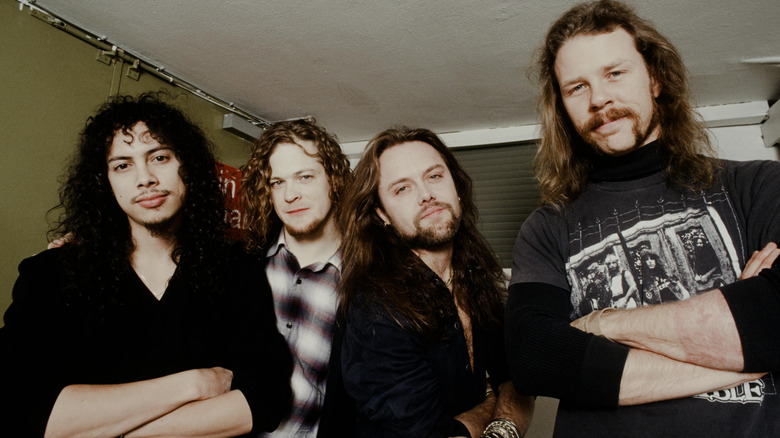
On September 28, 1991, some of the biggest rock and heavy metal bands in the world played to an adoring audience of fans who knew all the words to their songs. That wouldn't be a big deal, except that most people in the crowd didn't speak English, the music had been banned for years, and the country was the USSR.
No one is sure how many people were on the Tushino Airfield on the outskirts of Moscow that day. Some estimate that 1.6 million Soviets went to see Metallica, AC/DC, the Black Crowes, Pantera, and E.S.T. at the Monsters of Rock festival, while others calculated the crowd at a relatively more modest 500,000. But even that low-end number shows a population — especially young people — that was ready for change in their country, and if it meant they could go to more awesome rock concerts, even better.
From the reason the headline act was previously banned from the country to the soldiers rocking out instead of working security to the amazing fact that no one died, here's the truth about the wild concert that rocked the USSR weeks before its collapse.
It was not the first Western rock concert in the USSR
There is something poetic in envisioning rock bands touching down in the USSR, their music opening the minds of the repressed populace to the amazing things that existed on the other side of the Iron Curtain, and the system of Communism falling within three months, but it didn't happen exactly like that. By the time the Monsters of Rock rocked Moscow, the USSR was in its death throes and had been collapsing for years.
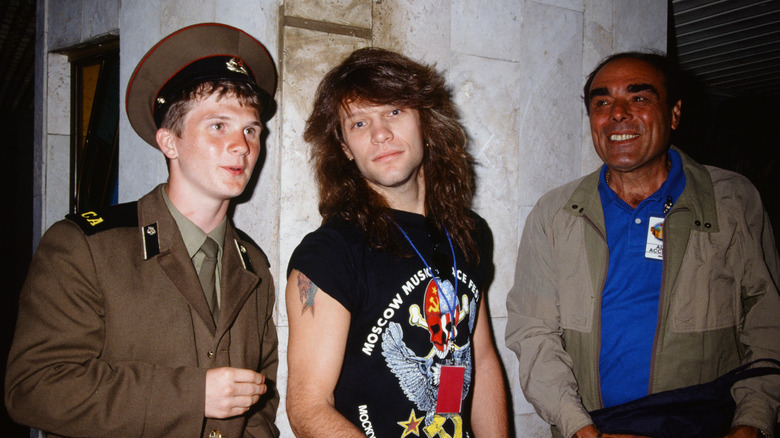
In fact, if you did want to boil down a long, complicated, and painful political and societal collapse to the work of a single rock concert, then you would have to give the credit not to Metallica but to Bon Jovi, because the Monsters of Rock show was not the first major hard-rock concert by Western musicians to take place in Moscow.
In August 1989, Bon Jovi, Ozzy Osbourne, Mötley Crüe, Scorpions, Cinderella, and Skid Row played to 180,000 fans at Lenin Stadium during the two-day Moscow Music Peace Festival. The audience for that event had to purchase tickets (the equivalent of $16 in 1989, or about $44 in 2026), with the proceeds going to programs that fought drug and alcohol abuse in the USSR and the U.S. In an interview shortly after the concert, Jon Bon Jovi told The Record, "You couldn't really tell it was Russia when you were on the stage. Lenin Stadium was bigger than Giants Stadium," but he lamented that no one there probably knew where New Jersey was.
The concert was a gift to the youth for resisting a coup attempt
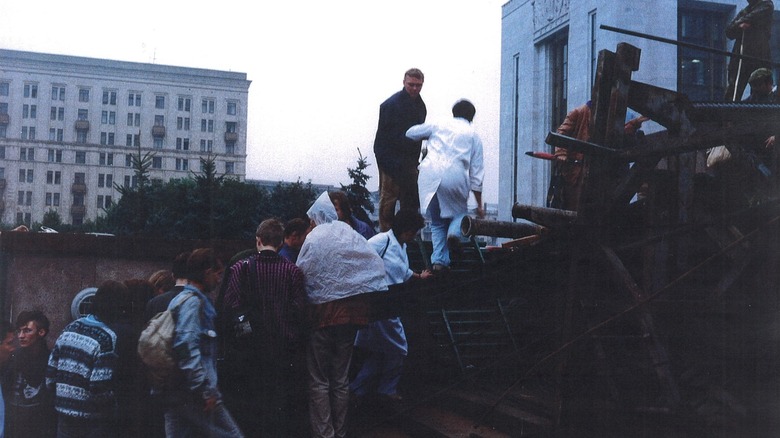
There are plenty of moments in Russian history that went horribly wrong, and in August 1991, they came very close to another one. That was when Communist hardliners tried to stage a coup against Soviet president Mikhail Gorbachev. The politics behind the coup, counter-coup, and the ultimate failure of everyone involved to resolve the country's issues and make life better for the people of the Soviet Union are incredibly complicated. Suffice to say, when it became clear that Gorbachev was being overthrown, citizens of Moscow, including many young people, set up makeshift barricades around the White House (no, not that one; the administrative center of the Russian government), in support of him. The coup attempt collapsed after 72 hours.
Metallica's former bassist Jason Newsted told the "Talk Toomey" podcast, "We got a message from a prime minister representative from Russia ... they had talked to the kids that stood up to the tanks ... 'What would you like in reward for saving us all?' You know, 'we want American rock and roll.'" While it sounds crazy, he is pretty much exactly right. With the encouragement of local concert promoters and a Western music company, the young people were given a rock concert as a thank-you.
One attendee of the show, 21-year-old radio technician Oleg Popov, told the AP (via The Republican), "Metallica and AC/DC are my favorite groups. We think the coup played a role in getting them here. It's great."
The logistics for the last-minute concert were almost impossible
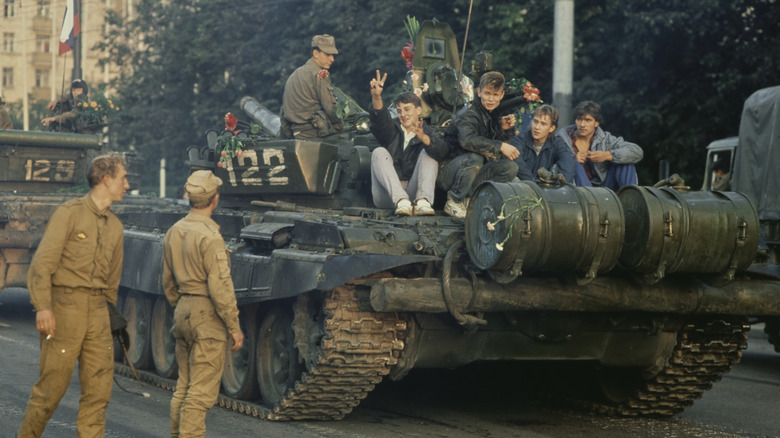
The teens who stood up to tanks didn't have long to wait for their thank-you concert. The whole event was planned, built, and held in just five weeks. In fact, it was such a quick turnaround and seemed so outside the realm of possibility that a concert like that would happen in Moscow that one of the biggest hurdles was convincing people the festival was real. The host of a Russian music show dedicated an episode to convincing his audience that this wasn't just a rumor; it was actually happening.
Or at least it was happening if it could get put together in time. This required a gargantuan effort by the USSR's adversary in the Cold War. Eduard Ratnikov, the Russian co-organizer of the concert, told Afisha, "We put the entire festival together in three weeks — and I have to admit, the Americans did most of the work. They brought in an incredible amount of equipment, used the Marines to build everything, and didn't sleep day and night — I remember delivering McDonald's food to them."
Since the concert was free, no one knew how many people would show up. Crowd size was a major issue, since police in the USSR had little to no experience controlling concert audiences. Basically, there was no way Monsters of Rock in Moscow should have been feasible. It should have gone down in rock history as a concert that devolved into chaos.
The location of the concert was meaningful
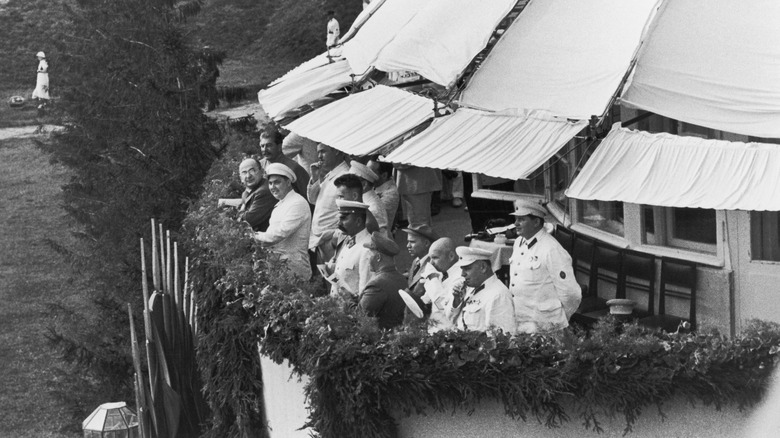
The festival was held on Tushino Airfield on the outskirts of Moscow, a location that, for more than 50 years, had been a venue to showcase the might of the USSR's now-crumbling empire. The military site was traditionally used on Soviet Air Forces Day, including in 1937, when the airshow was used to distract from a purge. Josef Stalin is pictured above, watching one of these aerial displays at Tushino. A massive, Western concert taking place at that location as the Soviet Union collapsed was almost too on-the-nose.
But Tushino Airfield was not the first site considered for the show. According to co-organizer Eduard Ratnikov, when he met with Time Warner to work out logistics, including the lineup and location, "Khodynka [Airfield] was an option at first, but we decided against it; the memory was too bloody" (via Afisha).
That was putting it mildly. It might not have been an attractive prospect for fans to crowd together for a massive concert in the location where, less than a century before, a crowd crush and stampede at celebrations for the coronation of Nicholas II left an estimated 1,400 dead and many thousands more injured, most of them women and children. A disaster of that magnitude could easily have happened again at the Monsters of Rock concert.
The concert was sponsored by a corporation but tried to avoid a capitalist label
A Communist government throwing together a festival with some of the biggest Western bands in the world in a matter of weeks with the help of the U.S. government ... if you are waiting for the other shoe to drop, here it is. The whole event was the brainchild of, and bankrolled by, the U.S. media conglomerate Time Warner Inc.
Don't worry, though. This capitalist corporation was going to all these lengths and great expense out of the goodness of its heart. A Time Warner spokesperson said the concert was "in celebration of the successful defense of democracy as a gift to the youth of Russia. There is nothing commercial connected to it, no live telecasts, no HBO specials, nothing" (according to the AP, via The Republic).
Eduard Ratnikov, the Russian co-organizer, put it a bit differently decades later, telling Afisha, "Time Warner ... had an idea to celebrate the victory of the forces of democracy over the evil empire with a big concert." But it was Metallica's James Hetfield who spelled out the company's real motivation most plainly on "The Joe Rogan Experience": "[In] '91 when the curtain came down and all of that, Time Warner wanted to basically get their foot in the door, and so they created a free concert."
The USSR was a shock to the musicians
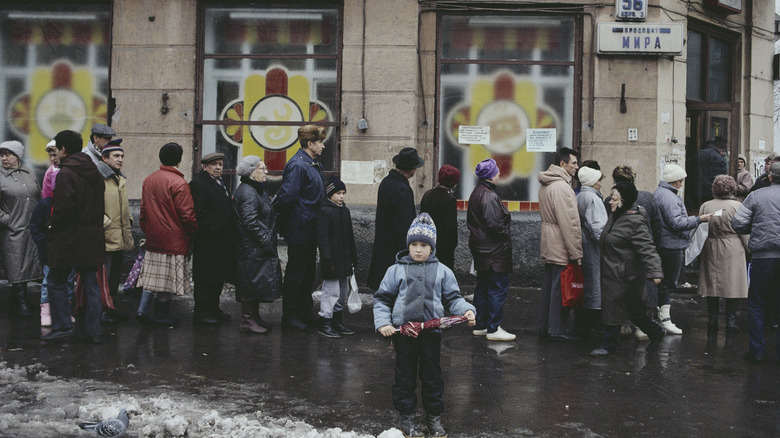
Life under Communist rule was worse than you think, and seeing that reality firsthand was shocking to the famous musicians playing the festival. Everything from the food to the (lack of) infrastructure to the fact that the audience knew all the words to their songs blew the minds of the various band members, who still seem awed when talking about the experience today. Jason Newsted says that what he saw during the few days they were there still makes him appreciate little things like his morning cup of coffee decades later.
Perhaps the greatest example of how little the musicians were prepared for what awaited them came from Pantera's photographer, Joe Giron, who told Revolver, "Since he had never been to Russia, Dimebag [Darrell Abbott] wasn't sure he would be able to get whisky, so he brought a bottle of Listerine mouthwash and filled it up with whisky. He didn't know if he'd be able to find anything to drink over there."
There were moments when evidence that things were already changing broke through. Phil Anselmo of Pantera reminisced to Louder Noise about landing in the USSR: "It's just this gray city, dismal, everyone kind of shoddy and downtrodden. ... over the bus radio I hear the local station playing and out of nowhere they played 'Planet Caravan,' and dude, it was like the most atmospherically perfect [moment]."
There was a heavy police and military presence
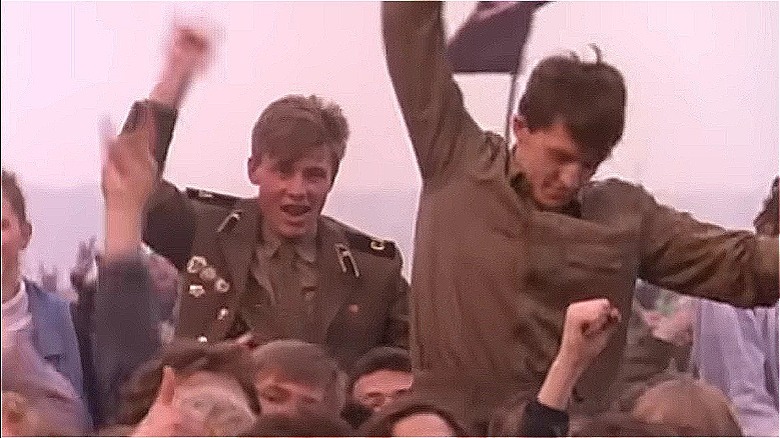
The USSR government might have been nice enough to allow the concert, but they were not taking any chances. More than 10,000 police, soldiers, and private security personnel attempted to do crowd control. In some cases, the audience saw this as aggression rather than a concern for public safety. The bands had strict instructions not to throw anything into the audience, lest something bad happen in the rush to grab it.
Lars Ulrich explained to the "Conan O'Brien Needs a Friend" podcast what he saw from the stage: "There are tens of thousands of Russian soldiers in uniform. ... There are Sikorsky helicopters flying right over the audience. I don't know if it's a scare tactic or whether they're keeping people [safe], but these giant Sikorsky helicopters hovering right over the audience. [It] looked like people could just reach out and touch them."
If being a soldier for a collapsing empire and working with your back to the stage during the most exciting music event of your lifetime doesn't sound like fun, it wasn't. On "The Joe Rogan Experience," James Hetfield remembered when something amazing happened: "Down in the front, there were guys in uniforms, there was police, military. So they're standing there in their uniforms, and after like three or four songs, they're like, 'F*** this.' And they took off their stuff, and they're out there headbanging and having a good time. So we saw the transformation of a closed-down society to freedom right before us, individually in people. It was awesome."
AC/DC's inclusion in the lineup was especially noteworthy
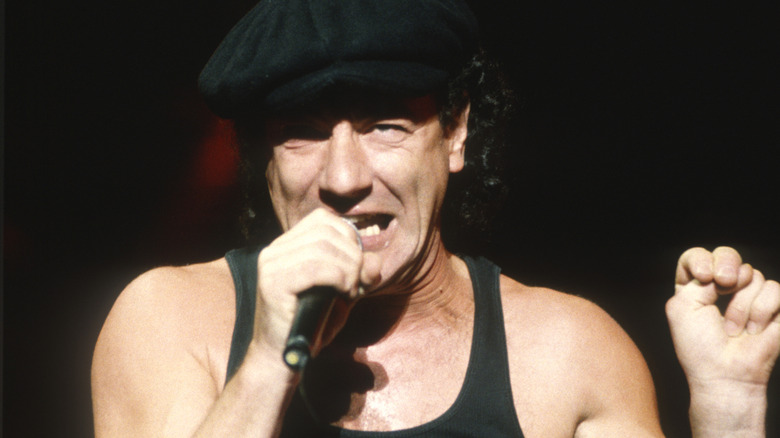
All the bands were in rare form that day. Pantera, barely known in the U.S., let alone the USSR, after just one major-label album, gave an incredible performance that set the bar extremely high. Metallica might have had one of the absolute worst concert performances of the 1990s in Quebec the following year, but the Moscow show is considered by many to be its greatest live show ever.
The biggest name on the bill and the headlining act was AC/DC, which played a two-hour set. The band's presence in the country was shocking, considering that being in possession of its music would have gotten those in the crowd arrested only a few years prior to the concert. Sure, some AC/DC songs have been used for torture by various governments, but that isn't why the group was banned in the USSR. According to documents from the time, the headlining act was considered too dangerous for the Communist country because of its music "promoting neofascism." If that isn't the first thing that comes to mind when you start humming "Back in Black," just know that other acts banned for the same reason were 10cc and Julio Iglesias.
Even at the time, officials in the USSR knew they were fighting a losing battle. Speaking to The New York Times in 1991, the Russian music critic Andrei Orlov said, "Look at the graffiti in the city [Moscow]. AC/DC is written on every wall."
There were some small fights and minor injuries
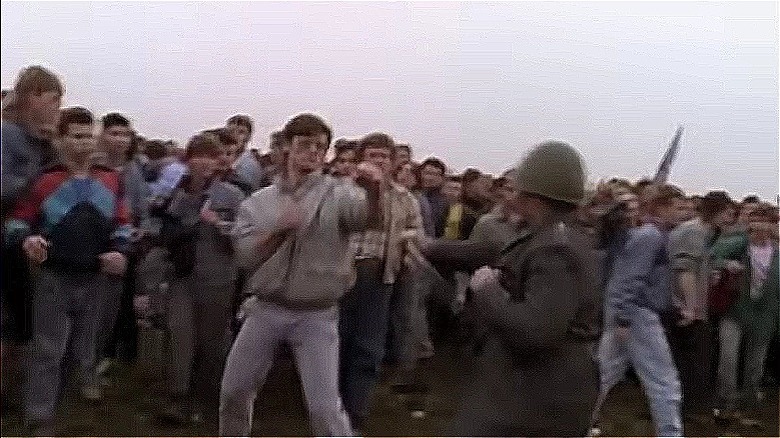
There was no alcohol sold at the concert itself, although there were no rules about BYOB, and plenty of fans were already drunk when they arrived (there were also no restrooms). So, unsurprisingly, things didn't go perfectly over the course of the day.
There were more than 50 hospitalizations, and even more people arrested for drunkenness. Reporters for the AP noted that there were many young people passed out on the ground and saw one soldier with a bloody face being helped away.
There were several scuffles between the security force and audience members, and at one point, the police tried to control the crowd by beating them with truncheons, with obvious results. Bottles were thrown at the soldiers and even other audience members. One fight was so bad that the concert briefly paused to let the crowd calm down. But over the course of the day, the violence and difficulty controlling the crowd seemed to decrease, as the audience got more into the music and the vibe of the show.
One rock group from the USSR was on the bill
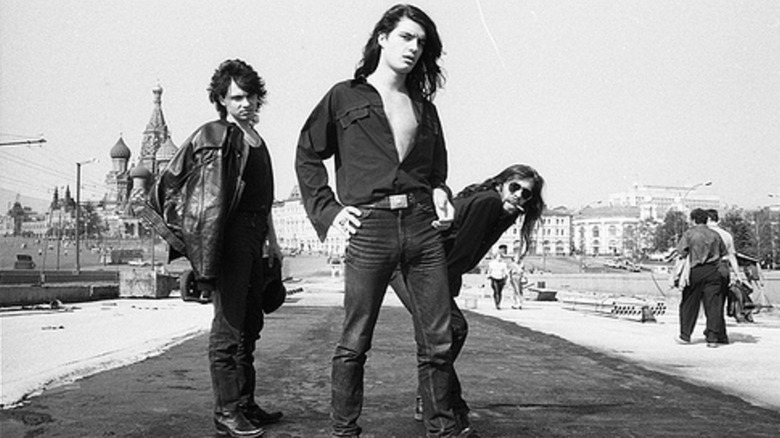
While reminiscing about the Moscow concert on "The Joe Rogan Experience" in 2016, Metallica's James Hetfield attempted to recall the show's lineup: "It was AC/DC, us, Pantera, and I think maybe a local band." He might not have been able to remember their name, but Hetfield was correct. All the acts (he also left out the Black Crowes) were from the West except for E.S.T. (Electro Shock Therapy), which was Russian born and bred.
While its official website and reports from the time say the group won a phone vote to be added to the lineup, the concert's co-organizer Eduard Ratnikov remembers its inclusion being the idea of him and his business partner. However it got there, the band was already popular in the USSR and had two albums under its belt. It got a good spot in the lineup, playing third, right before Metallica.
The band continued touring and releasing albums until the death of founding member and frontman Zhan Sagadeev in 2009. Since 2012, various combinations of former members have used the E.S.T. name, leading to a lawsuit. Apparently, a version of the band is still active as of 2026.
The entire concert was filmed
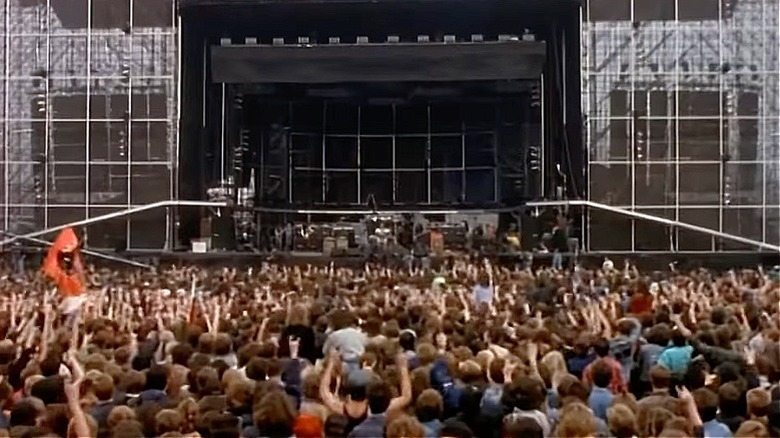
Time Warner made sure every minute of the event it paid for was filmed, resulting in the 1992 documentary "For Those About to Rock: Monsters in Moscow." It compressed the 10-hour concert into a more manageable 1 hour and 24 minutes and included only one song from the Russian band E.S.T.
Much of the concert, both from the documentary and videos made by the bands themselves, is easy to watch today. In an interview with the "Conan O'Brien Needs a Friend" podcast, Lars Ulrich said, "We had the camera crew... and they filmed it, and if you go to YouTube now, it is among the most surreal and extraordinary footage of Metallica ever ... it's a real mindf*** of a concert to watch 30 years later."
While Time Warner tried to spin its footing the bill and then producing a documentary purely as an altruistic way for the conglomerate to celebrate democracy finally coming to Russia, most people who were familiar with how capitalism works weren't buying it, including The New York Times, which snidely wrote, "In return for bringing the acts to Moscow, Time Warner will come away with a documentary film that will presumably celebrate Time Warner celebrating democracy and freedom in the Soviet Union." The outlet also noted that at all times, there were twice as many camera operators on stage as musicians. It's estimated that Time Warner made $80 million from distribution and other rights related to the documentary and additional footage.