

5 Doo-Wop Songs That Take Boomers Right Back To Roller Rink Nights
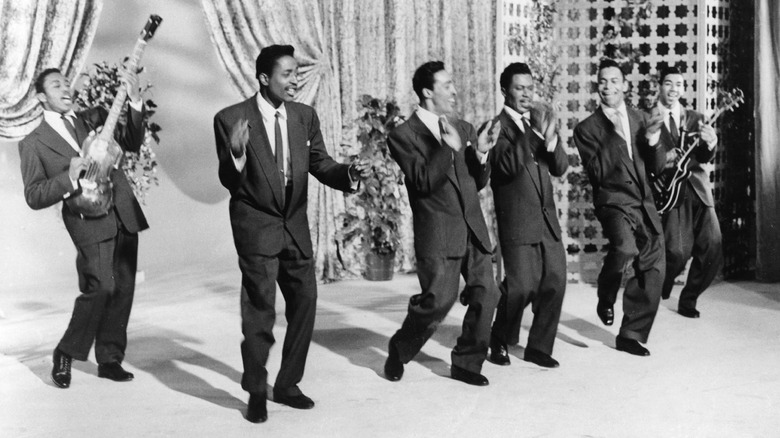
In the 1950s, vocal groups in American cities began emphasizing harmony and the voice in backing music, building on existing traditions of small-group harmony. From there, a distinctive genre emerged, consisting mostly but not exclusively of young African American men. It saw a group of good voices backing an excellent voice carrying the melody with little or no instrumental accompaniment. "Doo-wop" came from the scat-like vocalizations that were common for these backing groups to use, with many of the vocal patterns becoming the most distinctive parts of the songs' lyrics.
While doo-wop went on to influence many genres that followed it (and, like swing, disco, and everything else, it comes back from the alleged grave to say "hello" every few years), its true heyday was the 1950s. Despite its complicated position as a largely Black genre in a still-segregated United States, doo-wop has joined the poodle skirt, the malt shop, and that haven of the well-chaperoned date, the roller rink, as symbols that immediately evoke America in the 1950s. In fact, the following five songs will take you right back to those nights on the rink.
Runaround Sue — Dion
Teeny-bop songs of the '50s were obsessed with nothing more than teenage love: get-togethers and breakups and crushes and crashes. Dion's 1961 hit "Runaround Sue," the story of a girl who would rather date widely than steadily, manages to thread the needle perfectly: It's about heartbreak but sung energetically enough that you can dance (or skate) to it. The singer fell for Sue and now offers a warning to anyone else who might fall for "the touch of her hand and this girl's warm embrace." He's still hung up on her, though: For all her wayward ways, Sue apparently gets under his skin.
Good news for anyone worried about Runaround Sue herself, by the way. In a 2019 interview with Forbes, Dion said that he had written the song about an actual "sociable" girl — real name withheld — he had known growing up. She'd gone on to marry a rabbi and have six children, after whom she probably did quite a bit of running around.
Sh-Boom — The Chords
You may remember this song as "Life Could Be a Dream," the clearest actual words in the lyrics, but its government name is the simple "Sh-Boom." This track belongs in whatever doo-wop hall of fame may one day be built for two reasons: The 1954 version by The Chords was the first song by Black artists to cross over from R&B to do well on the pop charts, and it has a remarkably high and diverse population of nonsense words. The refrain, in its full wordless glory, is "Day dong da ding-dong / Sha-lang-a-la-lang-a-la-lang-a-la-lang-a-la / Woah, woah, bip / Ah bo da do da dip, woah." You say it best when you say nothing at all, apparently.
The Chords recorded it first, but they didn't do it the most successfully from a financial perspective. That "honor" went to The Crew-Cuts, a white Canadian group that got rich covering Black artists' songs in near-identical versions. Check the version on your playlist and make sure The Chords are getting their belated due.
Who Put the Bomp? — Barry Mann
It's the question that haunts us to this day: "Who put the bomp / In the bomp bah bomp bah bomp?" While nonsense words have a long history in music, they're also frequently silly, and by 1961, doo-wop had reached a point where Barry Mann could make a perfectly successful doo-wop song that poked fun at doo-wop songs. The narrator wants to thank whoever came up with this style of music, since something in the magical concatenation of bom-bah-bomps and rama-lama-ding-dongs has made his girl fall for him. (She might have kissed him to shut him up, to keep him from continuing to sh-boom and bip-da-dip all across the roller rink; we'll never know.)
Mann was a one-hit wonder, but "Who Put the Bomp" is one of those '60s songs that still has us hooked today. He went on to have a successful songwriting career, frequently working with wife, Cynthia Weil. And if doo-wop once struck the young Mann as the apex of girl-getting music, we can only hope that he and Weil have had a long and happy marriage.
Rama Lama Ding Dong — The Edsels
Whatever you call your dearest is between you, them, and the surveillance state, but heed this one piece of advice: Keep it short. The Edsels' 1958 doo-wop triumph "Rama Lama Ding Dong" is an abbreviated version of his best girl's name, given as "Rama lama lama lama-lama ding dong," like she's a show cat or a racehorse. Bless them, they didn't even come up with that 12-syllable monster to force a rhyme since they only ever rhyme the name with itself. Fortunately, their gorgeous voices and vocal play more than make up for the flatly ridiculous name this poor girl has to schlep down the song.
"Rama lama lama lama-lama ding dong" isn't the only bad name here. The Edsels named themselves after the Ford Edsel, which had just come out, hoping to hitch themselves to a cool new car but unfortunately following it to the scrap heap. The Edsels only had the one hit, and the Ford Edsel (named after Henry Ford's late son) was such a failure that books and academic articles have been written about the historic flop.
Da Doo Ron Ron — The Crystals
The Crystals' "Da Doo Ron Ron" is a classic doo-wop song without being classically doo-wop. It's got some of the traditional ingredients — nonsense words; one lead voice over dense, active vocal backing; and it's about a cute boy — but it showcases female voices instead of the male voices that were the bulk of doo-wop. Furthermore, the spare arrangement goes out the window. This is a Phil Spector production, and for all his many failings, he didn't skimp on orchestration — and by "Da Doo Ron Ron," the famous Wall of Sound is here. It wasn't even meant to be called "Da Doo Ron Ron," but the placeholder gibberish worked well enough that the crew kept it in.
The Crystals' version only made it to No. 3 on the charts in 1963, but Shaun Cassidy covered the song in 1978. He flipped the gender of the cutie ("Bill" to "Jill") and ... the song ran all the way to the No. 1 position! There's no accounting for taste.