

5 Classic Love Songs Everyone Thinks Hit No. 1 — But Never Did
Many love songs that are now considered classics didn't actually make it to No. 1 back when they were released because it took time for the public to get on board — the same public that would probably be surprised to learn those anthems never topped the Billboard Hot 100. A beautiful love song can touch lives and keep doing so over the decades. It gets to the point where a tune has such a cultural impact that we collectively assume that when it was first released, it was instantly appreciated and hit No. 1. But alas, while such songs were moderate to massive hits in the '60s, '70s, and '80s, they didn't urgently claim that milestone.
These love songs missed out on the temporary high of No. 1 single status, but they resonated over time and attained cultural ubiquity. They have been played at proms and wedding receptions and will be aired on classic rock and oldies stations until the end of time. Still, these five tracks didn't top the charts, even if you didn't realize it.
Unchained Melody — Righteous Brothers
"Unchained Melody" was so entrenched in the collective memory as a love song like no other that more than 20 years after the Righteous Brothers first released its version, it became a hit all over again. One of the most dramatic — if not melodramatic — songs ever recorded, "Unchained Melody" packs an emotional wallop. It starts as a softly delivered ballad about romantic need and desire, framed within some commentary about the passage of time. Then, it builds into something grand and epic, befitting the overwhelming and powerful emotions associated with falling in love. By the end, main vocalist Bobby Hatfield wails and almost cries as he struggles to make his feelings heard and known over what sounds like the world's biggest and loudest orchestra.
Initially created by composer Alex North for the soundtrack of a forgotten prison movie called "Unchained" (hence the title) in 1955, "Unchained Melody" was unforgettable and instantly vital when handled by the Righteous Brothers in 1965 — but not so much as to propel it to No. 1. It reached No. 4 on the Hot 100. Come 1990, the producers of the supernatural romantic drama "Ghost" needed a song that could define the relationship of its separated-by-death lovers Sam and Molly, and they secured the rights to "Unchained Melody." It became a hit once more, making it up to No. 19.
Something — The Beatles
It's understood and acknowledged that The Beatles absolutely dominated the 1960s, from the band's appearance on "The Ed Sullivan Show" in early 1964 until the end of the decade. The group also topped the Hot 100 a stunning 20 times, a feat unmatched more than 55 years after The Beatles' breakup. The band also sang about love a lot, and you might assume then that one of those scores of No. 1 hits was "Something," probably the most affecting and swoon-worthy one that the Fab Four ever recorded.
Tingly, majestic, and powered by the passionate guitar work of the song's composer, George Harrison, "Something" soars in its attempts to describe the feelings of love. "Something in the way she moves / Attracts me like no other lover," a dazed and amazed Harrison sings. And yet "Something," someway and somehow, couldn't take that combination of timelessness and profundity and ride the wave of ongoing Beatles success to the No. 1 spot. One of the last singles released by the band, "Something" peaked at No. 3 in 1969.
Nobody Does It Better — Carly Simon
A confluence of factors should've taken "Nobody Does It Better" to the top slot of the Hot 100, but they couldn't quite get the job done. The 1970s were an era dominated by singer-songwriter types, and Carly Simon was one of the movement's biggest breakouts. After years of hits like Carly Simon's mysterious "You're So Vain" and the anguished "Haven't Got Time for the Pain," the musician was tapped to record the sensual love theme for the 1977 James Bond film "The Spy Who Loved Me." Co-written by multiple Grammy Award-winning composer Marvin Hamlisch, the tune is flirty, irresistible, and only sort of about a fictional British spy. Simon really sells the song, ecstatically describing the subject as "the best" at loving her in most every way that can be defined.
"The Spy Who Loved Me" was a box office smash, and that should've also helped what's since been regarded as one of the best-known and better-selling James Bond songs into the No. 1 spot. Instead, in October 1977, "Nobody Does It Better" peaked at No. 2 on the pop chart, lingering on the Hot 100 for a total of six months before it went on to a second life as an entry on who knows how many romantic mixtapes.
Baby, I Love Your Way — Peter Frampton
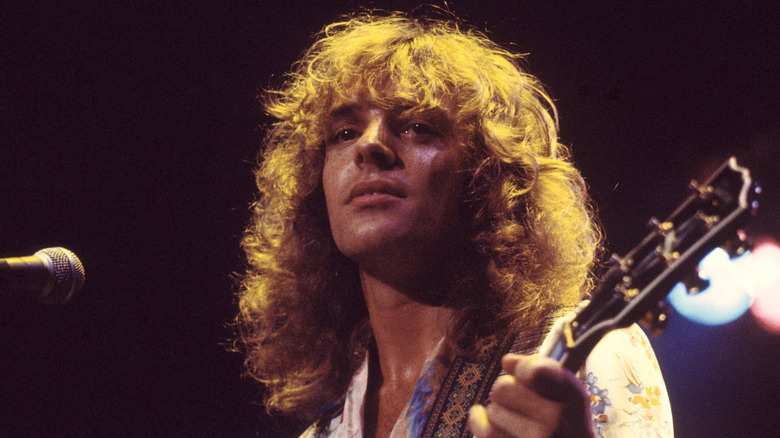
Sweet, gentle, and altogether earnest, Peter Frampton is as taken with the target of "Baby, I Love Your Way" as he is with his own growing feelings of love, so well-expressed in the 1976 single. He's a man in love, and he's got to sing about it. Cooing, ringing, and full of echo, the tune sounds like it's coming from a distant stage or a car radio. That's the kind of track that's destined to be "our song" for millions of couples getting together in the late 1970s. At that time, the singer and guitarist was a massive celebrity, taking his live album "Frampton Comes Alive!" to eight-times-platinum status. That era of Frampton saturation could've very well led many to think that the musician also topped the singles charts with cuts from that popular record.
"Baby, I Love Your Way" may be the most romantic and memorable song from the LP, but it wasn't even the biggest hit. The first single, "Show Me the Way," hit No. 6, and the third single, "Do You Feel Like We Do," made it up to No. 10. In between, "Baby, I Love Your Way" released to radio just in time for summer romance, yet it could manage only a No. 12 placement.
You're the Inspiration — Chicago
By the mid-1980s, Chicago had completed its transition from a boisterous and jazzy rock band into a heavily produced synthesizer-forward ballad group to showcase the voice of Peter Cetera. This period produced "You're the Inspiration," a catchy slow jam with grand keyboard flourishes and Cetera laying bare thoughts of undying devotion and how the relationship ought to go. The song is a love letter in musical form, declaring a romance to be fated and deeply fulfilling because the subject makes life worth living, traits that will never not be true.
This tune has been played by countless school-dance DJs and for just-married couples taking their first spin as spouses in front of their wedding guests. And yet "You're the Inspiration" isn't even Chicago's most successful single as far as the charts are concerned. The similar-sounding and apologetic "Hard to Say I'm Sorry" made it to No. 1 in 1982, and the post-Cetera Chicago 1988 breakup song "Look Away" topped the charts, too. But "You're the Inspiration," the one about love pure and ongoing, topped out at No. 3 in 1985.