

5 Hit Songs That Prove 1967 Was The Decade's Greatest Year For Women In Rock
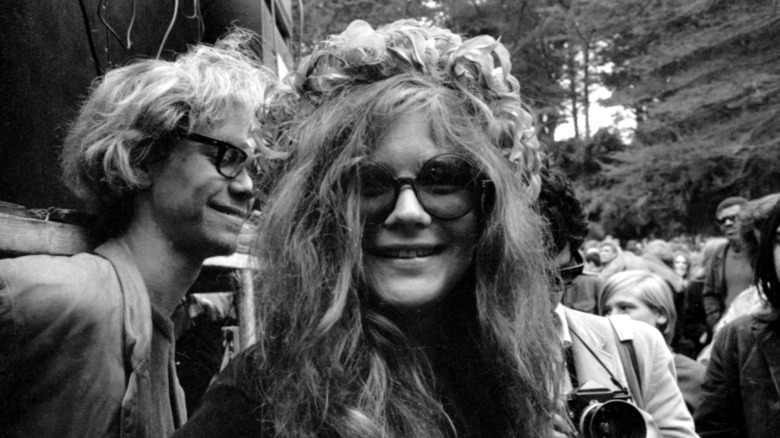
Too often, histories of rock 'n' roll tend to concentrate on the men who've made it big in the genre. While their contributions are certainly part of the story, what about women? Women have been part of rock since the very beginning, from Big Mama Thornton singing "Hound Dog" (it was written for her, after all) to the edgy girl group The Ronettes. By the '60s, rock was well underway as the boundary-pushing genre of choice for young folks, and women were continuing to make their mark. Going by the hits racked up by female performers, 1967 may be the most consequential year of the decade on that front.
That year saw Janis Joplin's astounding breakout performance at the Monterey Pop Festival, as well as the rise of psychedelic rocker extraordinaire Grace Slick. There were more accessible hits, too, though don't dismiss artists like Lulu or the Mamas & the Papas just because they got plenty of radio play with softer tracks. Looking back, 1967 proved seriously consequential for women rockers, and given how their achievements have echoed through the years, for those making their mark today, too.
Ball and Chain — Big Brother and the Holding Company
Okay, technically, "Ball and Chain" was released on Big Brother and the Holding Company's 1968 album, "Cheap Thrills," but singer Janis Joplin made her mark with the song the year prior. The group's breakout performance at the June 1967 Monterey Pop Festival utterly changed its fortunes, with Joplin in particular being catapulted into rock 'n' roll history. Audience members stood up for her extraordinary performance, made remarkable by her raw energy and authentic delivery, despite an uninspired Saturday afternoon spot in the schedule.
The song even made it to the screen in 1968's "Monterey Pop" concert film, which covers the 1967 show. The band originally didn't consent to being recorded that Saturday, which some allegedly regretted after Joplin's electric performance. The do-over set was on Sunday night, and though the band had qualms about going back onstage to earn more money for appearing in the film — it was worried about selling out — the group did so anyway.
Even on the second round, Joplin stood out with her indelible singing informed by years of performing soul and blues songs. Janis Jopin continued to stand out until her tragic death in 1970, though male critics could be downright gross about Joplin's energy and physicality. Still, Joplin nevertheless would recall the festival appearance as a supremely happy point. Meanwhile, the rest of Big Brother and the Holding Company was often ignored, and the band broke up the next year.
Somebody to Love — Jefferson Airplane
For all that Grace Slick became a symbol of the psychedelic 1960s, one of her foundational hits with Jefferson Airplane actually has a bit of a conservative streak. "Somebody to Love," which became a Top 10 hit on the Billboard Hot 100 in the summer of 1967, was actually first recorded in 1966 as "Someone to Love." What's more, it wasn't even a Jefferson Airplane original, though Slick was the original vocalist. It's just that she first recorded it while singing with the Great Society, which included her then-husband Jerry as drummer and brother-in-law Darby as songwriter and guitarist. Darby, upset by his girlfriend skipping a phone call, was inspired to write a song that argues for a steady, loving relationship in contrast to the unattached, freewheeling romantic style of the era.
Even with Slick delivering the vocals, the Great Society version is a bit staid. Then, Grace Slick fatefully became Jefferson Airplane's singer, stepping in when the original lead vocalist left abruptly. Slick brought both "Somebody to Love" and "White Rabbit" to the group, which rearranged the first track into a faster-paced affair with edgier delivery. This version became a hit, even if the Jefferson Airplane cover can sound dark and even vindictively angry compared to the slower, more polished original — and the variety of reimaginings that eventually followed (cover artists for this track include the Ramones and KT Tunstall). Slick became a rock legend, thanks in part to her improved delivery and powerful voice back in 1967.
To Sir with Love — Lulu
Precisely defining what's rock and what's not can get pretty complicated, but we'd venture that Scottish singer Lulu's 1967 hit, "To Sir with Love," can at least qualify as pop rock. It's got a more polished sound than the more unconventional stuff coming out of California at the time, but this track also sports the sort of guitar and bass riffs that are clearly drawn from the rock 'n' roll world. Lulu's delivery of the song is heartfelt in a way that manages to avoid falling into a fully sentimental trap that might characterize more pop-centric singers, though it admittedly doesn't have the raw rock edge of something from Janis Joplin or Grace Slick.
Let's define this single as "pop rock," then, and give it credit for genuine popularity while we're at it. "To Sir with Love" readily topped charts in the U.S. and was certified gold by the RIAA in November 1967, though it didn't quite reach the same level of success in Lulu's native U.K. It was also a popular movie theme song that ruled the charts for the highly successful film of the same name, starring Lulu herself along with acting legend Sidney Poitier. The story dealt with rebellious teens and racism levied against Poitier's character in a British school, further lending the title song some more cred compared to other, more twee pop songs of the era. At the same time, it proved that women had a place in the British and worldwide music scenes — and the charts, too.
Dedicated to the One I Love — Mamas & the Papas
Don't be so fast to dismiss the Mamas & the Papas as yet another agreeable soft-rock group. The band wasn't always edgy, but it was still interesting, with complex harmonies and moody early hits like "California Dreamin'" and "Monday Monday." Two women were part of the four-person lineup: Michelle Phillips and Cass Elliot, who played alongside John Phillips and Dennis Doherty. On the group's 1967 hit, "Dedicated to the One I Love," both Michelle Phillips and Elliot frankly steal the show, with Phillips kicking off the song and Elliot more than doing her part to hold up the band's characteristically lush harmonies. Even though the tune was a cover — it was first recorded by The "5" Royales in 1957, and The Shirelles covered it in 1959 — it proved a hit for the Mamas & the Papas, reaching No. 2 on the Hot 100 in March 1967.
The Mamas & the Papas' cover is especially successful because it uses a striking chord progression and has Elliot (who did not particularly like to be called "Mama Cass") and her unforgettably strong and clear voice. The song was a hit because of the group's on-point harmonies, sure, but it also brought Elliot further into the public eye. That was hardly surprising in retrospect, as she is often singled out as the most charismatic member of the Mamas & the Papas. Certainly, she is still remembered to this day for her clear, commanding, and beautifully distinct voice, which helped her stand out both in this hit song and her subsequent solo career.
Different Drum — Stone Poneys
You have to give Stone Poneys credit where it's due: We may not collectively remember this folk-rock trio much anymore, but we certainly do remember lead singer Linda Ronstadt and the single that really put her in the public eye, "Different Drum." The song, meant as a gentle sort of breakup song, was actually copyrighted in the summer of 1965. Songwriter Michael Nesmith (who would later join The Monkees, which coincidentally had its own No. 1 hit in 1967) reportedly performed it with the Survivors in 1963. Ronstadt came into the picture after she reportedly found herself growing tired of the more staid folk stuff Stone Poneys was putting out ... and of pretty regularly singing harmony rather than lead in the group's songs.
Nesmith approved of Ronstadt's cover, which ironically didn't include the rest of the trio — especially the changes she made to sing it from a woman's perspective (later listeners gave it a feminist slant, though that wasn't strictly Ronstadt's idea). Then, there's Ronstadt's powerful voice, which she told The New Yorker in 2019 came about due to technical limitations. "I had no idea that I sang as loud as I did," she said. "I always thought I wasn't singing loud enough, because in the early days there were no monitors. You couldn't hear yourself." Still, she came across beautifully clear and well-expressed, and though Ronstadt eventually lost the ability to sing due to the effects of the Parkinson's-like disorder progressive supranuclear palsy, she cemented her place in folk-rock history back in 1967.