

In 1967, Cat Stevens Just Missed Jimi Hendrix Perform The Most Rock 'N' Roll Move Of The Decade
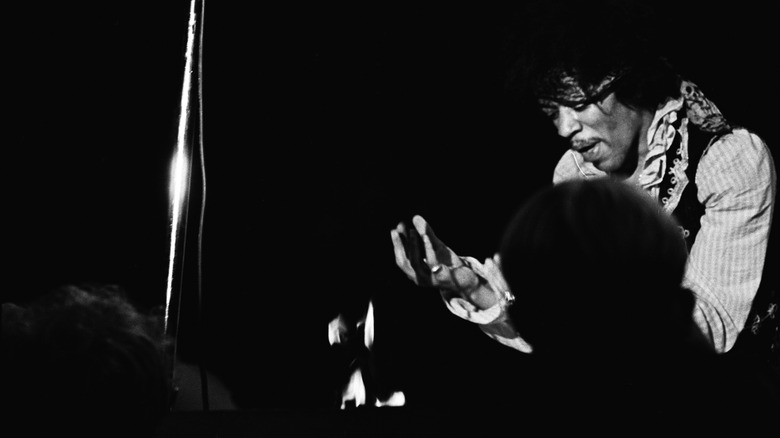
Jimi Hendrix stepped onstage at the Monterey Pop Festival in 1967 as a near-unknown in America. By the time his set was over, he'd cemented his legend as one of rock's greatest guitarists thanks to a nearly-unprecedented onstage stunt — one that, only a few months before, was completely missed by folk-rocker Cat Stevens while sharing a bill with Hendrix in London.
The Jimi Hendrix Experience had quite a reputation in Europe before the Monterey Pop set. By the spring of '67, both the debut single "Hey Joe" and "Purple Haze" had reached the U.K. Top 10, and the Jimi Hendrix Experience's debut LP "Are You Experienced" had peaked at No. 2. The album hadn't been released in America when the group took the stage on June 18, 1967, following sets by The Who and the Grateful Dead. But no record could quite capture what happened on stage that night: during a set-closing cover of the Troggs' "Wild Thing," Hendrix laid down his guitar, poured lighter fluid on it, and lit a match. The image of Hendrix kneeling over his instrument as it went up in flames remains one of the most powerful images in live music history.
But how could Stevens miss a practice run for such an iconic moment? Chalk it up to a case of pre-show nerves — and maybe a bit of misunderstanding of whether the fire was part of a greater emergency.
Hendrix first lit his guitar on fire at a London gig
Jimi Hendrix first pulled off his pyrotechnic stunt at the London Astoria on March 31, 1967. He was part of an unusual tour, playing high-intensity rock in between sets by well-known folk and pop acts like the Walker Brothers, Engelbert Humperdinck, and Cat Stevens. Unfazed by the seeming mismatch, Hendrix was focused on making sure his sets stood out as much as possible.
The guitarist got the idea for setting his instrument on fire while sitting with manager/producer Chas Chandler and journalist Keith Altham, as noted in John McDermott's Ultimate Hendrix: An Illustrated Encyclopedia of Live Concerts and Sessions. Knowing that The Who were making similar headlines for bizarre antics to keep the musicians' fans watching, like setting off smoke bombs and smashing instruments on stage, Hendrix wanted to go a step further. "Well, it's a pity you can't set fire to your guitar," Altham quipped. Almost immediately, Chandler sent Hendrix's road manager after a can of lighter fluid, and at the close of his set, Hendrix made his first flaming sacrifice to the rock gods.
Perhaps unsurprisingly, the U.K. press had no idea what to make of the stunt. "Hendrix was lying on stage playing the guitar with his teeth when it suddenly burst into flames," said Melody Maker journalist Chris Welch, who was in attendance. "The guitar was left burning dangerously near the closed curtains ... An attendant rushed on stage with a fire extinguisher and put out the flames which were leaping ten feet in the air."
Backstage, Cat Stevens was too focused to notice
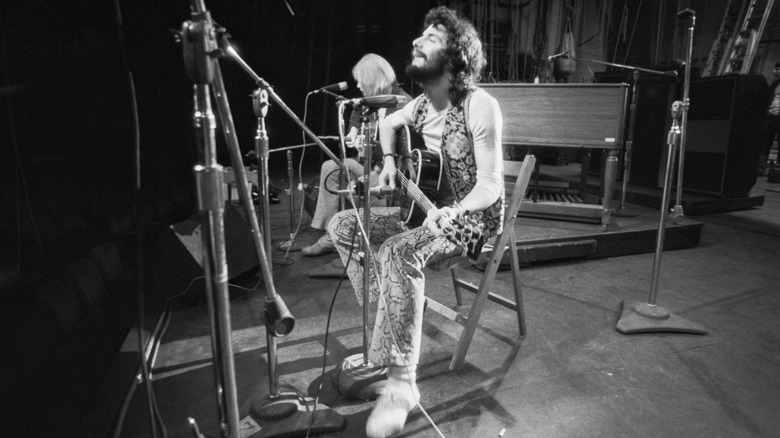
Despite the wild scene at the Astoria, at least one of Jimi Hendrix's famous tour mates didn't realize there was a fire until it was nearly extinguished. And he knows it makes a pretty good story.
"The first night, I think it was at Finsbury Astoria, and then we heard: 'Ahh, there's a fire on stage!'" Cat Stevens, now known as Yusuf Islam, told BBC's "Desert Island Discs" in 2020. "But then we found out, of course, that was the first time he ever lit his guitar on stage." Two years later, Stevens told Rolling Stone why he never saw any of the pyrotechnics in person.
"I was too scared in my dressing room, thinking about how I'm going to approach my set, to even bother about going down there and having a look," he said with a laugh. Despite the backstage intensity, he had nothing but positive things to say about his time with the late rock legend, recalling a shared bond on the road that even extended to "a few puffs, as you would, in that purple haze."
Stevens may not have exactly stood next to Hendrix's fire, but he's happy to be counted as one of the millions blown away by what the guitarist achieved in his career, which was cut short in one of the biggest rock 'n' roll tragedies of the '70s.