

5 Songs From 1981 That Prove It Was The Decade's Best Year For Synth-Pop
For many music fans, the 1980s were defined by synth-pop. But while the charts of the whole decade pulsate with the futuristic sound of synthesizers, we believe that 1981 is the year that synth-pop truly hit its stride, and we have five tracks that prove it.
Since the 1960s, popular music makers had been working with synthesizers to push the sonic boundaries that had previously limited them in the studio and in live settings. Often, this was folded into rock trajectories and featured as a new plaything on serious-minded progressive rock albums. But by 1980, through the work of acts like Gary Numan, Visage, Kraftwerk, and even Paul McCartney, with his divisive synth-led track "Temporary Secretary," synth-pop was firmly established as the subgenre that would become the sound most associated with the decade as a whole.
Here are five tracks that show 1981 is synth-pop's most timeless year. While there might have been bigger hits later in the decade — a-ha's classic "Take on Me" is one notable track that could arguably have given the title of best synth-pop year to 1985 — 1981 set the template for the genre with tracks that have become not only the staples of synth-pop as a genre but also emblematic of the music of the decade. Just try to resist these hits.
Don't You Want Me – The Human League
The use of electronic synthesizer sounds typically gives synth-pop a smooth, glimmering sound that more rock-focused instrumentals often lack. "Don't You Want Me" is one of the most aesthetically successful synth-pop tunes of all time, underpinning a narrative song about a breakup with what at the time was a futuristic synth-heavy instrumentation to produce something that was surprisingly commercially friendly and utterly unique.
Penned by Human League frontman Phil Oakey, it is confident, brash, and bombastic — the perfect song to soundtrack the early 1980s. But nothing about the creation of "Don't You Want Me" was straightforward. Before the single became an international hit, reaching No. 1 in both the U.S. and the U.K., The Human League had been shaken by a period devoid of hits and the loss of several founding members. Oakey was forced to replace them with dancers Joanne Catherall and Susan Ann Sulley, whom he recruited in a nightclub in the band's home city of Sheffield, England, before adding more members. It proved to be an inspired choice, with the band's new line-up capturing the imagination of music fans.
The recording of the track was also haphazard but blessed once again by happy accidents. The use of synths to the degree The Human League did was still experimental in 1981, and there was plenty of trial and error as the band developed the synth lines on the Roland MC-8. Notably, the guitar-like synth line heard during the chorus was arranged half a bar earlier than the band intended but was kept in as it sounded better than what had been planned.
Tainted Love – Soft Cell
Soft Cell vocalist Marc Almond was a huge fan of "Tainted Love," a relatively obscure Northern Soul track by 1960s vocalist Gloria Jones. When he and bandmate Dave Ball were looking for cover songs to include on the 1981 album "Non-Stop Erotic Cabaret," "Tainted Love" seemed like an obvious choice. "I was 21, already feeling world-weary after some love affairs. I adored the sneering, curled-lip aspect of the song," he told The Guardian in 2017.
The instrumental for the cover came together quickly, with Almond and Ball responding to each other with simple parts on the drum machine and synthesizer, respectively. But the alchemy of the song, which has a steam-powered sense of locomotion about it, as well as the celebrated music video — an eye-popping spectacle back in 1981 — made "Tainted Love" an international smash that remains an evergreen dance-floor filler.
The only problem for Almond is that the multi-platinum single was accompanied by another cover version as its B-side. "Having a cover version on both sides meant we didn't get any songwriting royalties for the biggest-selling hit of 1981. That must have cost us millions of pounds," he told The Guardian.
Just Can't Get Enough – Depeche Mode
Depeche Mode became one of the biggest stadium bands in the world by the end of the 1980s, but the band truly started making waves as a synth-pop outfit in 1981, with the release of the album "Speak & Spell." Though Depeche Mode had yet to become a global sensation, they became a well-known band in Europe thanks to the album — or, more specifically, the success of its biggest single, "Just Can't Get Enough," a ridiculously catchy synth-pop track that became a club classic.
Penned by the band's frontman at the time, Vince Clarke — who would later go on to find success with various bands, most notably Erasure — the song was, at the time of its release, a perfect marriage of the recognizable and the obscure. While Depeche Mode's use of synths was mind-blowing to many listeners, the song structure, vocal melodies, and background harmonies are perfect ear candy to any fan of traditional rock and pop music.
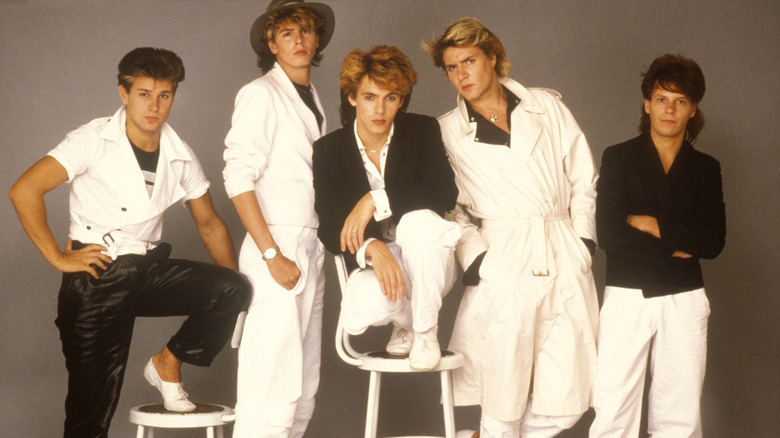
Girls on Film – Duran Duran
Duran Duran would go on to have huge international successes in 1982, with "Rio" and "Hungry Like the Wolf" establishing the band as one of the biggest acts of the decade. But the band's breakthrough came with "Girls on Film," a 1981 smash that performed especially well in the U.K., peaking at No. 5.
Duran Duran first recorded a version of the song in 1979 with original singer Andy Wickett. But the arrival of Duran Duran's new frontman, Simon LeBon, led to the song being rewritten, with saucier lyrics that reflected the sexual nature of a fashion photo shoot. "Girls on Film" had two different music videos, one that was relatively tame and could be aired on TV, and another, more explicit version that could be shown in nightclubs, the combination of which made the track a hit.
Though "Girls on Film" failed to chart on the Billboard Hot 100, it set the tone for Duran Duran's later pop dominance and was hugely influential in terms of associating synth-pop with decadence and sleaze. The '80s just wouldn't have been the same without it.
Maid of Orleans – Orchestral Manoeuvres in the Dark
They may be among the '80s musicians who folks have forgotten about, but 1981 was a seismic year for Orchestral Manoeuvres in the Dark (OMD), which released its seminal album "Architecture & Morality" that year. The record spawned three key singles in the group's discography. The last of these, "Maid of Orleans (the Waltz Joan of Arc)" is among the band's most ambitious work.
A cinematic soundscape revolving around the story of the titular French patron saint, the song features a 6/8 time signature, lush Mellotron lines, and aggressive drum fills that summon the militaristic aspects of Joan of Arc's story. Synth-pop isn't generally considered high concept, but with "Maid of Orleans," OMD sought to build on the work of progressive rockers of the previous generation to offer storytelling on a grander scale than most pop acts would ever dream of.
The track "Enola Gay" from 1980 is undoubtedly a more danceable track, while 1986's "If You Leave" was a far bigger international hit for OMD. But "Maid of Orleans" sees the group following its instincts with little thought for commercial appeal, which, in the end, made the track a success.