

This Cover Of Bob Dylan's 1968 Single Outperformed His Own Release By A Mile
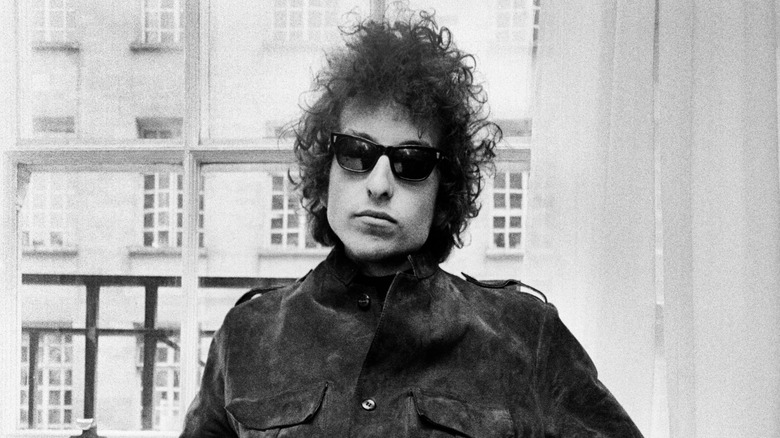
In December 1967, Bob Dylan released "John Wesley Harding," a spare, mostly acoustic album he'd recorded in secret in Nashville, that included "All Along the Watchtower." The album was very different from Dylan's last, 1966's "Blonde on Blonde," but in the year and a half since then, Dylan had been in seclusion following a motorcycle accident near his home in Woodstock, New York, that helped spark a new direction for him. Still, "All Along the Watchtower" didn't seem to resonate much with critics. In many reviews, it's barely mentioned if it's mentioned at all, with most reviewers instead keying in on cuts like "I'll Be Your Baby Tonight." It would take another musician to turn this harmonica-driven tune into something truly memorable.
Jimi Hendrix had been listening to "John Wesley Harding" and was enthralled by what he was hearing. He was about to record his third album, "Electric Ladyland," with his band, the Jimi Hendrix Experience. Hendrix ended up recording "All Along the Watchtower," which, when released as a single in September 1968, shot to No. 20 on the Billboard Hot 100, becoming his highest-charting hit. Dylan's version was also released as a single, in November 1968, backed with "I'll Be Your Baby Tonight," but it failed to chart. Hendrix's version transformed Dylan's stripped-down, country-flecked folk tune into a virtuosic psychedelic tour de force.
Hendrix worked hard on his version of All Along the Watchtower
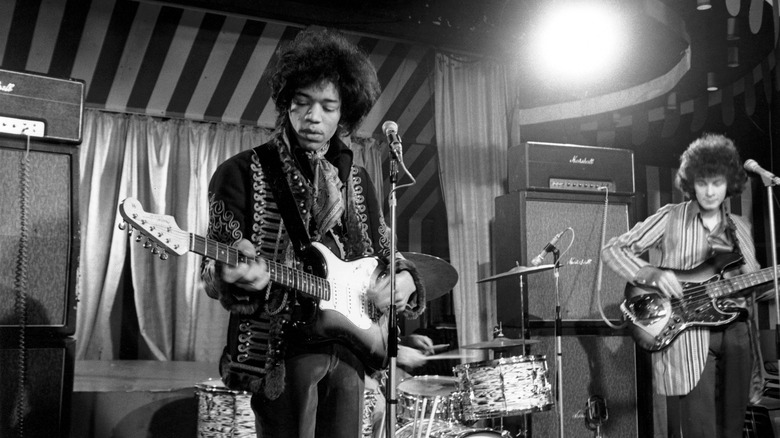
Jimi Hendrix had been a long-time Bob Dylan fan and was determined to record something from "John Wesley Harding" for "Electric Ladyland," either "I Dreamed I Saw St. Augustine" or "All Along the Watchtower." According to the book "Jimi Hendrix FAQ: All That's Left to Know About the Voodoo Child," Hendrix's girlfriend at the time, Kathy Etchingham, convinced him to record the latter, believing the former was "too personal to Dylan." Other sources tell a different story. Dave Mason of Traffic recalled that Hendrix had been obsessed with "All Along the Watchtower" from the get-go.
Either way, by January 1968, Hendrix was in a London studio with his band, along with Mason on 12-string guitar. Over multiple takes, Hendrix fought with bassist Noel Redding, who eventually walked out, and berated Mason for his inability to get the tricky guitar part right. Mason eventually stepped in on bass after Redding's exit. Hendrix continued working on the song in New York City for months, overdubbing Redding's and Mason's bass parts with his own, and futzing with his guitar parts. By July 1968, Hendrix had completed his masterpiece.
Jimi Hendrix's psychedelic tour de force
Where Bob Dylan's version of "All Along the Watchtower" is spacious, spare, and driven by acoustic guitar and harmonica, Jimi Hendrix transformed the song into a swirling, multi-layered soundscape with a driving rhythm that doesn't let up. With Dylan's lyrics of an apocalyptic vision filled with Biblical themes and a coming reckoning, Hendrix's version musically both builds off these themes and beautifully encapsulates them in sonic form. In September 1968, only nine months after Dylan released his album "John Wesley Harding," Hendrix's version of "All Along the Watchtower" hit the streets. It quickly made an impact, becoming his only Top 40 hit.
This wasn't the first time Hendrix had quickly learned and made other artists' work his own. A year earlier, in June 1967, after hearing the Beatles' "Sgt. Pepper's Lonely Hearts Club Band" album that had come out only three days earlier, Hendrix and his band performed the title song at a gig in London with Paul McCartney and John Lennon in attendance. They were blown away by Hendrix's version, as was Dylan when he heard Hendrix's fiery reinterpretation of "All Along the Watchtower." "It overwhelmed me, really," Dylan recalled in a 1995 South Florida Sun Sentinel interview. "He found things that other people wouldn't think of finding in there." Dylan admitted that he performs "All Along the Watchtower" in the style of Hendrix rather than how he had originally recorded it.