

5 Nearly Perfect '70s Songs That Almost Everyone Agrees On
The 1970s are arguably the 20th century's greatest decade for popular music. There is much to enjoy about the songs of this decade — in fact, many of the most timeless pieces that emerged during this era are pretty much perfect. Though the world mourned the loss of The Beatles, which announced their breakup in 1970, the decade was characterized by a burgeoning sense of new possibilities. Rock bands broadened their horizons following the explosion of the genre thanks to the psychedelic revolution, while soul acts embraced the wide sonic palette allowed by better studio technology and the dawn of funk to create some of the grooviest music to ever exist.
Music is, of course, subjective, but when we think of perfection, we think of those songs that it's hard to imagine anyone really criticizing harshly with any degree of believability. With that in mind, here are five tracks that anyone with an appreciation for rhythm, melody, musicianship, and top-class songwriting will have trouble finding any issue with. This list could easily be much longer, and in truth, trying to keep this to five picks has meant we've left a great deal of close-to-perfect music out. See if you agree with our choices.
September — Earth, Wind & Fire
Listen to a classic Earth, Wind & Fire album today, and it seems impossible that the soul group could achieve such incredibly high production standards in the 1970s. Indeed, the shimmering harmonies have rarely been bettered in the half-century of popular music that came after. Almost every song in the group's discography demonstrates Maurice White and co.'s incredible musicality. But "September," a classic from 1978, shows the group at their most perfect.
Possibly the most reliable dancefloor filler of the decade, "September" is an infectiously groovy, uptempo number with unforgettably catchy lyrics that can probably be summoned in an instant by anyone who has heard the song at least once. Accompanied by celebratory brass, bright guitar, and a bassline that simply never stops moving, the track balances exceptional vocal performances with a lyrical arrangement that you just can't help singing along to. It sounds as crisp and clean over a PA today as it did back in the day, and, if anything, has grown in popularity in the years since its release.
Dreams — Fleetwood Mac
Fleetwood Mac's "Rumours" is possibly the quintessentially perfect '70s album, a monster bestseller that continues to score highly in the pop charts deep into the 21st century. But among the album's glittering tracklist, one song stands among the rest as being especially perfect: "Dreams."
Written by vocalist Stevie Nicks about her relationship with Fleetwood Mac guitarist and vocalist Lindsey Buckingham — that famously came to an end during the recording of "Rumours" — "Dreams" is a breakup classic. The song is a fragile ballad that nevertheless needles its subject: "It's only right that you should / Play the way you feel it / But listen carefully to the sound / Of your loneliness," Nicks sweetly sings. The instrumental is equally delicate, with a subtle, minor-key guitar solo from Buckingham himself that stands among the finest in the band's discography.
"Dreams" was the only single from "Rumours" — and the band's whole discography — to hit the No. 1 spot on the Billboard Hot 100. It peaked in June 1977, and the song has remained popular ever since. In 2020, the tune gained a huge influx of fresh interest when skateboarder Nathan Apodaca used the song to soundtrack a viral TikTok of himself drinking cranberry juice while skateboarding down a highway. The video led to countless imitators, including one by Fleetwood Mac founder Mick Fleetwood, and a huge spike in streaming numbers for the song.
Superstition — Stevie Wonder
Stevie Wonder established himself as one of popular music's most forward-thinking creatives in the 1970s. Following his early career as a teenage performer that began at the start of the previous decade, his combination of incredible musicianship, talent as a composer, and rich voice combined to make some of the decade's lasting hits. "Superstition" is, understandably, Wonder's signature tune.
The highlight of his 1972 album "Talking Book," "Superstition" is a pop-orientated, funk-infused home run that peaked atop the Billboard Hot 100, winning Wonder two Grammy Awards. Strangely, however, he had written the song without the intention of singing it himself. Instead, after he came up with the tune while touring as a support act with The Rolling Stones, Stevie Wonder planned to offer the now-hit to guitar supremo Jeff Beck, who played on one song from the same album: "Lookin' For Another Pure Love." Thankfully, Wonder's management convinced him that the track would be a hit if he performed it himself. "Superstition" is one of those rare perfect songs that you can't help getting lost in once it comes on the radio — whether it's the keys, the vocal melody, or the bassline that catches you, it's dangerously hooky.
Bohemian Rhapsody — Queen
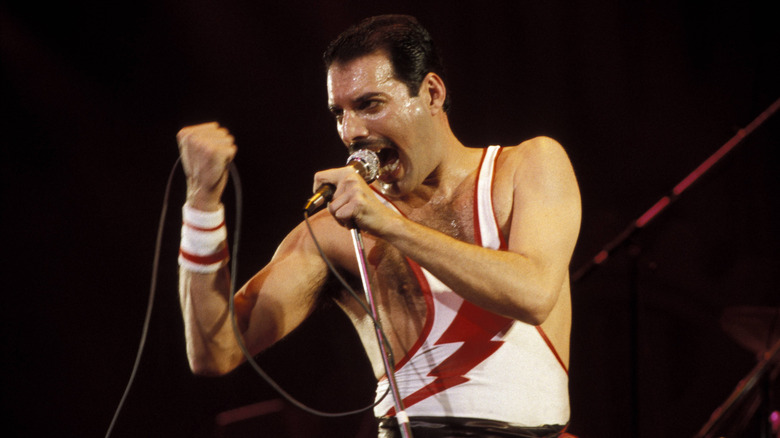
Even with confusing lyrics, Queen's "Bohemian Rhapsody" is the ultimate sing-along classic, a catch-all track that appeals to fans of both the theatrical side of popular music and hard rock's heavier side. Everyone probably remembers that joyous scene in "Wayne's World." You know, when Mike Myers, Dana Carvey, et al. lip-sync the track's operatic passages perfectly before indulging in several bars of headbanging, their shoulder-length hair flying around the car interior as they do so.
Play "Bohemian Rhapsody" for a mixed group today, and you're likely to find that several of those in your company will react to the track in the same way. Maybe you take Freddie Mercury's masterpiece on its own terms, or maybe you listen to it with the lashings of irony that many listeners enjoy it with. Regardless, the song is undoubtedly a wonder of composition and performance and one of the songs from the 1970s that you can imagine still finding an audience another 50 years from now.
What's Going On — Marvin Gaye
The U.S. record-buying public as a whole hasn't always been willing to buy socially conscious music in large numbers. A quick look at the historical discrepancies between what fills the R&B and soul charts and the pop charts down the decades confirms this. But in 1971, soul legend Marvin Gaye showed that, with the right performance, listeners would lap up a song dealing with the most difficult social issues of the age.
"What's Going On" was inspired by a slew of disturbing news stories from the late 1960s and 1970s, including the trauma of the Vietnam War and the police brutality that met anti-war protests as the war dragged on. As the song's low-key, tentative instrumentation makes clear, it's a reflection of Gaye's sense of heartbroken bafflement at where American society had found itself at the start of the 1970s.
Shot through with pure emotion, it is Gaye's greatest moment on wax, and it landed at Billboard's No. 2 spot. In the years since its release, "What's Going On" has become a soul standard, covered by other legends, including Quincy Jones and Donny Hathaway. But Gaye's original is utter perfection, with the performance and songwriting complementing each other unlike little else in the world of music, and the song remains a touchstone for those trying to make sense of the chaotic nature of the world around them.