

Lionel Richie Wrote This Kenny Rogers No. 1 — And It Became His Biggest Love Song
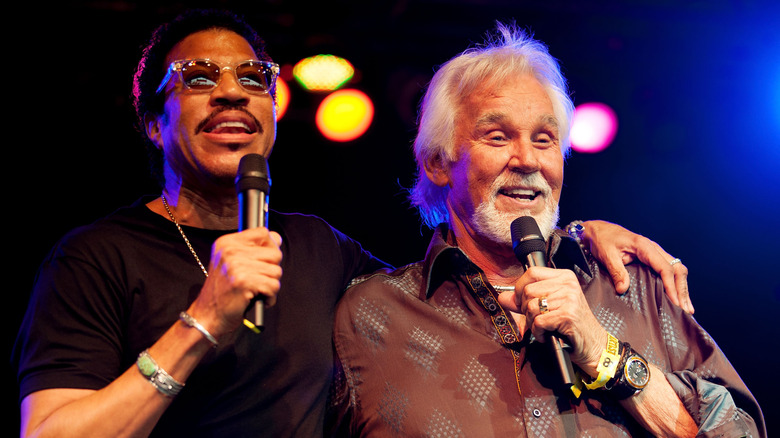
Certain love songs soar because they convey vulnerability; they confess and reveal tender emotion with every note and lyric. No doubt that sense is what makes Kenny Rogers' "Lady," written by R&B and pop legend Lionel Richie, so powerful and successful. The slight crackle in his voice at the beginning of each verse wrecks us every time, so it's little wonder that audiences in 1980 ate it up. The crossover hit became the "Gambler" singer's most successful single as a solo artist, reaching No. 1 on the Billboard Hot 100, Country, and Adult Contemporary Charts. In fact, the tender love song held the No. 1 spot the longest in 1980. Richie's peerless song-craft became the perfect vehicle for Rogers' smooth croon and heart-wrenching delivery: a one-two punch that knocked hearts out.
The collaboration also proved massively impactful for Richie, helping to lay the groundwork for a solo career that was getting set to take off in the '80s. While he'd explored soft, smooth sounds with the Commodores — such as the 1978 chart-topper "Three Times a Lady" — writing for Rogers took his smooth pop a step further. And in addition to producing and songwriting credits, Richie gained a close friend.
"Lady" shows us how well country and R&B can complement each other. The collaboration brought out the best in both artists, and what emerged became pop music gold and goldmine: a love song that leaves us crying into our coffee every single time we put it on.
Lionel Richie pitched the song to Kenny Rogers
In 1980, Kenny Rogers invited Lionel Richie to meet, as the country singer was seeking an original song for his upcoming "Greatest Hits" album. When the two met up, Richie brought in the germ of an idea that the Commodores had turned down. In keeping with how he'd write for his band, all he had was the now-iconic piano riff, chord structure, and the word "baby" followed by a hummed melodic line. Though light on details, the sketch proved enough to convince Rogers; it'd probably have worked for us, too.
The title change was a collaboration of sorts. As Richie told "The Bobby Bones Show," "[Rogers] was telling me about [how] he'd just got married ... [to] a real lady" in actor Marianne Gordon, referring to a union that would span from 1977 to 1993. When Rogers first asked what the song's title was, Richie immediately swapped "Lady" for "Baby."
The song's emotional reach and gravity may be attributed in part to it being about that lady. You believe and feel Rogers as his voice sways and wavers with tender emotion, giving power to lines like, "I'm your knight in shining armor" and "You have made me what I am and I am yours." It's what makes "Lady" a perfect wedding song to stir up nostalgia in boomers.
Lady was completed under a very tight deadline
As any writer can tell you, there's nothing like the pressure of a deadline. For Lionel Richie, the clock counting down forced literal last-second brilliance. By the time he and Kenny Rogers got together in the studio, he still didn't have anything beyond the first verse of "Lady." They'd started off with a different song, but an abrupt change in plans left him scrambling.
"So, I said, 'Excuse me, can I go to the bathroom?'" Richie explained on "The Drew Barrymore Show" in 2023, where he knocked out the rest in five frantic minutes. "You will do some amazing things when you're scared to death," he added. To think: some of the song's most sensual images — "Let me wake to see you / Each and every morning / Let me hear you whisper softly in my ear" — may have first been scribbled on toilet paper.
In the documentary "Kenny Rogers: The Man and His Music," Rogers called "Lady" one of his favorite songs, reflecting, "I think he kind of helped me do something I wanted to do," calling it a "fun juxtaposition of music and concept." But it's become much, much more than that; it's the product of a budding friendship and an enduring expression of love. At the 63rd annual Grammy Awards, Richie performed a gut-wrenching rendition of "Lady" as part of the night's "In Memoriam" segment, marking the country rock superstar's passing in March 2020. "I miss you, Kenny; I miss you, man," he concluded, before bowing his head in silence (via Access Hollywood). There couldn't have been a dry eye in that room.