

5 Bee Gees Songs That Prove 1978 Was The Best Year Of Their Career
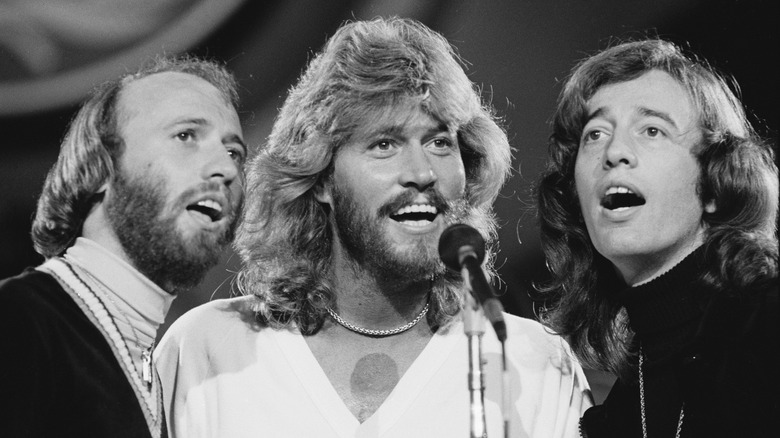
The Bee Gees would come to define the culturally ubiquitous sound of disco, earning the most No. 1 hits in the 1970s. While the trio had enjoyed mounting success in previous years, they reached a career high in 1978, propelled by the success of the previous year's iconic film "Saturday Night Fever." The movie's Bee Gees-infused, eponymous soundtrack album secured the group's legacy with five Grammy awards and over 40 million copies sold worldwide.
We've chosen five songs, all of them staples of the "Saturday Night Fever" soundtrack, which made 1978 a top year for the Bee Gees. While the album itself was released in late 1977, we have to consider that the full weight of its cultural impact was felt in 1978, with its string of chart-topping singles, critical acclaim, and subsequent 1979 Grammy wins (which honor the preceding year). For that reason, we're including entries that were released in 1977, but which peaked in 1978.
From the irresistibly groovy "Stayin' Alive" to the thoughtful ballad of "How Deep Is Your Love," these are the tunes that took the Bee Gees from merely excellent to legendary. We've even included a couple of entries that demonstrate the Bee Gees' emerging role as chart-busting songwriters in 1978. Without further ado, it's time to dance.
Stayin' Alive
Who could forget the opening credits of "Saturday Night Fever," with the intoxicating groove and syncopated guitar riff of "Stayin' Alive" underscoring actor John Travolta's alpha-male strut as Tony Manero? Searing vocal harmonies from brothers Barry, Robin, and Maurice Gibb cut through the mix with lyrics that reflect themes of raw sexual bravado and the frustrations of a directionless life.
After its release in 1977, "Stayin' Alive" quickly emerged as a cultural juggernaut, peaking in early 1978 at the No. 1 position on Billboard's Hot 100, where it remained for four weeks. The enduring cultural impact of the song afforded the Bee Gees their long-term staying power and relevance long after the death of disco. "Stayin' Alive" would show up in the closing moments of the 1983 "Saturday Night Fever" sequel, "Staying Alive," and other films, such as 1980's "Airplane," would prominently feature the song. It has been covered numerous times by artists from Ozzy Osbourne to the Happy Mondays, and its steady tempo would make it a go-to accompaniment track for EMTs practicing CPR chest compressions.
How Deep Is Your Love
"How Deep Is Your Love" is a gentle, contemplative ballad that crescendos in the final scene of "Saturday Night Fever," as the lead characters Tony and Stephanie work through their feelings, eventually agreeing to slowly pursue a more meaningful relationship. The song was initially conceived of as a vehicle for Yvonne Elliman (who would go on to record "If I Can't Have You," another Gibb brothers song), but was eventually recorded and released by the Bee Gees at the insistence of their manager, Robert Stigwood.
Although released as a single in September of 1977, "How Deep Is Your Love" would go on to win the award for best pop performance by a duo or group with vocal at the 1978 Grammys, further cementing 1978 as a banner year for the Bee Gees. The first of a streak of six consecutive Billboard Hot 100 No. 1 hits for the Bee Gees, the song's legacy continued with a number of cover versions released by notable artists such as Take That, Luther Vandross, and PJ Morton.
Night Fever
The only Bee Gees song to surpass the four-week streak of "Stayin' Alive" at the top slot on the Billboard Hot 100, "Night Fever" held the No. 1 position for eight weeks in early 1978 — a feat the band would never match again. Soon after its February 1978 release, Billboard magazine dubbed it "another melodic, catchy tune by the hottest group around," noting its jumping groove and falsetto vocals.
Held together by Dennis Bryon's steady, pulsating drum work and muted funk guitar from Barry Gibb and Alan Kendall, the track captures the core essence of what the Bee Gees were riding up the charts: impossible-to-ignore grooves and soaring melodic hooks. Said grooves infected other recording artists of the time, with cover versions springing up that same year from various artists, such as Springbok, Blonde on Blonde, and Gunter Noris.
As well as being perhaps one of the Bee Gees' most famous tracks, "Night Fever" also contributed to the title of the film that sent it into music history. "Saturday Night Fever" originally had the working title of "Saturday Night," which was also the proposed name for what would become "Night Fever." When the Bee Gees chose the latter name, "Night Fever" also provided a lead on the film's eventual title.
More Than a Woman
1978 was more than just a commercially successful year for the Bee Gees. It was a year that established the group as a legacy act that would have a cultural voice for decades to come. To that end, "More Than a Woman," a track that shows up during the climactic dance competition in "Saturday Night Fever," provided some early and important foreshadowing.
The track maintains the driving disco groove of its Bee Gees stablemates and was a staple of the band's live set until the death of Maurice Gibb in 2003. Although not a chart-topping smash like its other "Saturday Night Fever" counterparts, the track did reach a respectable No. 39 on the Billboard Adult Contemporary chart in mid-1978.
The Tavares version fared better, entering the Top 40 on the Hot 100. The importance of the alternate version's success cannot be overstated, as it served to cement the Bee Gees as hitmakers for other artists, a move that would define their post-disco years.
If I Can't Have You — Yvonne Elliman
A popular false belief about the Bee Gees is that they failed to outlive the death of disco at the end of the 1970's. Instead, shifting musical tides only served to open new avenues for the Gibb brothers, who became hit-making songwriters for other artists, including Kenny Rogers' 1983 career-defining classic, "Islands in the Stream." For that reason, we've chosen Yvonne Elliman's hit "If I Can't Have You."
Penned by the Gibb brothers, "If I Can't Have You" would go on to reach No. 1 on the Billboard Hot 100 in May 1978. Elliman had already earned recognition for the 1976 hit "Love Me," another Gibb brothers composition, but "If I Can't Have You" truly foreshadowed the Bee Gees' future success as behind-the-scenes hit makers for other artists. That career shift would include writing credits on all the tracks for Barbra Streisand's 1980 album "Guilty" (including the Grammy-winning title track, a duet with Barry Gibb) and "Immortality," a 1998 collaboration with Celine Dion.