

5 Songs From 1984 That Prove It Was The Decade's Best Year For Punk
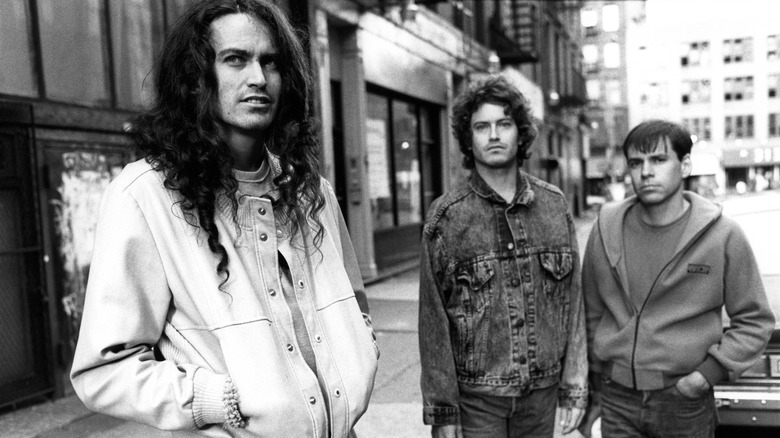
Early punk rock warned us about the dangers of 1984, but in an ironic twist, it turned out to be a landmark year for the genre. After the first wave crested in 1977 (in what many consider to be that decade's best year for punk rock), this vein of underground rock consolidated into something faster, leaner, louder, and meaner: hardcore. It was a completely different sound than what was first played at CBGB's in the '70s. Amidst the slamdances and stagedivers, there were politically charged anthems and existential reflections soaked in Corona. There were furious declarations that inspired girls and women to riot. And there were art-rock explosions emanating from the heart of the Arizona desert, so loud that it reverberated well up the coast to Aberdeen, influencing a young Kurt Cobain long before he and Nirvana defined the emerging grunge sound.
One could make the case that every year in the '80s was the decade's best. Hardcore sprung up at the start of the decade, resulting in blistering classics like Black Flag's "Damaged," Dead Kennedys' "Fresh Fruit for Rotting Vegetables," and Bad Brains' self-titled LP. At the end of the decade, there were the early emo bands like Rites of Spring, experimental post-hardcore like Naked Raygun and Fugazi, garage rockers like the Gories, and the start of alternative rock.
What makes 1984 stand above them all is that it was a transitional year. The rage that screamed during the decade's first half was waning, leaving behind new sounds and ideas that would determine the shape of punk to come. Indeed, 1984 was the right middle ground between the fury and the fuzz, and the following albums will show why.
This Ain't No Picnic — Minutemen
There are two albums deeply associated with punk in 1984 because they are considered two of the greatest punk LPs of all time: Hüsker Dü's "Zen Arcade" and Minutemen's "Double Nickels on the Dime." The latter is held in higher regard in punk history, but it's important to remember that "Double Nickels" wouldn't exist if Minutemen — Mike Watt, George Hurley, and the late D. Boon — hadn't heard what the group's SST labelmate was up to. "We had an album ready to go," Watt told Punk Rock Theory, "but Husker Du [was about to] put out 'Zen Arcade.' So we decided to go back and write more songs to make it a double album."
One of the standout songs on "Double Nickels" is the blue-collar anthem, "This Ain't No Picnic." Inspired by an ugly, racist comment D. Boon's boss said while he worked at an auto parts store, "This Ain't No Picnic" captured Minutemen's signature abstract lyrics, cutting guitar parts, and working-class mentality. "Working on the edge / Losing my self-respect / For a man who presides over me / The principles of his creed," D. Boon sings before bemoaning the endless cycle of "punch in, punch out" that results in a paycheck.
"This Ain't No Picnic" also came with a music video. Director Randall Jahnson spliced footage of a World War II educational short to depict a pre-presidency Ronald Reagan ('80s punk's greatest villain) attacking the band on the worksite via a WWII bomber.
I Will Dare — The Replacements
Punk in the early '80s was an outlet for a teenage rebellion, a way for kids to carve out a space for themselves. But what happens when, come the middle of the decade, you've aged out of the moshpits and fights? Well, you channel your disillusionment into what's called the greatest rock album ever made about growing up, also known as the Replacements' "Let It Be." The Minneapolis band's third album opens with singer and principal songwriter Paul Westerberg grappling with the difficult process of growing up: "How young are you? How old am I? / Let's count the rings around my eye," he sings at the start of "I Will Dare."
It is a heartfelt reflection on age and a desire to find a real connection in the world. "Ain't lost yet, so I gotta be the winner / Fingernails and cigarettes, a lousy dinner," Westerberg sings. The song served as the blueprint for the vulnerable songwriting that would blossom into college rock of the late '80s and beyond.
Even before "Let It Be": The Replacements was already on its way out of the hardcore scene: The group's sophomore album, "Hootenanny," played around with surf, synth-pop, and folk-punk. In fact, the band was never interested in appealing to hardcore sensibilities. "I think on this night we were warming up, and the crowd was yelling, 'Faster.' We weren't up-tempo enough for them at that time," drummer Chris Mars told The Washington Post in 2025. "And so then we just looked at each other and broke into Hank Williams, 'Hey, Good Lookin'.' And they were just booing. And we were just laughing. And I think that moment to us was more punk than punk was."
Fascist Attitudes — Agnostic Front
"I've always said it was a movement," Agnostic Front vocalist Roger Miret explained when talking to Dazed about New York hardcore punk in the 1980s. Miret and his band helped pioneer the distinctive sound of New York hardcore, which got harder, meaner, and heavier. It was inspired by the city they lived in, New York City in the 1980s, and the growing thrash metal scene (many would consider Agnostic Front crossover, the hybrid of hardcore and thrash).
In 1984, Agnostic Front released its debut album, "Victim In Pain." One of the most important tracks is "Fascist Attitudes," in which Miret addresses the misconception that hardcore is full of white power skinheads — and the idea that these right-wing supremacists were welcome in the scene. "Why should you go around bashing one another?" he sings. "If they look or think different, why let it bother? / Everyone's got their own style, their own thoughts / Don't let it bother you, don't let it get caught."
For Miret, a Cuban immigrant who was raised in multicultural neighborhoods, he wasn't going to let his scene get corrupted by hate. "We came through all walks and paths of life and all kinds of different family backgrounds and bands like Agnostic Front ... became safe havens," he told Dazed.
A Man's Gotta Do What a Man's Gotta Do — Frightwig
Hardcore punk was, at first glance, very male. While women had a visible presence in the first waves of punk, post-punk, and goth, history has painted hardcore as very much a boy's club. But there were women rocking out during that rise of the genre, and one of the few all-female bands of the scene was San Francisco's Frightwig. Consisting of Deanna Mitchell, Mia D'Bruzzi, and Cecila Kuhn, Frightwig came together in 1982, and, two years later, the group released its debut album, "Cat Farm Faboo." Listening to the song that closes side one, "A Man's Gotta Do What A Man's Gotta Do," you can hear elements of funk, disco, punk, and the early seeds of what would bloom into riot grrrl.
"A man starts as a boy and he plays with his little toys / He does what his mama tells him to, he's just a little boy," d'Bruzzi sings. "Gotta prove that he's right, he's got to prove that he can fight / When his mama's not around, he's hanging all over town / She said boys will be boys, will be boys, will be boys." It's a caustic rebuke against the idea that a man is entitled to what he wants from a woman romantically, delivered against a proto-dancepunk beat.
The impact of "Cat Farm Faboo" can be felt in the generations of female-fueled rock that came afterward. "Frightwig was just a hugely influential band on Bikini Kill," Kathleen Hanna once told Spin, crediting the group's second album, "Faster, Frightwig! Kill! Kill!" with changing her life. Courtney Love also gave the band flowers while speaking to KQED, saying that her and her friends all started bands the day after seeing the group perform.
Plateau — Meat Puppets
They say never judge a book by its cover, but with an abstract artwork, "Meat Puppets II" is just as strange as Curt Kirkwood's painting on the front. Released in the time of hardcore, "Meat Puppets II" took the Phoenix, Arizona trio — brothers Curt and Cris Kirkwood and Derrick Bostrom — to a different level. The group's self-titled debut, released two years prior, was more noise rock wrecking ball, akin to the early experiments of Captain Beefheart and the Butthole Surfers. But Meat Puppets' second album, and "Plateau," turned the band into desert travelers, acid rock freaks gazing into eternity.
The song begins as a meandering, low-key, twangy ode about people dedicated "to beautify the foothills." Then there's the earworm of a chorus: "There's nothing on the top but a bucket and a mop / And an illustrated book about birds / You see a lot up there, but don't be scared / Who needs actions when you've got words." When it swells at the end, it's like the night sky is opening up over the Arizona desert.
Kurt Loder once called "Meat Puppets II" one of "the funniest and most enjoyable albums of 1984" in a Rolling Stone review, and the album had a few other high-profile fans. Most notably, Nirvana, which covered "Plateau," "Oh Me," and "Lake of Fire" during its 1993 "Unplugged" concert. The Kirkwood brothers even played with the band. "[The Meat Puppets] cemented for me that punk rock music doesn't have to be about loud guitars and, you know, aggressive vocals," Nirvana's Krist Novoselic once told Rolling Stone. "There's a lot of diversity within that music. I thought the Meat Puppets record [II] was as good as ... anything in the big rock cannon."