

5 Songs That Prove 1977 Was The Decade's Best Year For Punk Rock
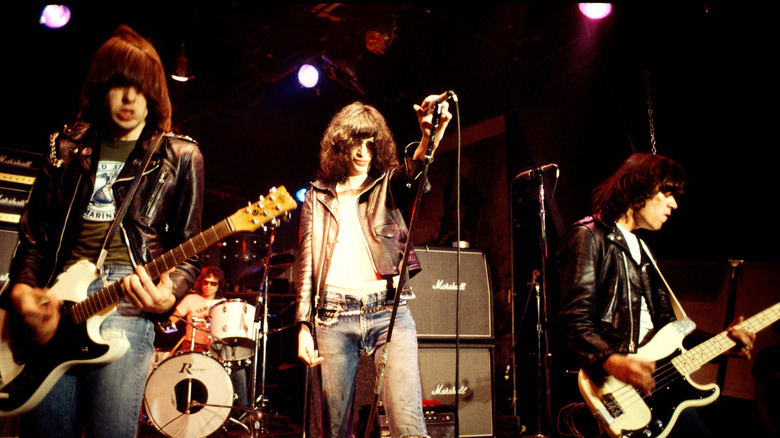
When trying to determine who really invented punk, opinions can certainly vary — although it's clear that the 1976 release of the Ramones' first album was a watershed moment in rock history. Yet it's also undeniable that the genre really hit its apex in 1977, with a musical explosion that launched punk into the mainstream.
But punk did not emerge in a vacuum. In retrospect, 1977 was an amazing year for music lovers with many competing genres represented. Let's not forget that year saw the release of the Bee Gees' disco classic "Saturday Night Fever" soundtrack, Rush's prog masterpiece "A Farewell to Kings," Bob Marley & the Wailer's "Exodus," the Kiss classic "Love Gun," Iggy Pop delivering both "Lust for Life" and "The Idiot," Peter Gabriel's first solo album, Meat Loaf's "Bat Out of Hell," Queen's "News of the World," Motörhead's self-titled debut, Jackson Browne's "Running on Empty," David Bowie's "Low" and "Heroes," "Talking Heads 77," Aerosmith's "Draw the Line," Steely Dan's "Aja," Elvis Costello's "My Aim is True," Fleetwood Mac's "Rumours," a blockbuster album inspired by the band's interpersonal drama.
In the midst of that musical melange was punk, which truly defined itself as a genre that year. Looking back, it's clear that several bands made an indelible mark on the pop culture consciousness. To discover more, read on for a rundown of five songs that prove 1977 was the decade's best year for punk rock.
Sex Pistols -- God Save the Queen
When recounting the tragic real-life story of the Sex Pistols, it all began with the band's debut album, "Never Mind the Bollocks," and the lead single, "God Save the Queen." Released during Queen Elizabeth II's silver jubilee year, the song's anti-monarchist lyrics led to serious discussions of treason, and "God Save the Queen" was banned by both the BBC and Britain's Independent Broadcasting Authority. Despite the ban, the album proved to be wildly popular, reportedly outselling Rod Stewart (although Sir Rod reportedly held the No. 1 spot due to chart manipulation out of respect to Her Royal Highness, per BBC).
Accompanying the 1977 single's razor-slashing riff and thunderous pace are singer Johnny Rotten's nasty, bile-spewing lyrics: "God save the Queen / The fascist regime / It made you a moron / Potential H-bomb / God save the Queen / She ain't no human being / There is no future / In England's dreaming."
In a 2012 interview with NME, Rotten, whose given name is John Lydon, reflected on the legacy of "God Save the Queen." "It's musically timeless, although it absolutely encapsulates that period and free spirit of teenage angst and rebellion," Lydon said. "But it's bigger than that. It's braver. It's by far the hardest thing to have done initially: it was a full-on challenge to the establishment, and I meant it to be so ... it was an incredible achievement for a record to be discussed openly in the Houses of Parliament under the Traitors And Treasons Act."
The Dead Boys -- Sonic Reducer
Led by flamboyant frontman Stiv Bators, the Dead Boys unveiled a punk masterpiece with their 1977 single "Sonic Reducer." Buoyed by Bators' sneering vocals, a hooky riff from guitarist Cheetah Chrome, and a catchy singalong chorus, "Sonic Reducer" emanates sheer energy. "I got my dull machine," Bators sings. "Got my electronic dream / Sonic reducer, ain't no loser."
The legacy of "Sonic Reducer" is undeniable. It remains a punk favorite that's been covered by bands ranging from the Vibrators to Pearl Jam – while the opening guitar riff was sampled by the Beastie Boys in "An Open Letter to NYC." Its ascendance to the pinnacle of the punk pantheon is made all the more impressive when considering it was created in just 10 minutes, when lyricist David Thomas showed Chrome what he'd written, and the guitarist quickly came up with the song's iconic guitar riff. "It happened so fast," Chrome told the Pittsburgh Post-Gazette. "David had the lyrics, which I think are brilliant, basically about the classic outsider building a bomb in the basement."
Among the song's biggest fans was late celebrity chef Anthony Bourdain. "You talk about great rock 'n' roll songs, great punk songs ... that is the iconic," Bourdain said of "Sonic Reducer" when appearing on the "Turned Out a Punk" podcast. "It's got the perfect sound, perfect lyrics, it's about longing and rage and envy and a desire for revenge. It's absolutely what rock 'n' roll should be about — in a perfect world."
Richard Hell and the Voidoids -- Blank Generation
After exiting the New York band Television and then quitting Johnny Thunders' Heartbreakers, singer Richard Hell launched his own group, Richard Hell and the Voidoids. With Hell on vocals and virtuoso axeman Robert Quine on guitar, the band's 1977 debut album, "Blank Generation," yielded the single of the same name. The song immediately found favor with punk fans, who embraced its message of teenage alienation, sort of a late-1970s version of The Who's "My Generation." "I belong to the blank generation and / I can take it or leave it each time," Hell sings in the chorus, describing how, at the moment of his birth, the doctor grabbed the newborn by the throat and declared the infant to be "God's consolation prize."
"The rawness and roughness of the music, it was kind of basic, but we didn't just burn through it," record company owner Richard Gottehrer told Uncut. "We did it with real attitude."
The song should have laid the groundwork for further success, but soon after the single's release, Hell sued his label, Sire Records, to be released from his contract. "So we vanished. We didn't tour. We refused. We just did gigs in New York that would pay the rent," Hell told Uncut." Over time, though, the song took on a life of its own, becoming a punk anthem that remains iconic. "It's almost more a document of the time than a rock 'n' roll record," added Gottehrer.
The Clash -- White Riot
The Clash would have bigger successes down the road, but the British band announced themselves ably with their 1977 self-titled debut album, and first single "White Riot." A masterpiece of punk minimalism, "White Riot" is built upon just a couple of chords, with lyrics that attacked the racial divide that was roiling West London at the time, urging white people to stand with their oppressed Black neighbors. "Black man got a lotta problems / But they don't mind throwin' a brick / White people go to school / Where they teach you how to be thick," the lyrics declare.
While the song's intent is actually to point out how the powers that be profit from pitting Black against white, the song was accused of calling for a race war. Even worse, "White Riot" tended to stir up violence whenever the Clash played it live — to the point that promoters began asking the band to leave it off the set list to prevent venues from getting trashed. Eventually, "White Riot" would come to represent the Clash at the band's most raw and fierce, a seminal punk classic that captured the zeitgeist of a disenfranchised generation.
Ramones -- Pinhead
Hot on the heels of the Ramones' 1976 self-titled debut album, January 1977 saw the release of its follow-up, "Leave Home." A collection of three-chord, lightning-fast rockers, including "Suzy is a Headbanger" and "Gimme Gimme Shock Treatment," the album's highlight is undeniably "Pinhead."
After kicking off with Tommy Ramone's unmistakable drum pattern, next comes the chant of "Gabba gabba, we accept you, we accept you, one of us" (inspired by the 1932 horror classic "Freaks"). Johnny Ramone's buzzsaw guitar slashes its way into the fray, boosted by frontman Joey Ramone's minimalist chorus of "I don't wanna be a pinhead no more / I just met a nurse that I could go for," followed by, "D-U-M-B / Everyone's accusing me."
Later in 1977, the Ramones released a third album, "Rocket to Russia," featuring another punk classic, "Sheena is a Punk Rocker." Yet in hindsight, it's clear that "Pinhead" proved to be a far more impactful song for the band, with the repeated "Gabba Gabba Hey!" chorus that ends the song becoming an enduring rallying cry for punks of all ages — and a highlight of the band's live shows, when a masked crew member dressed as the titular "Pinhead" would hop onstage to lead the audience in the singalong chorus.
For their part, the band members admitted they took their admittedly lowbrow lyrics with a grain of salt. "Everything's kind of a joke with us," Joey told The New York Times in 1978. "You can't take things too seriously, or it doesn't pay to live."