

5 Songs That Prove 1976 Was The Decade's Best Year For Outlaw Country
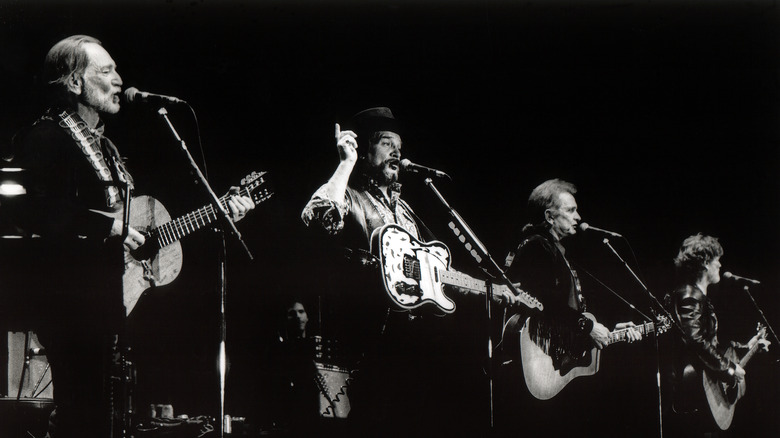
Outlaw country was born from rebellion, and in 1976, some of the best and most timeless songs of the subgenre graced the airwaves. Brought into existence by Waylon Jennings and Willie Nelson, outlaw country exists because these artists were fed up with the limitations set by record labels and music executives in Nashville who expected country music songs to stay in their well-worn, formulaic lanes. In order to have creative control over their craft, in the early '70s, some country artists recorded their own albums their own way and eventually, labels reluctantly released them.
Fans quickly caught on, and artists like Johnny Cash, Merle Haggard, Kris Kristofferson, David Allan Coe, and Johnny Paycheck became the bad boys of outlaw country. A few of them had actually served some time in prison, or at least had spent a night in jail, and Nelson has had a few public arrests, but mostly, as Jennings said in his biography, "For us, 'outlaw' meant standing up for your rights, your own way of doing things. It felt like a different music, and outlaw was as good a description as any," (via PBS).
Many classic songs are considered outlaw country, such as "Pancho and Lefty" and "Sunday Mornin' Comin' Down," and the subgenre has spawned even more subgenres through the decades, including alt-country and neo-outlaw, but here, we'll be looking particularly at songs released in 1976 that prove it was the best year of the '70s for outlaw country.
My Heroes Have Always Been Cowboys — Waylon Jennings
The term "outlaw country" coalesced in 1976 with the compilation album, "Wanted! The Outlaws," which went platinum that year, a first for a country album. It included songs from Waylon Jennings, Willie Nelson, Jessi Colter, and Tompall Glaser, and two of those songs are so quintessential outlaw country that we're pulling both for our list. The first is "My Heroes Have Always Been Cowboys," sung by Jennings, but written by Sharon Vaughn from the male point of view. Vaughn, a session musician and songwriter, said in a video interview published by The Tennessean that she brought Waylon the song she had recorded, and he liked it so much that he recorded it the very first night he heard it.
The song leans into fantasies of cowboy life that are met with the harsh loneliness that cowboys may endure. And while the lyrics speak of cowboys having "... their own brand of misery / From being alone too long," there is still a certain wistful romanticism to the drifter's hardscrabble life that comes through. Waylon's version is the first song on "Wanted! The Outlaws," but Nelson released his own version as a single in 1979, which went to No. 1 for two weeks on the Hot Country Charts and to No. 44 on Billboard's Hot Hits in 1980, while Jennings' version didn't chart at all.
Still, as the initial song on the album that catapulted outlaw country into the mainstream, "My Heroes Have Always Been Cowboys" is the OG OC. With that song and that album, Waylon said, "Suddenly, we didn't need Nashville. They needed us," per PBS's "Country Music: A Film By Ken Burns."
Good-Hearted Woman — Willie Nelson and Waylon Jennings
It's not often you hear a song by two men singing the praises of a "good-hearted woman," but Willie Nelson and Waylon Jennings did just that in 1976. "Good-Hearted Woman" went to No. 25 on the Billboard Hot 100, and it spent three weeks at No. 1 on the Hot Country Chart. The classic hit was written by Waylon and Nelson, with the idea coming from an article Jennings had read about Tina Turner that said she was singing songs about "good-hearted women loving good-timing men" (via "The Billboard Book of Number One Country Hits").
Jennings immediately saw the potential in that line, and shortly after, during a poker game, he and Nelson started coming up with the lyrics, with Nelson's then-wife Connie writing them down. The song became autobiographical for the two men, with Nelson saying, "I think Connie and Jessi [Jennings' wife] both were the object of that song. Naturally, we started thinking about the ones who were having to put up with us at that particular time."
This was another great example of outlaw country paying homage to plenty of people's realities; in this case, it's a love song of sorts, appreciating the women who accepted their "good timin' man" and all their "wicked ways." The woman in the song "never complains of the bad times or bad things he's done, Lord / She just talks about the good times they've had and all the good times to come." Today, we may call that enabling, but the '70s were a different time. It sounds like a good setup for the man, at least, and the rest of us got a great song out of it.
One Piece at a Time — Johnny Cash
Johnny Cash's "One Piece at a Time" is one of his tongue-in-cheek songs in which the narrator tells a story, in the same vein as "A Boy Named Sue." In this case, it's about a man who works at General Motors on the assembly line making Cadillacs, where he gets the idea to start stealing parts so that he can put together a Caddy on his own for free, with the chorus saying: "I'd get it one piece at a time / And it wouldn't cost me a dime." Written by Wayne Kemp, the song was inspired by a story he'd heard about a military man who took parts from the base where he was stationed to build a helicopter.
In the case of the Cash hit, the car turned out to be Frankenstein-esque in the end, with missing parts and a patchwork of elements from various years as he slowly smuggled the pieces out bit by bit, but the narrator made the best of it, with Cash singing, "You'll know it's me when I come through your town / I'm going to ride around in style / I'm going to drive everybody wild / Because I'll have the only one there is around."
The novelty song related to working-class men and was one of Cash's biggest hits, hitting No. 1 on the Hot Country Songs chart in May of 1976, where it stayed for two weeks. It also climbed to No. 29 on Billboard's Hot Hits.
Willie Nelson — I'd Have To Be Crazy
Willie Nelson's "I'd Have To Be Crazy" was released on his 1976 album "The Sound in Your Mind," along with his mega hit "If You've Got the Money I've Got the Time," but while the latter topped the country charts, we're choosing the former as one of the best outlaw country songs from the '70s for its reflective, self-aware lyrics — a hallmark of outlaw country music. Besides, "I'd Have To Be Crazy" did pretty well in 1976, climbing to No. 11 on Billboard's Hot Country Songs.
The song points out the singer's eccentricities and penchant for poor or unusual choices, but iterates that no matter the things he has done that may make others question his sanity, he would "have to be crazy / Plum out of my mind / To fall out of love with you." Nelson's gorgeous, gentle delivery makes the song feel autobiographical, but Texas Poet Laureate and singer/songwriter Steve Fromholz wrote it.
By 1976, Nelson knew his way around a song, having written many for others before becoming a performer in his own right, and his approach to "I'd Have To Be Crazy" has a mesmerizing, soothing quality that pulls listeners in. The song incorporates a lilting waltz time signature, and in Nelson's recording, Fromholz sings the bridge. Country artist Jack Ingram describes why this was such a great outlaw country song in an interview for Texas Monthly, [2:15] "... It's intricate but simple, ... it's always this juxtaposition of how they were, their images were so reckless and rowdy, but then you turn on the record, and it's grabbing for your heart." That's exactly what makes "I'd Have To Be Crazy" one of the best outlaw songs of the decade.
Longhaired Redneck — David Allan Coe
As divisive as David Allan Coe was, he had loyal fans and plenty of hit songs, including 1976's "Longhaired Redneck," which really leaned into the non-conformist attitude of outlaw country artists. As the title track on his 1976 album, Coe, who wrote the song with Jimmy Rabbitt, paints himself as somewhat of a caricature of an outlaw, boasting of the fact that he's "been to prison," so the "loud mouth in the corner" talking smack about his hair and earrings oughta watch himself. Coe takes issue with the fact that some people may judge him for having long hair, but points out that his neck is still red underneath. He argues that he knows all the old country songs, and sings, "I've been the Rhinestone Cowboy for so long I can't remember," though we're not sure if that's the flex he thought it was regarding outlaw country artists.
At the heart of the song are identity issues and demonizing others who aren't like you, "where bikers stare at cowboys, who are laughing at the hippies / Who are praying they'll get out of here alive," but Coe doesn't have any words of wisdom; he more laments the fact that he feels falsely judged for his appearance, which is relatable. What's more, outlaw country artists may have seen a bit of each of those personas in themselves, and at least two of those weren't jiving with classic country sensibilities.
Outlaw country was all about deviating from Nashville's clean-cut traditions, and "Longhaired Redneck" was an anthem for that subgenre not only for its content, but also because of its twangy country sound and toe-tapper feel that was sure to lift the spirits of everyone in the bar as they sang along.